
Mapa mental
Memory studies
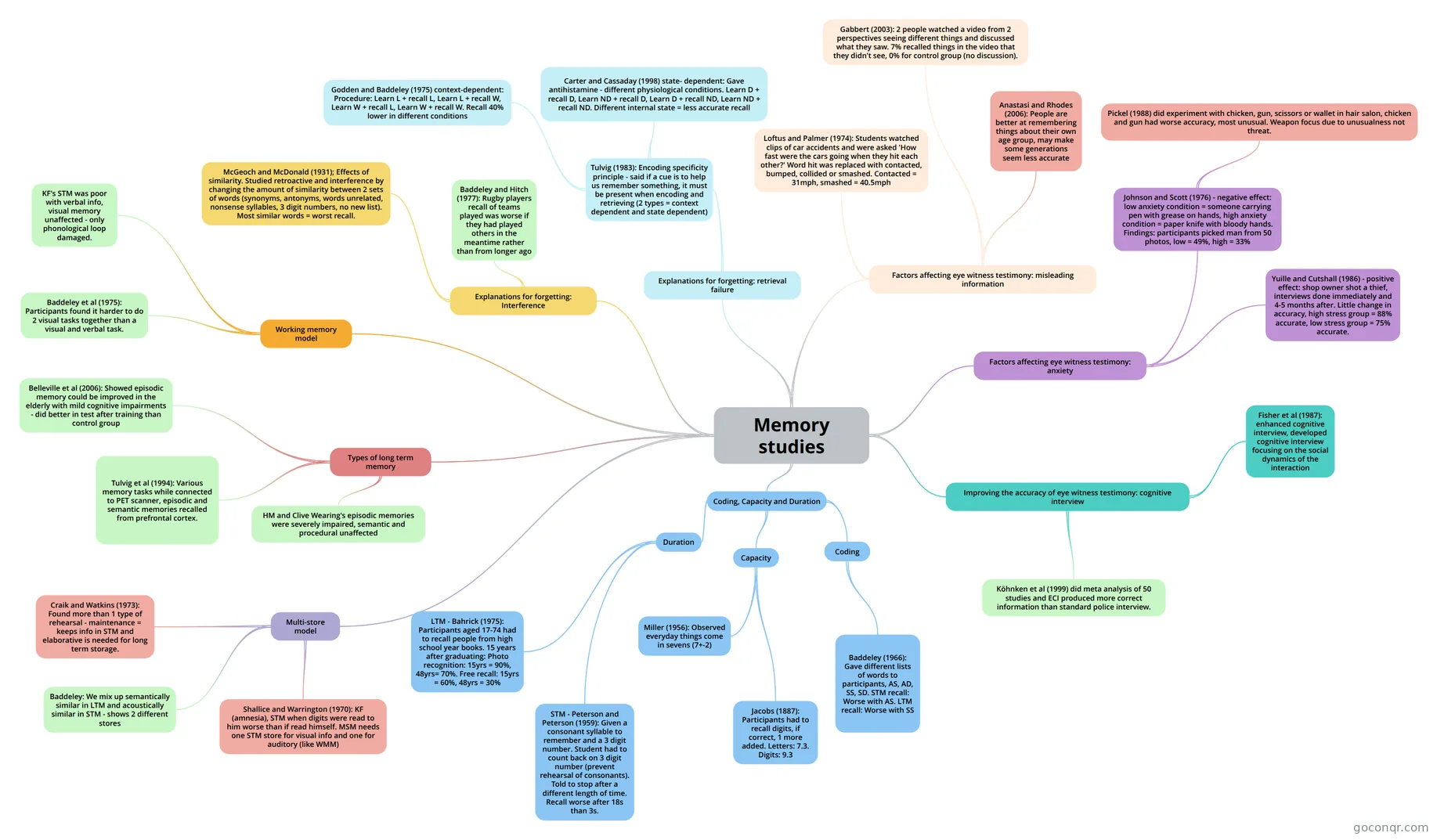
Mind map: Memory studies
Conteúdo do mapa
Memory studies
Coding, Capacity and Duration
- Coding
- Baddeley (1966): Gave different lists of words to participants, AS, AD, SS, SD. STM recall: Worse with AS. LTM recall: Worse with SS
- Capacity
- Jacobs (1887): Participants had to recall digits, if correct, 1 more added. Letters: 7.3. Digits: 9.3
- Miller (1956): Observed everyday things come in sevens (7+-2)
- Duration
- STM - Peterson and Peterson (1959): Given a consonant syllable to remember and a 3 digit number. Student had to count back on 3 digit number (prevent rehearsal of consonants). Told to stop after a different length of time. Recall worse after 18s than 3s.
- LTM - Bahrick (1975): Participants aged 17-74 had to recall people from high school year books. 15 years after graduating: Photo recognition: 15yrs = 90%, 48yrs= 70%. Free recall: 15yrs = 60%, 48yrs = 30%
- Coding
Multi-store model
- Baddeley: We mix up semantically similar in LTM and acoustically similar in STM - shows 2 different stores
- Shallice and Warrington (1970): KF (amnesia), STM when digits were read to him worse than if read himself. MSM needs one STM store for visual info and one for auditory (like WMM)
- Craik and Watkins (1973): Found more than 1 type of rehearsal - maintenance = keeps info in STM and elaborative is needed for long term storage.
Types of long term memory
- Belleville et al (2006): Showed episodic memory could be improved in the elderly with mild cognitive impairments - did better in test after training than control group
- Tulvig et al (1994): Various memory tasks while connected to PET scanner, episodic and semantic memories recalled from prefrontal cortex.
- HM and Clive Wearing's episodic memories were severely impaired, semantic and procedural unaffected
Working memory model
- KF's STM was poor with verbal info, visual memory unaffected - only phonological loop damaged.
- Baddeley et al (1975): Participants found it harder to do 2 visual tasks together than a visual and verbal task.
Explanations for forgetting: Interference
- McGeoch and McDonald (1931); Effects of similarity. Studied retroactive and interference by changing the amount of similarity between 2 sets of words (synonyms, antonyms, words unrelated, nonsense syllables, 3 digit numbers, no new list). Most similar words = worst recall.
- Baddeley and Hitch (1977): Rugby players recall of teams played was worse if they had played others in the meantime rather than from longer ago
Explanations for forgetting: retrieval failure
- Tulvig (1983): Encoding specificity principle - said if a cue is to help us remember something, it must be present when encoding and retrieving (2 types = context dependent and state dependent)
- Godden and Baddeley (1975) context-dependent: Procedure: Learn L + recall L, Learn L + recall W, Learn W + recall L, Learn W + recall W. Recall 40% lower in different conditions
- Carter and Cassaday (1998) state- dependent: Gave antihistamine - different physiological conditions. Learn D + recall D, Learn ND + recall D, Learn D + recall ND, Learn ND + recall ND. Different internal state = less accurate recall
- Tulvig (1983): Encoding specificity principle - said if a cue is to help us remember something, it must be present when encoding and retrieving (2 types = context dependent and state dependent)
Factors affecting eye witness testimony: misleading information
- Loftus and Palmer (1974): Students watched clips of car accidents and were asked 'How fast were the cars going when they hit each other?' Word hit was replaced with contacted, bumped, collided or smashed. Contacted = 31mph, smashed = 40.5mph
- Gabbert (2003): 2 people watched a video from 2 perspectives seeing different things and discussed what they saw. 7% recalled things in the video that they didn't see, 0% for control group (no discussion).
- Anastasi and Rhodes (2006): People are better at remembering things about their own age group, may make some generations seem less accurate
Factors affecting eye witness testimony: anxiety
- Johnson and Scott (1976) - negative effect: low anxiety condition = someone carrying pen with grease on hands, high anxiety condition = paper knife with bloody hands. Findings: participants picked man from 50 photos, low = 49%, high = 33%
- Pickel (1988) did experiment with chicken, gun, scissors or wallet in hair salon, chicken and gun had worse accuracy, most unusual. Weapon focus due to unusualness not threat.
- Yuille and Cutshall (1986) - positive effect: shop owner shot a thief, interviews done immediately and 4-5 months after. Little change in accuracy, high stress group = 88% accurate, low stress group = 75% accurate.
- Johnson and Scott (1976) - negative effect: low anxiety condition = someone carrying pen with grease on hands, high anxiety condition = paper knife with bloody hands. Findings: participants picked man from 50 photos, low = 49%, high = 33%
Improving the accuracy of eye witness testimony: cognitive interview
- Fisher et al (1987): enhanced cognitive interview, developed cognitive interview focusing on the social dynamics of the interaction
- Köhnken et al (1999) did meta analysis of 50 studies and ECI produced more correct information than standard police interview.