
Mapa mental
Memory
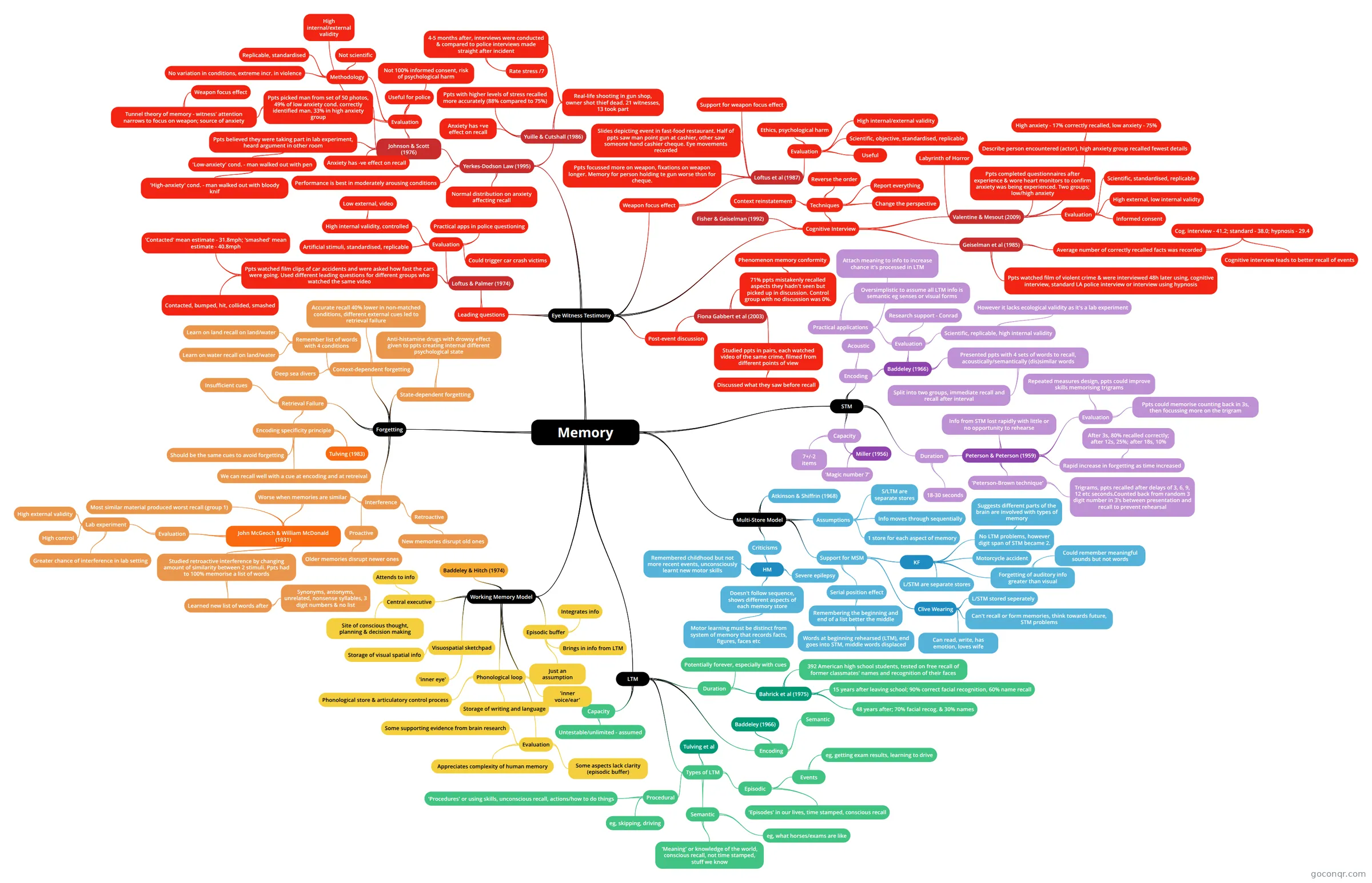
Mind map: memory
Conteúdo do mapa
Memory
Multi-Store Model
- Atkinson & Shiffrin (1968)
- Assumptions
- S/LTM are separate stores
- Info moves through sequentially
- 1 store for each aspect of memory
- Support for MSM
- Serial position effect
- Remembering the beginning and end of a list better the middle
- Words at beginning rehearsed (LTM), end goes into STM, middle words displaced
- Remembering the beginning and end of a list better the middle
- KF
- Motorcycle accident
- No LTM problems, however digit span of STM became 2.
- Suggests different parts of the brain are involved with types of memory
- L/STM are separate stores
- Forgetting of auditory info greater than visual
- Could remember meaningful sounds but not words
- Clive Wearing
- L/STM stored seperately
- Can't recall or form memories, think towards future, STM problems
- Can read, write, has emotion, loves wife
- Serial position effect
- Criticisms
- HM
- Severe epilepsy
- Doesn't follow sequence, shows different aspects of each memory store
- Motor learning must be distinct from system of memory that records facts, figures, faces etc
- Remembered childhood but not more recent events, unconsciously learnt new motor skills
- HM
LTM
- Duration
- Bahrick et al (1975)
- 392 American high school students, tested on free recall of former classmates' names and recognition of their faces
- 15 years after leaving school; 90% correct facial recognition, 60% name recall
- 48 years after; 70% facial recog. & 30% names
- Potentially forever, especially with cues
- Bahrick et al (1975)
- Encoding
- Baddeley (1966)
- Semantic
- Capacity
- Untestable/unlimited - assumed
- Types of LTM
- Tulving et al
- Episodic
- 'Episodes' in our lives, time stamped, conscious recall
- Events
- eg, getting exam results, learning to drive
- Semantic
- 'Meaning' or knowledge of the world, conscious recall, not time stamped, stuff we know
- eg, what horses/exams are like
- Procedural
- 'Procedures' or using skills, unconscious recall, actions/how to do things
- eg, skipping, driving
- Duration
STM
- Duration
- Peterson & Peterson (1959)
- 'Peterson-Brown technique'
- Trigrams, ppts recalled after delays of 3, 6, 9, 12 etc seconds.Counted back from random 3 digit number in 3's between presentation and recall to prevent rehearsal
- Rapid increase in forgetting as time increased
- After 3s, 80% recalled correctly; after 12s, 25%; after 18s, 10%
- Info from STM lost rapidly with little or no opportunity to rehearse
- Evaluation
- Ppts could memorise counting back in 3s, then focussing more on the trigram
- Repeated measures design, ppts could improve skills memorising trigrams
- 'Peterson-Brown technique'
- 18-30 seconds
- Peterson & Peterson (1959)
- Capacity
- 7+/-2 items
- Miller (1956)
- 'Magic number 7'
- Encoding
- Baddeley (1966)
- Presented ppts with 4 sets of words to recall, acoustically/semantically (dis)similar words
- Split into two groups, immediate recall and recall after interval
- Evaluation
- Scientific, replicable, high internal validity
- However it lacks ecological validity as it's a lab experiment
- Research support - Conrad
- Practical applications
- Attach meaning to info to increase chance it's processed in LTM
- Oversimplistic to assume all LTM info is semantic eg senses or visual forms
- Scientific, replicable, high internal validity
- Presented ppts with 4 sets of words to recall, acoustically/semantically (dis)similar words
- Acoustic
- Baddeley (1966)
- Duration
Working Memory Model
- Baddeley & Hitch (1974)
- Central executive
- Site of conscious thought, planning & decision making
- Attends to info
- Visuospatial sketchpad
- Storage of visual spatial info
- 'inner eye'
- Phonological loop
- Storage of writing and language
- 'inner voice/ear'
- Phonological store & articulatory control process
- Episodic buffer
- Integrates info
- Just an assumption
- Brings in info from LTM
- Evaluation
- Some aspects lack clarity (episodic buffer)
- Appreciates complexity of human memory
- Some supporting evidence from brain research
Forgetting
- Interference
- Proactive
- Older memories disrupt newer ones
- Retroactive
- New memories disrupt old ones
- Worse when memories are similar
- John McGeoch & William McDonald (1931)
- Studied retroactive interference by changing amount of similarity between 2 stimuli. Ppts had to 100% memorise a list of words
- Learned new list of words after
- Synonyms, antonyms, unrelated, nonsense syllables, 3 digit numbers & no list
- Learned new list of words after
- Most similar material produced worst recall (group 1)
- Evaluation
- Lab experiment
- High external validity
- High control
- Greater chance of interference in lab setting
- Lab experiment
- Studied retroactive interference by changing amount of similarity between 2 stimuli. Ppts had to 100% memorise a list of words
- John McGeoch & William McDonald (1931)
- Proactive
- Retrieval Failure
- Insufficient cues
- Encoding specificity principle
- Tulving (1983)
- We can recall well with a cue at encoding and at retreival
- Should be the same cues to avoid forgetting
- Context-dependent forgetting
- Deep sea divers
- Remember list of words with 4 conditions
- Learn on land recall on land/water
- Learn on water recall on land/water
- Accurate recall 40% lower in non-matched conditions, different external cues led to retrieval failure
- State-dependent forgetting
- Anti-histamine drugs with drowsy effect given to ppts creating internal different psychological state
- Interference
Eye Witness Testimony
- Leading questions
- Loftus & Palmer (1974)
- Ppts watched film clips of car accidents and were asked how fast the cars were going. Used different leading questions for different groups who watched the same video
- Contacted, bumped, hit, collided, smashed
- 'Contacted' mean estimate - 31.8mph; 'smashed' mean estimate - 40.8mph
- Evaluation
- Artificial stimuli, standardised, replicable
- High internal validity, controlled
- Low external, video
- Could trigger car crash victims
- Practical apps in police questioning
- Ppts watched film clips of car accidents and were asked how fast the cars were going. Used different leading questions for different groups who watched the same video
- Loftus & Palmer (1974)
- Yerkes-Dodson Law (1995)
- Normal distribution on anxiety affecting recall
- Performance is best in moderately arousing conditions
- Johnson & Scott (1976)
- Anxiety has -ve effect on recall
- Ppts believed they were taking part in lab experiment, heard argument in other room
- 'Low-anxiety' cond. - man walked out with pen
- 'High-anxiety' cond. - man walked out with bloody knif
- 'Low-anxiety' cond. - man walked out with pen
- Ppts picked man from set of 50 photos, 49% of low anxiety cond. correctly identified man. 33% in high anxiety group
- Tunnel theory of memory - witness' attention narrows to focus on weapon; source of anxiety
- Weapon focus effect
- Tunnel theory of memory - witness' attention narrows to focus on weapon; source of anxiety
- Evaluation
- Methodology
- Not scientific
- No variation in conditions, extreme incr. in violence
- Replicable, standardised
- High internal/external validity
- Not 100% informed consent, risk of psychological harm
- Useful for police
- Methodology
- Yuille & Cutshall (1986)
- Anxiety has +ve effect on recall
- Real-life shooting in gun shop, owner shot thief dead. 21 witnesses, 13 took part
- 4-5 months after, interviews were conducted & compared to police interviews made straight after incident
- Rate stress /7
- 4-5 months after, interviews were conducted & compared to police interviews made straight after incident
- Ppts with higher levels of stress recalled more accurately (88% compared to 75%)
- Post-event discussion
- Fiona Gabbert et al (2003)
- Studied ppts in pairs, each watched video of the same crime, filmed from different points of view
- Discussed what they saw before recall
- 71% ppts mistakenly recalled aspects they hadn't seen but picked up in discussion. Control group with no discussion was 0%.
- Phenomenon memory conformity
- Studied ppts in pairs, each watched video of the same crime, filmed from different points of view
- Fiona Gabbert et al (2003)
- Cognitive Interview
- Fisher & Geiselman (1992)
- Techniques
- Context reinstatement
- Change the perspective
- Reverse the order
- Report everything
- Valentine & Mesout (2009)
- Labyrinth of Horror
- Ppts completed questionnaires after experience & wore heart monitors to confirm anxiety was being experienced. Two groups; low/high anxiety
- Describe person encountered (actor), high anxiety group recalled fewest details
- High anxiety - 17% correctly recalled, low anxiety - 75%
- Evaluation
- Scientific, standardised, replicable
- High external, low internal validty
- Informed consent
- Geiselman et al (1985)
- Ppts watched film of violent crime & were interviewed 48h later using, cognitive interview, standard LA police interview or interview using hypnosis
- Average number of correctly recalled facts was recorded
- Cog. interview - 41.2; standard - 38.0; hypnosis - 29.4
- Cognitive interview leads to better recall of events
- Cog. interview - 41.2; standard - 38.0; hypnosis - 29.4
- Weapon focus effect
- Loftus et al (1987)
- Slides depicting event in fast-food restaurant. Half of ppts saw man point gun at cashier, other saw someone hand cashier cheque. Eye movements recorded
- Ppts focussed more on weapon, fixations on weapon longer. Memory for person holding te gun worse thsn for cheque.
- Support for weapon focus effect
- Evaluation
- Scientific, objective, standardised, replicable
- High internal/external validity
- Ethics, psychological harm
- Useful
- Loftus et al (1987)
- Leading questions
Informações
- Descrição
- A level Psychology (Memory) Mapa Mental sobre Memory, criado por Chloe Beasley em 13-02-2018.
- Criado por
- Chloe Beasley
- Visualizações
- 0
- Avaliação