
Mapa mental
evolution of intelligence
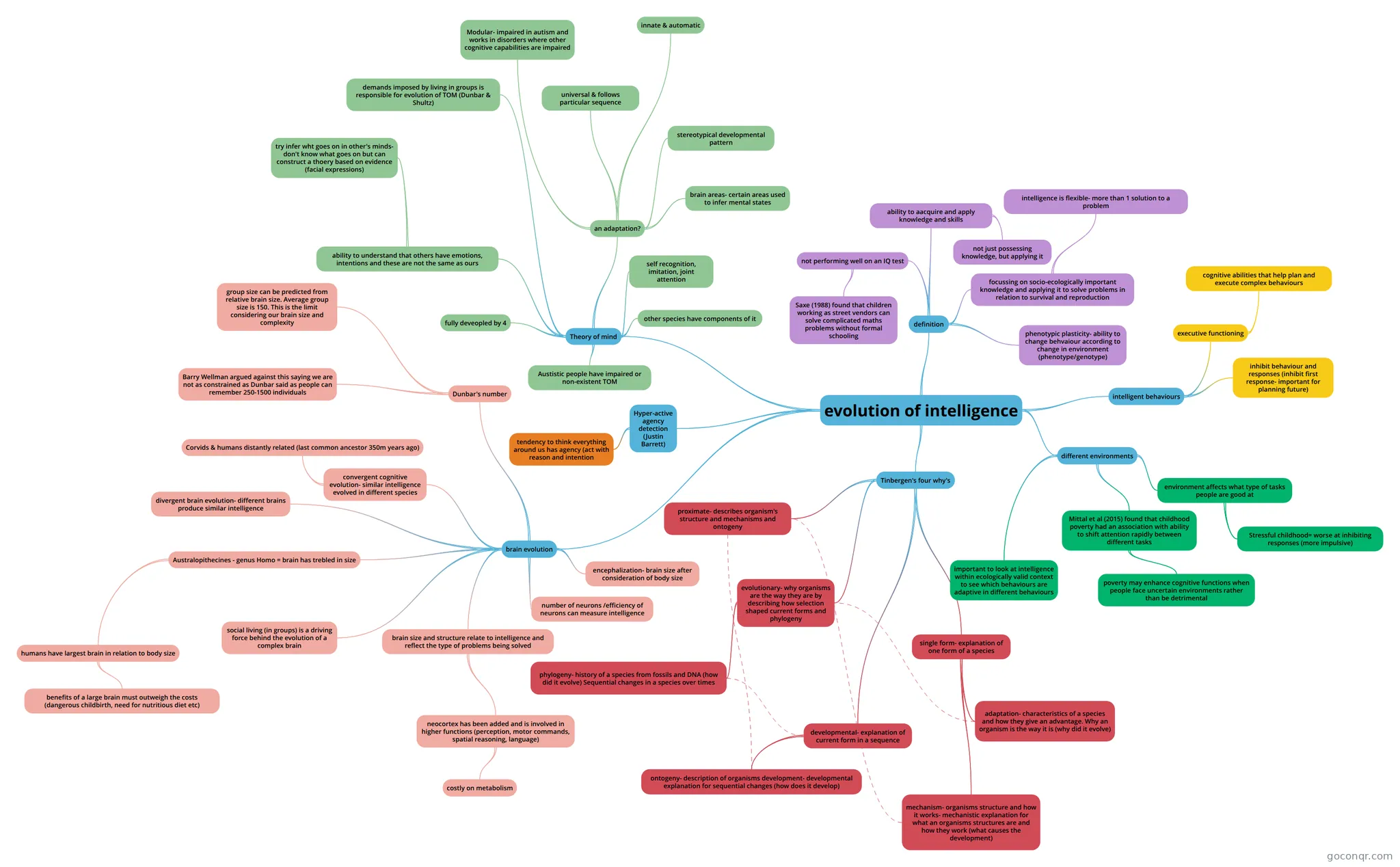
Mind map: evolution of intelligence
Conteúdo do mapa
evolution of intelligence
definition
- ability to aacquire and apply knowledge and skills
- not just possessing knowledge, but applying it
- not performing well on an IQ test
- Saxe (1988) found that children working as street vendors can solve complicated maths problems without formal schooling
- focussing on socio-ecologically important knowledge and applying it to solve problems in relation to survival and reproduction
- intelligence is flexible- more than 1 solution to a problem
- phenotypic plasticity- ability to change behvaiour according to change in environment (phenotype/genotype)
- ability to aacquire and apply knowledge and skills
intelligent behaviours
- executive functioning
- cognitive abilities that help plan and execute complex behaviours
- inhibit behaviour and responses (inhibit first response- important for planning future)
- executive functioning
different environments
- environment affects what type of tasks people are good at
- Stressful childhood= worse at inhibiting responses (more impulsive)
- Mittal et al (2015) found that childhood poverty had an association with ability to shift attention rapidly between different tasks
- poverty may enhance cognitive functions when people face uncertain environments rather than be detrimental
- important to look at intelligence within ecologically valid context to see which behaviours are adaptive in different behaviours
- environment affects what type of tasks people are good at
Tinbergen's four why's
- proximate- describes organism's structure and mechanisms and ontogeny
- evolutionary- why organisms are the way they are by describing how selection shaped current forms and phylogeny
- phylogeny- history of a species from fossils and DNA (how did it evolve) Sequential changes in a species over times
- developmental- explanation of current form in a sequence
- ontogeny- description of organisms development- developmental explanation for sequential changes (how does it develop)
- single form- explanation of one form of a species
- mechanism- organisms structure and how it works- mechanistic explanation for what an organisms structures are and how they work (what causes the development)
- adaptation- characteristics of a species and how they give an advantage. Why an organism is the way it is (why did it evolve)
brain evolution
- brain size and structure relate to intelligence and reflect the type of problems being solved
- neocortex has been added and is involved in higher functions (perception, motor commands, spatial reasoning, language)
- costly on metabolism
- neocortex has been added and is involved in higher functions (perception, motor commands, spatial reasoning, language)
- social living (in groups) is a driving force behind the evolution of a complex brain
- encephalization- brain size after consideration of body size
- number of neurons /efficiency of neurons can measure intelligence
- Australopithecines - genus Homo = brain has trebled in size
- humans have largest brain in relation to body size
- benefits of a large brain must outweigh the costs (dangerous childbirth, need for nutritious diet etc)
- humans have largest brain in relation to body size
- convergent cognitive evolution- similar intelligence evolved in different species
- Corvids & humans distantly related (last common ancestor 350m years ago)
- divergent brain evolution- different brains produce similar intelligence
- Dunbar's number
- group size can be predicted from relative brain size. Average group size is 150. This is the limit considering our brain size and complexity
- Barry Wellman argued against this saying we are not as constrained as Dunbar said as people can remember 250-1500 individuals
- brain size and structure relate to intelligence and reflect the type of problems being solved
Hyper-active agency detection (Justin Barrett)
- tendency to think everything around us has agency (act with reason and intention
Theory of mind
- ability to understand that others have emotions, intentions and these are not the same as ours
- try infer wht goes on in other's minds- don't know what goes on but can construct a thoery based on evidence (facial expressions)
- fully deveopled by 4
- Austistic people have impaired or non-existent TOM
- demands imposed by living in groups is responsible for evolution of TOM (Dunbar & Shultz)
- an adaptation?
- Modular- impaired in autism and works in disorders where other cognitive capabilities are impaired
- universal & follows particular sequence
- innate & automatic
- stereotypical developmental pattern
- brain areas- certain areas used to infer mental states
- self recognition, imitation, joint attention
- other species have components of it
- ability to understand that others have emotions, intentions and these are not the same as ours
Informações
- Descrição
- AS - Level Psychology (intelligence) Mapa Mental sobre evolution of intelligence, criado por Lucy Sheard em 01-05-2018.
- Criado por
- Lucy Sheard
- Visualizações
- 0
- Avaliação