
Mapa mental
Memory
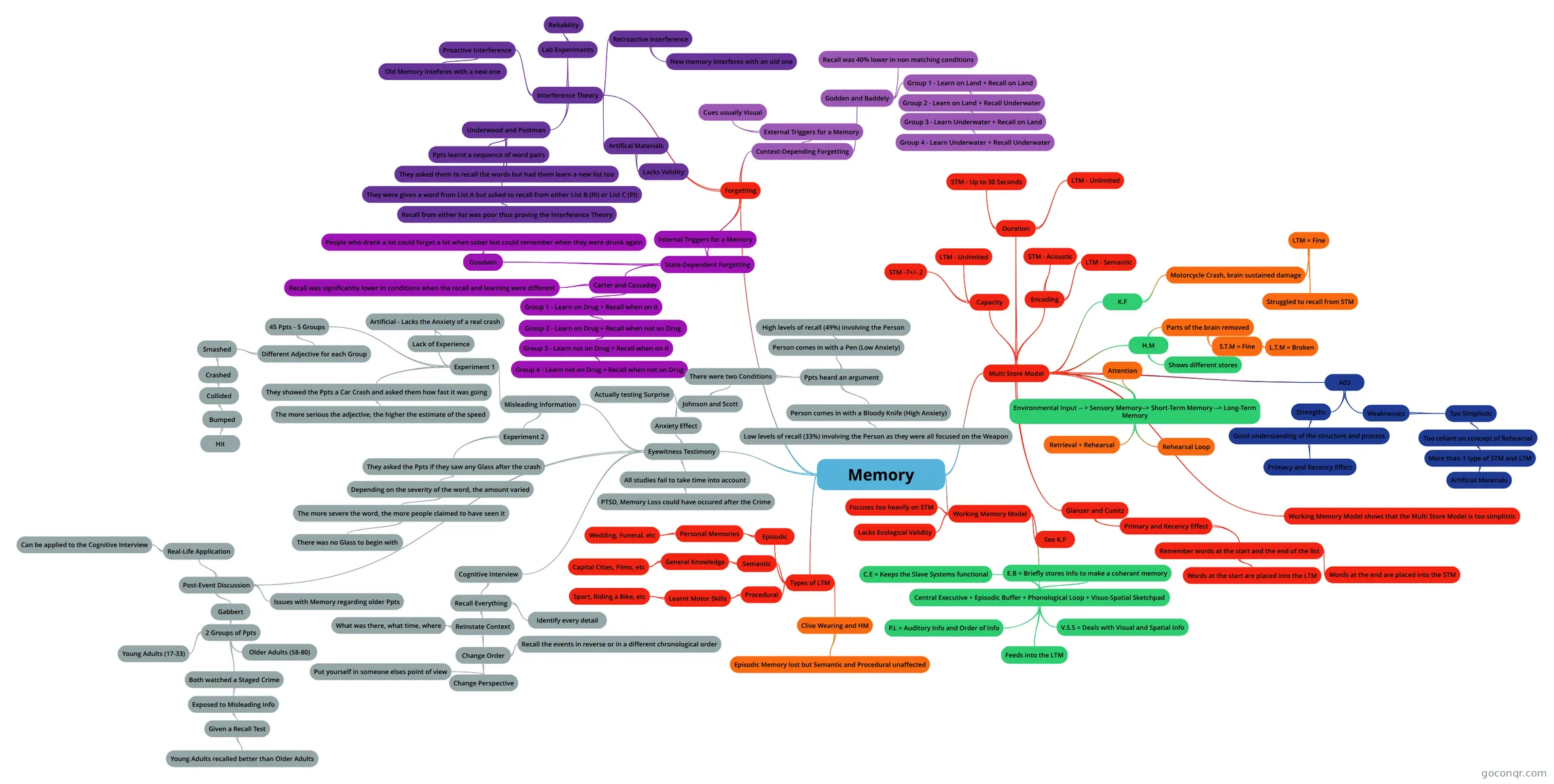
Mind map: Memory
Conteúdo do mapa
Memory
Multi Store Model
- Environmental Input -- > Sensory Memory--> Short-Term Memory --> Long-Term Memory
- Rehearsal Loop
- Retrieval + Rehearsal
- Attention
- H.M
- Parts of the brain removed
- S.T.M = Fine
- L.T.M = Broken
- S.T.M = Fine
- Shows different stores
- Parts of the brain removed
- Encoding
- LTM - Semantic
- STM - Acoustic
- Capacity
- STM -7+/- 2
- LTM - Unlimited
- Duration
- LTM - Unlimited
- STM - Up to 30 Seconds
- A03
- Strengths
- Good understanding of the structure and process
- Primacy and Recency Effect
- Good understanding of the structure and process
- Weaknesses
- Too Simplistic
- Too reliant on concept of Rehearsal
- More than 1 type of STM and LTM
- Artificial Materials
- More than 1 type of STM and LTM
- Too reliant on concept of Rehearsal
- Too Simplistic
- Strengths
- Working Memory Model shows that the Multi Store Model is too simplistic
- Glanzer and Cunitz
- Primary and Recency Effect
- Remember words at the start and the end of the list
- Words at the start are placed into the LTM
- Words at the end are placed into the STM
- Remember words at the start and the end of the list
- Primary and Recency Effect
- K.F
- Motorcycle Crash, brain sustained damage
- LTM = Fine
- Struggled to recall from STM
- LTM = Fine
- Motorcycle Crash, brain sustained damage
- Environmental Input -- > Sensory Memory--> Short-Term Memory --> Long-Term Memory
Working Memory Model
- Central Executive + Episodic Buffer + Phonological Loop + Visuo-Spatial Sketchpad
- Feeds into the LTM
- C.E = Keeps the Slave Systems functional
- E.B = Briefly stores Info to make a coherant memory
- P.L = Auditory Info and Order of Info
- V.S.S = Deals with Visual and Spatial Info
- See K.F
- Focuses too heavily on STM
- Lacks Ecological Validity
- Central Executive + Episodic Buffer + Phonological Loop + Visuo-Spatial Sketchpad
Types of LTM
- Episodic
- Personal Memories
- Wedding, Funeral, etc
- Personal Memories
- Semantic
- General Knowledge
- Capital Cities, Films, etc
- General Knowledge
- Procedural
- Learnt Motor Skills
- Sport, Riding a Bike, etc
- Learnt Motor Skills
- Clive Wearing and HM
- Episodic Memory lost but Semantic and Procedural unaffected
- Episodic
Forgetting
- Interference Theory
- Proactive Interference
- Old Memory inteferes with a new one
- Retroactive Interference
- New memory interferes with an old one
- Underwood and Postman
- Ppts learnt a sequence of word pairs
- They asked them to recall the words but had them learn a new list too
- They were given a word from List A but asked to recall from either List B (RI) or List C (PI)
- Recall from either list was poor thus proving the Interference Theory
- Artifical Materials
- Lacks Validity
- Lab Experiments
- Reliability
- Proactive Interference
- Context-Depending Forgetting
- External Triggers for a Memory
- Cues usually Visual
- Godden and Baddely
- Group 1 - Learn on Land + Recall on Land
- Group 2 - Learn on Land + Recall Underwater
- Group 3 - Learn Underwater + Recall on Land
- Group 4 - Learn Underwater + Recall Underwater
- Group 3 - Learn Underwater + Recall on Land
- Group 2 - Learn on Land + Recall Underwater
- Recall was 40% lower in non matching conditions
- Group 1 - Learn on Land + Recall on Land
- External Triggers for a Memory
- State-Dependent Forgetting
- Internal Triggers for a Memory
- Goodwin
- People who drank a lot could forget a lot when sober but could remember when they were drunk again
- Carter and Cassaday
- Group 1 - Learn on Drug + Recall when on it
- Group 2 - Learn on Drug + Recall when not on Drug
- Group 3 - Learn not on Drug + Recall when on it
- Group 4 - Learn not on Drug + Recall when not on Drug
- Group 3 - Learn not on Drug + Recall when on it
- Group 2 - Learn on Drug + Recall when not on Drug
- Recall was significantly lower in conditions when the recall and learning were different
- Group 1 - Learn on Drug + Recall when on it
- Interference Theory
Eyewitness Testimony
- Misleading Information
- Experiment 1
- They showed the Ppts a Car Crash and asked them how fast it was going
- The more serious the adjective, the higher the estimate of the speed
- 45 Ppts - 5 Groups
- Different Adjective for each Group
- Smashed
- Crashed
- Collided
- Bumped
- Hit
- Bumped
- Collided
- Crashed
- Smashed
- Different Adjective for each Group
- Artificial - Lacks the Anxiety of a real crash
- Lack of Experience
- They showed the Ppts a Car Crash and asked them how fast it was going
- Experiment 2
- They asked the Ppts if they saw any Glass after the crash
- Depending on the severity of the word, the amount varied
- The more severe the word, the more people claimed to have seen it
- There was no Glass to begin with
- The more severe the word, the more people claimed to have seen it
- Depending on the severity of the word, the amount varied
- They asked the Ppts if they saw any Glass after the crash
- Experiment 1
- Post-Event Discussion
- Gabbert
- 2 Groups of Ppts
- Young Adults (17-33)
- Older Adults (58-80)
- Both watched a Staged Crime
- Exposed to Misleading Info
- Given a Recall Test
- Young Adults recalled better than Older Adults
- Given a Recall Test
- Exposed to Misleading Info
- 2 Groups of Ppts
- Real-Life Application
- Can be applied to the Cognitive Interview
- Issues with Memory regarding older Ppts
- Gabbert
- Anxiety Effect
- Johnson and Scott
- There were two Conditions
- Ppts heard an argument
- Person comes in with a Bloody Knife (High Anxiety)
- Low levels of recall (33%) involving the Person as they were all focused on the Weapon
- Person comes in with a Pen (Low Anxiety)
- High levels of recall (49%) involving the Person
- Person comes in with a Bloody Knife (High Anxiety)
- Ppts heard an argument
- Actually testing Surprise
- There were two Conditions
- Johnson and Scott
- All studies fail to take time into account
- PTSD, Memory Loss could have occured after the Crime
- Cognitive Interview
- Recall Everything
- Reinstate Context
- Change Order
- Change Perspective
- Put yourself in someone elses point of view
- Recall the events in reverse or in a different chronological order
- Change Perspective
- What was there, what time, where
- Change Order
- Identify every detail
- Reinstate Context
- Recall Everything
- Misleading Information
Informações
- Descrição
- just a basic mind map innit
- Criado por
- Joseph Veevers
- Visualizações
- 13
- Tags
- Avaliação