
Mapa mental
Ind - aggression and antisocial behaviour part one
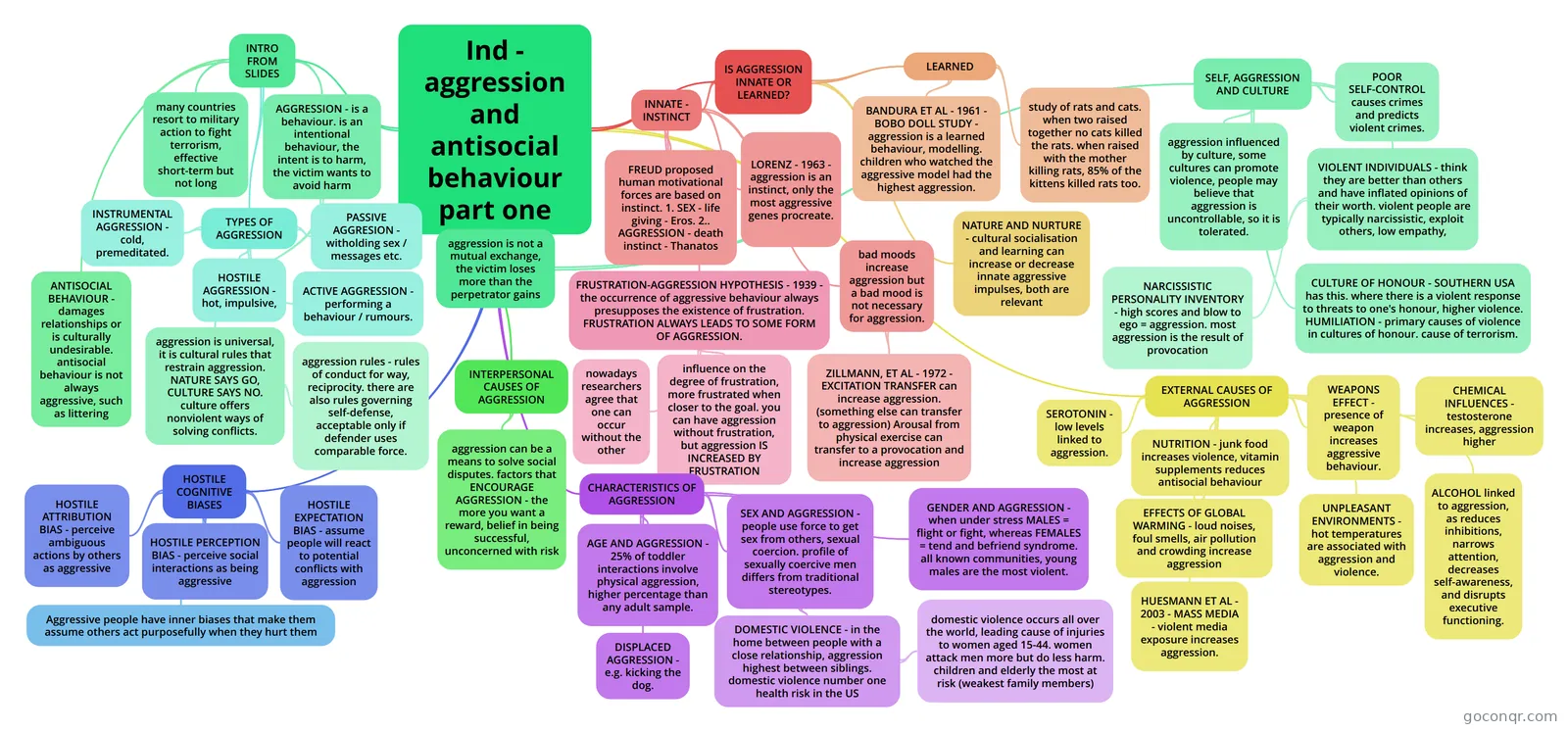
Mind map: Aggression and antisocial behaviour
Conteúdo do mapa
Ind - aggression and antisocial behaviour part one
INTRO FROM SLIDES
- many countries resort to military action to fight terrorism, effective short-term but not long
- AGGRESSION - is a behaviour. is an intentional behaviour, the intent is to harm, the victim wants to avoid harm
- aggression is universal, it is cultural rules that restrain aggression. NATURE SAYS GO, CULTURE SAYS NO. culture offers nonviolent ways of solving conflicts.
- aggression rules - rules of conduct for way, reciprocity. there are also rules governing self-defense, acceptable only if defender uses comparable force.
- aggression is universal, it is cultural rules that restrain aggression. NATURE SAYS GO, CULTURE SAYS NO. culture offers nonviolent ways of solving conflicts.
- TYPES OF AGGRESSION
- INSTRUMENTAL AGGRESSION - cold, premeditated.
- HOSTILE AGGRESSION - hot, impulsive,
- PASSIVE AGGRESION - witholding sex / messages etc.
- ACTIVE AGGRESSION - performing a behaviour / rumours.
- ANTISOCIAL BEHAVIOUR - damages relationships or is culturally undesirable. antisocial behaviour is not always aggressive, such as littering
IS AGGRESSION INNATE OR LEARNED?
- INNATE - INSTINCT
- FREUD proposed human motivational forces are based on instinct. 1. SEX - life giving - Eros. 2.. AGGRESSION - death instinct - Thanatos
- LORENZ - 1963 - aggression is an instinct, only the most aggressive genes procreate.
- FRUSTRATION-AGGRESSION HYPOTHESIS - 1939 - the occurrence of aggressive behaviour always presupposes the existence of frustration. FRUSTRATION ALWAYS LEADS TO SOME FORM OF AGGRESSION.
- nowadays researchers agree that one can occur without the other
- influence on the degree of frustration, more frustrated when closer to the goal. you can have aggression without frustration, but aggression IS INCREASED BY FRUSTRATION
- bad moods increase aggression but a bad mood is not necessary for aggression.
- ZILLMANN, ET AL - 1972 - EXCITATION TRANSFER can increase aggression. (something else can transfer to aggression) Arousal from physical exercise can transfer to a provocation and increase aggression
- LEARNED
- BANDURA ET AL - 1961 - BOBO DOLL STUDY - aggression is a learned behaviour, modelling. children who watched the aggressive model had the highest aggression.
- study of rats and cats. when two raised together no cats killed the rats. when raised with the mother killing rats, 85% of the kittens killed rats too.
- NATURE AND NURTURE - cultural socialisation and learning can increase or decrease innate aggressive impulses, both are relevant
- INNATE - INSTINCT
HOSTILE COGNITIVE BIASES
- HOSTILE ATTRIBUTION BIAS - perceive ambiguous actions by others as aggressive
- HOSTILE PERCEPTION BIAS - perceive social interactions as being aggressive
- HOSTILE EXPECTATION BIAS - assume people will react to potential conflicts with aggression
- Aggressive people have inner biases that make them assume others act purposefully when they hurt them
aggression is not a mutual exchange, the victim loses more than the perpetrator gains
- SELF, AGGRESSION AND CULTURE
- aggression influenced by culture, some cultures can promote violence, people may believe that aggression is uncontrollable, so it is tolerated.
- POOR SELF-CONTROL causes crimes and predicts violent crimes.
- VIOLENT INDIVIDUALS - think they are better than others and have inflated opinions of their worth. violent people are typically narcissistic, exploit others, low empathy,
- NARCISSISTIC PERSONALITY INVENTORY - high scores and blow to ego = aggression. most aggression is the result of provocation
- CULTURE OF HONOUR - SOUTHERN USA has this. where there is a violent response to threats to one's honour, higher violence. HUMILIATION - primary causes of violence in cultures of honour. cause of terrorism.
- SELF, AGGRESSION AND CULTURE
INTERPERSONAL CAUSES OF AGGRESSION
- aggression can be a means to solve social disputes. factors that ENCOURAGE AGGRESSION - the more you want a reward, belief in being successful, unconcerned with risk
CHARACTERISTICS OF AGGRESSION
- AGE AND AGGRESSION - 25% of toddler interactions involve physical aggression, higher percentage than any adult sample.
- GENDER AND AGGRESSION - when under stress MALES = flight or fight, whereas FEMALES = tend and befriend syndrome. all known communities, young males are the most violent.
- SEX AND AGGRESSION - people use force to get sex from others, sexual coercion. profile of sexually coercive men differs from traditional stereotypes.
- DOMESTIC VIOLENCE - in the home between people with a close relationship, aggression highest between siblings. domestic violence number one health risk in the US
- domestic violence occurs all over the world, leading cause of injuries to women aged 15-44. women attack men more but do less harm. children and elderly the most at risk (weakest family members)
- DOMESTIC VIOLENCE - in the home between people with a close relationship, aggression highest between siblings. domestic violence number one health risk in the US
- DISPLACED AGGRESSION - e.g. kicking the dog.
EXTERNAL CAUSES OF AGGRESSION
- WEAPONS EFFECT - presence of weapon increases aggressive behaviour.
- HUESMANN ET AL - 2003 - MASS MEDIA - violent media exposure increases aggression.
- UNPLEASANT ENVIRONMENTS - hot temperatures are associated with aggression and violence.
- EFFECTS OF GLOBAL WARMING - loud noises, foul smells, air pollution and crowding increase aggression
- CHEMICAL INFLUENCES - testosterone increases, aggression higher
- SEROTONIN - low levels linked to aggression.
- ALCOHOL linked to aggression, as reduces inhibitions, narrows attention, decreases self-awareness, and disrupts executive functioning.
- NUTRITION - junk food increases violence, vitamin supplements reduces antisocial behaviour
Informações
- Descrição
- Social of Individual Mapa Mental sobre Ind - aggression and antisocial behaviour part one, criado por becky.waine em 02-07-2013.
- Criado por
- becky.waine
- Visualizações
- 108
- Tags
- Avaliação