
Mapa mental
Neurocognitive Development
Conteúdo do mapa
Neurocognitive Development
Cognition
- mental abilities: Attention, Memory, Decision-making, etc
- changes considerably over lifespan, more than any other mental abilities
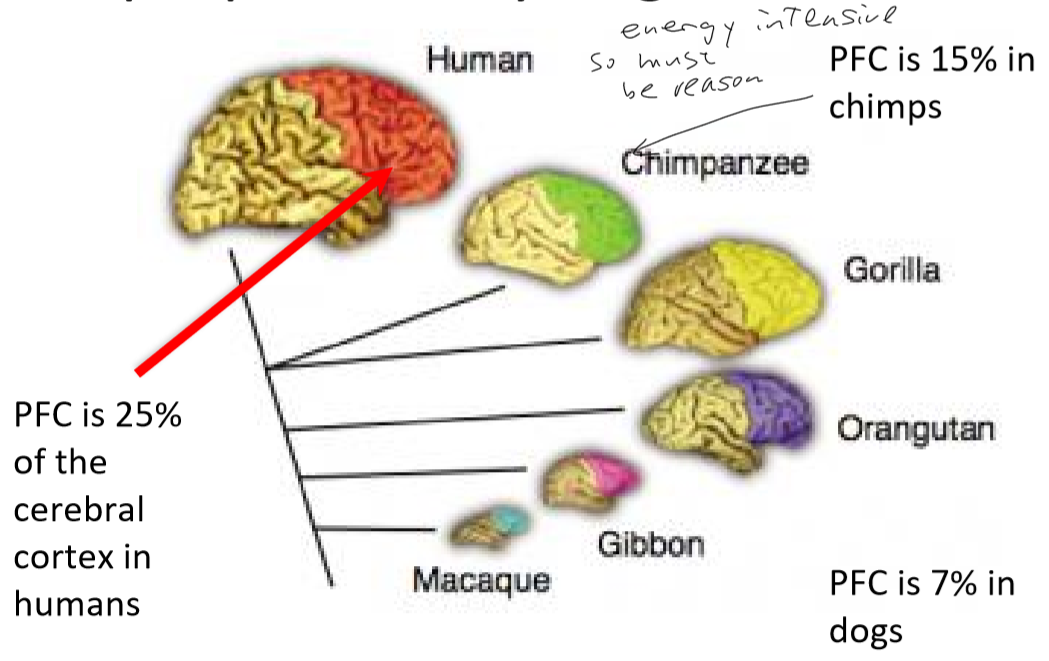
- Reason for Human's unique higher cognition
- evolved brain
- Highest brain size to body size ratio
- largest prefrontal cortex proportion
- Why do we need a prefrontal cortex
- cognitive flexibility: integrative function between sensory, motor, and higher cognitive regions
- animal without this are limited to simple approach and avoid behaviors
- Important regulatory role--> "top-down" processing: governance over other brain regions
- guiding behavior base on goals and ways to achieve them
- Cognitive control: goal-driven behavior in the face of distraction, those with prefrontal damage have a hard time
- guiding behavior base on goals and ways to achieve them
- cognitive flexibility: integrative function between sensory, motor, and higher cognitive regions
- Why do we need a prefrontal cortex
- evolved brain
Typical Development
- Structural Development
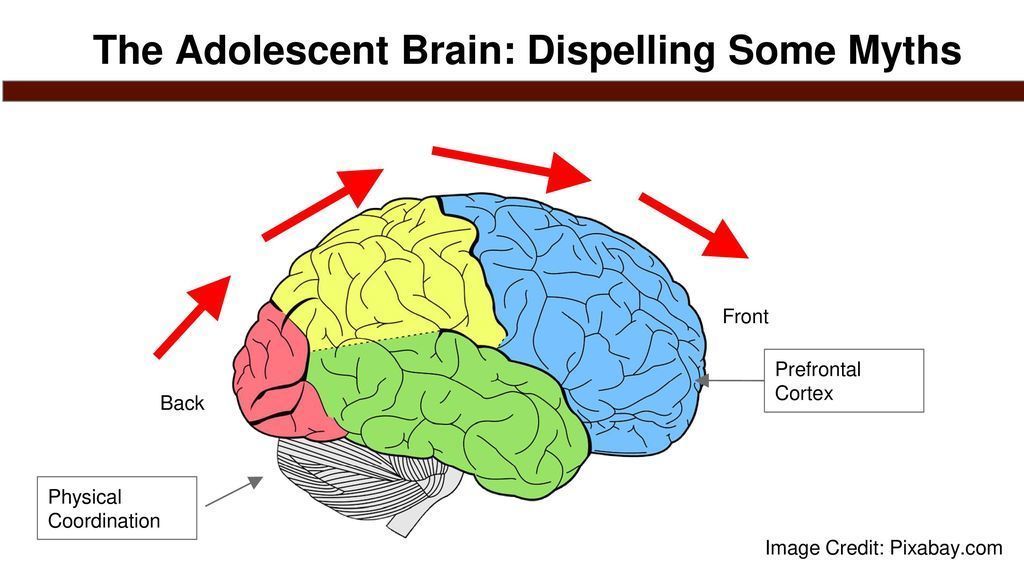
- Brain develops from the back to the front
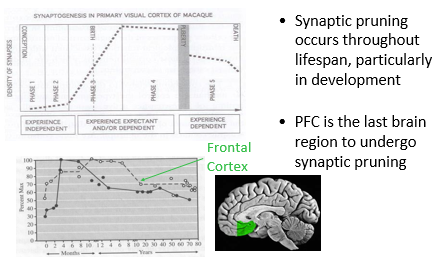
- Prefrontal cortex(PFC) is the last brain region to develop and undergoes synaptic pruning the last
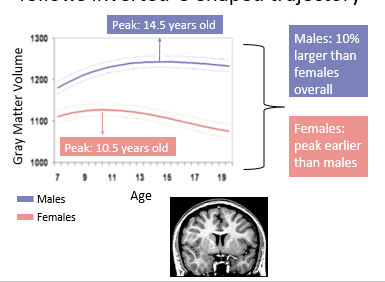
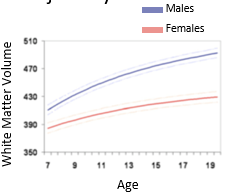
- NIMH Longitudinal study of brain structure
- gray matter follows inverted-U shaped trajectory
- peaks in early to mid adolescence
- white matter follows linear trajectory
- white matter
- increase speed of transmission
- greater integration of disparate brain regions
- modulates timing/ synchrony of neuron firing
- white matter
- gray matter follows inverted-U shaped trajectory
- Brain develops from the back to the front
- Functional Development
- Immature Cognitive Control
- limited ability to control behavior in the face of distraction, emotion, challenge
- Go/ No-Go Test
- Adults more accurate on incongruent and no-go trails
- Children showed a greater interference effect(much longer time for incongruent than neutral)
- Interference Suppression
- Adults show greater activation during interference suppression in the right PFC
- greater PFC activation --> less susceptible to interference(distraction)
- Adults show greater activation during interference suppression in the right PFC
- Adults more accurate on incongruent and no-go trails
- Go/ No-Go Test
- limited ability to control behavior in the face of distraction, emotion, challenge
- functional development of the prefrontal cortexs supports maturation of cognitive control
- delay gratification
- high delayers more PFC activation, better cognitive control-->inhibit no-go response
- emotional interference
- Kids and teens' cognitive control is more disrupted by -->perform worse in negative emotion trials
- can be adaptive for staying away from harms
- Kids and teens' cognitive control is more disrupted by -->perform worse in negative emotion trials
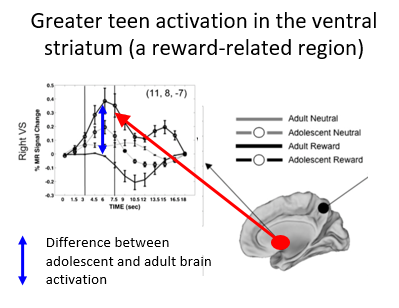
- incentives
- improve performance for teens but not adults
- teens' brain more sensitive to rewards
- more susceptible to external info--> beneficial
- greater activation in the ventral striatum (reward- related region)
- teens' brain more sensitive to rewards
- improve performance for teens but not adults
- delay gratification
- Immature Cognitive Control
- Structural Development
Atypical Development
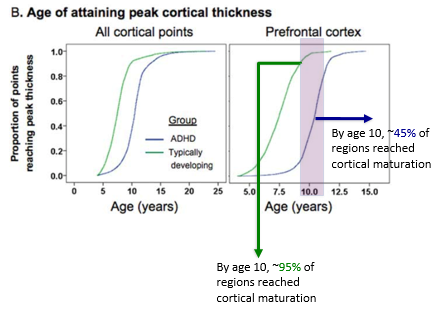
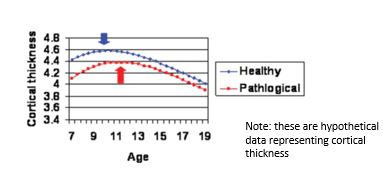
- delayed shifts
- same general shape but shifted to the right
- peak at later age(~11.5) compared to the healthy group(~10)
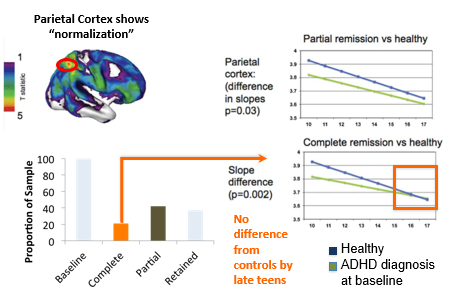
- ADHD
- examine cortical maturation(peak thichkenss)
- not simply a deviation in cortical maturation but a delay in specific regions
- "growing out" of ADHD may be the result of normalization of initial delays
- Stable(lifelong) ADHD may be the result of a deviant trajectory
- examine cortical maturation(peak thichkenss)
- same general shape but shifted to the right
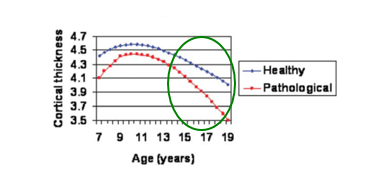
- disrupted velocity
- show the same developmental trajectory but the speed is altered
- Pruning occurs sooner and faster
- Schizophrenia
- Loss rate of gray matter was faster in kids with schizophrenia
- show the same developmental trajectory but the speed is altered
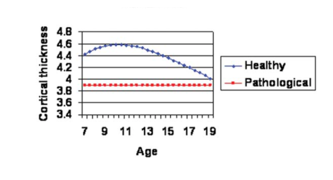
- deviant trajectories
- No resemblance of typical development
- delayed shifts
Imagens e arquivos do mapa
Informações
- Descrição
- MT1 Psychology Mapa Mental sobre Neurocognitive Development, criado por MULANGMA ZHU em 14-05-2019.
- Criado por
- MULANGMA ZHU
- Visualizações
- 0
- Avaliação