
Mapa mental
Explanations for forgetting
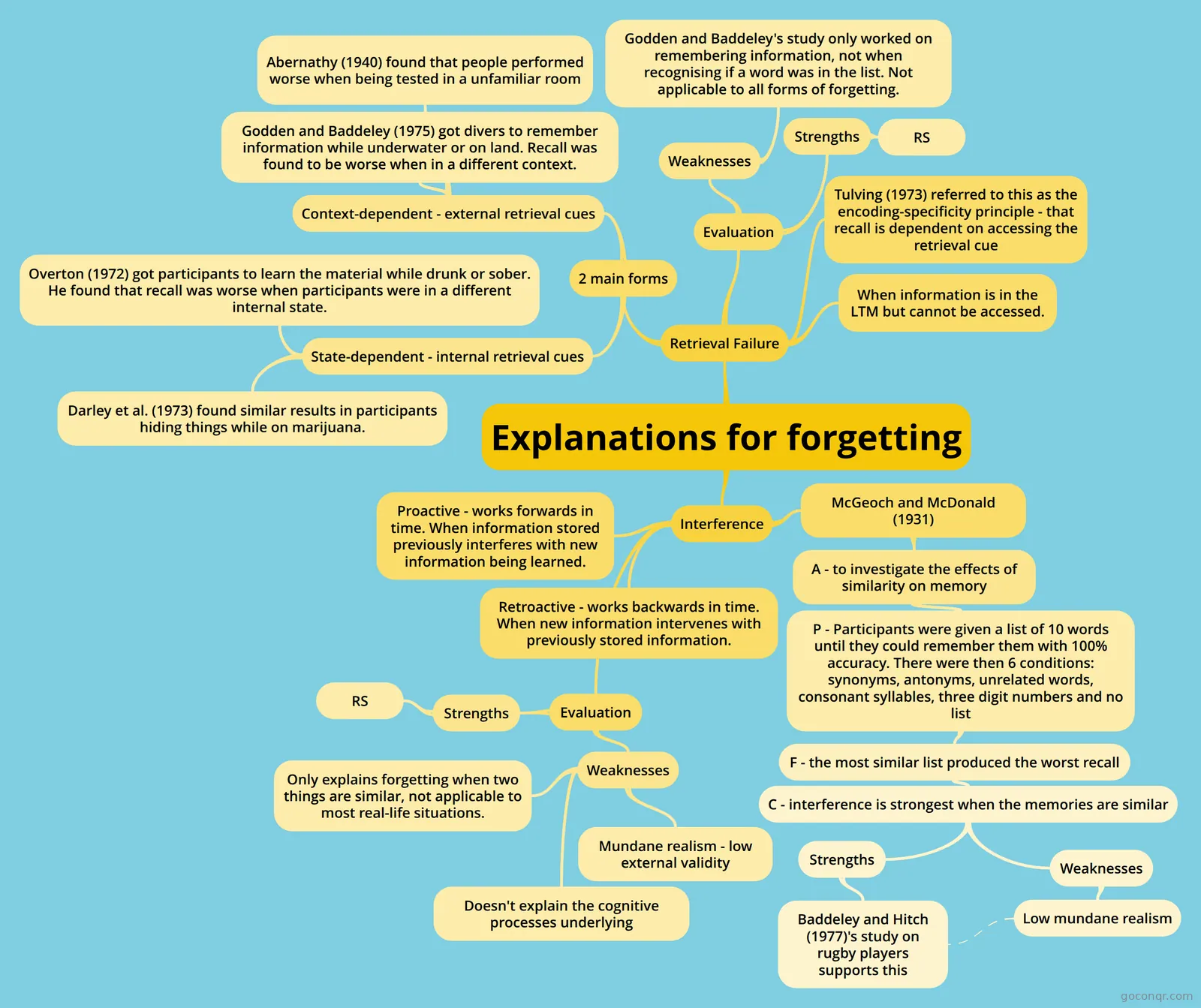
Mind map: Explanations for forgetting
Conteúdo do mapa
Explanations for forgetting
Interference
- Proactive - works forwards in time. When information stored previously interferes with new information being learned.
- Retroactive - works backwards in time. When new information intervenes with previously stored information.
- McGeoch and McDonald (1931)
- A - to investigate the effects of similarity on memory
- P - Participants were given a list of 10 words until they could remember them with 100% accuracy. There were then 6 conditions: synonyms, antonyms, unrelated words, consonant syllables, three digit numbers and no list
- F - the most similar list produced the worst recall
- C - interference is strongest when the memories are similar
- Strengths
- Baddeley and Hitch (1977)'s study on rugby players supports this
- Weaknesses
- Low mundane realism
- Strengths
- C - interference is strongest when the memories are similar
- F - the most similar list produced the worst recall
- P - Participants were given a list of 10 words until they could remember them with 100% accuracy. There were then 6 conditions: synonyms, antonyms, unrelated words, consonant syllables, three digit numbers and no list
- A - to investigate the effects of similarity on memory
- Evaluation
- Strengths
- RS
- Weaknesses
- Only explains forgetting when two things are similar, not applicable to most real-life situations.
- Mundane realism - low external validity
- Doesn't explain the cognitive processes underlying
- Strengths
Retrieval Failure
- When information is in the LTM but cannot be accessed.
- Tulving (1973) referred to this as the encoding-specificity principle - that recall is dependent on accessing the retrieval cue
- 2 main forms
- Context-dependent - external retrieval cues
- Abernathy (1940) found that people performed worse when being tested in a unfamiliar room
- Godden and Baddeley (1975) got divers to remember information while underwater or on land. Recall was found to be worse when in a different context.
- State-dependent - internal retrieval cues
- Overton (1972) got participants to learn the material while drunk or sober. He found that recall was worse when participants were in a different internal state.
- Darley et al. (1973) found similar results in participants hiding things while on marijuana.
- Context-dependent - external retrieval cues
- Evaluation
- Weaknesses
- Godden and Baddeley's study only worked on remembering information, not when recognising if a word was in the list. Not applicable to all forms of forgetting.
- Strengths
- RS
- Weaknesses
Informações
- Descrição
- A level Psychology (Memory) Mapa Mental sobre Explanations for forgetting, criado por Bethany Barnes em 31-05-2019.
- Criado por
- Bethany Barnes
- Visualizações
- 0
- Avaliação