
Mapa mental
Challenging religious changes
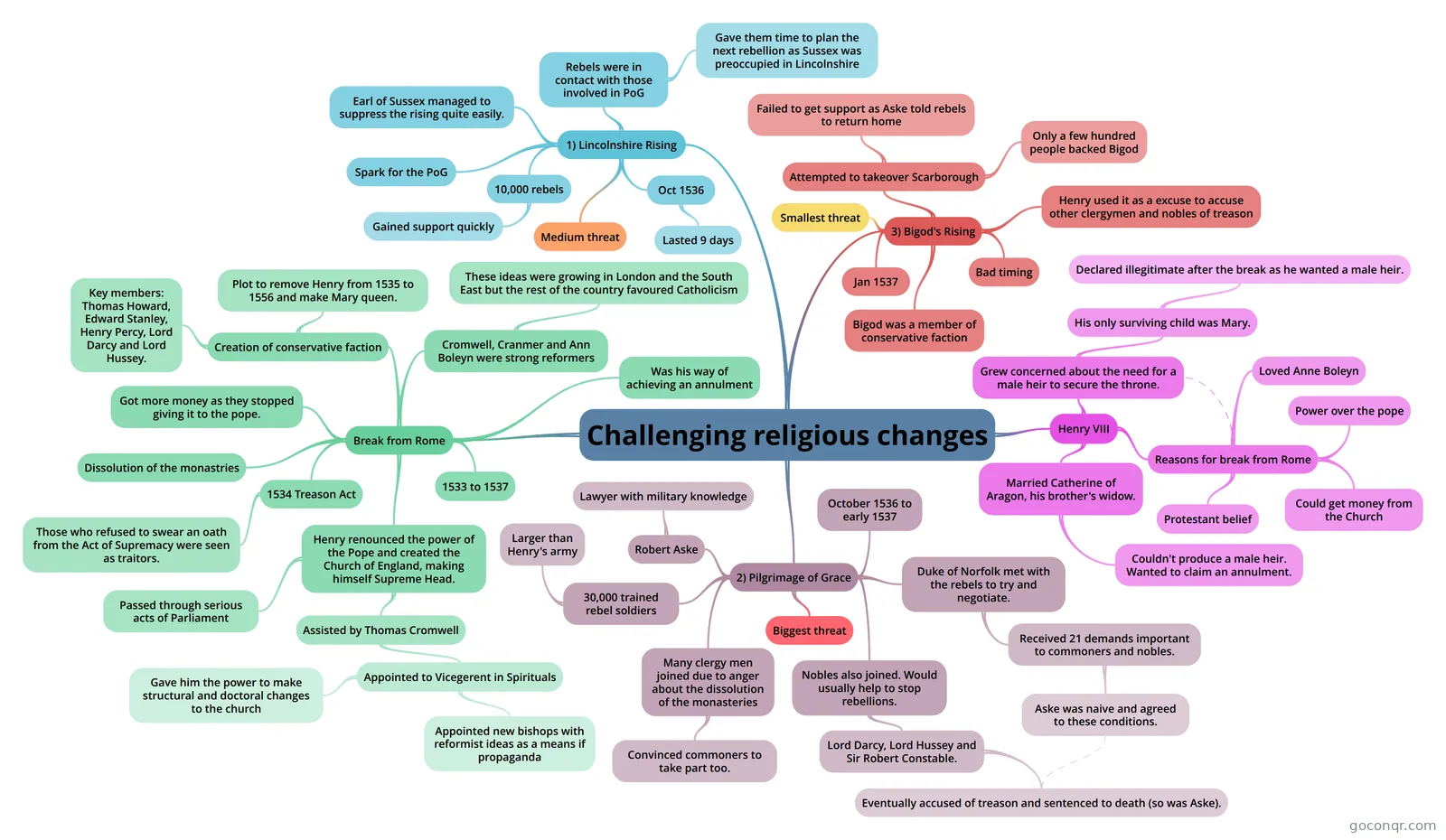
Mind map: Challenging religious changes
Conteúdo do mapa
Challenging religious changes
Break from Rome
- 1533 to 1537
- Henry renounced the power of the Pope and created the Church of England, making himself Supreme Head.
- Assisted by Thomas Cromwell
- Appointed to Vicegerent in Spirituals
- Gave him the power to make structural and doctoral changes to the church
- Appointed new bishops with reformist ideas as a means if propaganda
- Appointed to Vicegerent in Spirituals
- Passed through serious acts of Parliament
- Assisted by Thomas Cromwell
- Was his way of achieving an annulment
- Cromwell, Cranmer and Ann Boleyn were strong reformers
- These ideas were growing in London and the South East but the rest of the country favoured Catholicism
- 1534 Treason Act
- Those who refused to swear an oath from the Act of Supremacy were seen as traitors.
- Got more money as they stopped giving it to the pope.
- Creation of conservative faction
- Plot to remove Henry from 1535 to 1556 and make Mary queen.
- Key members: Thomas Howard, Edward Stanley, Henry Percy, Lord Darcy and Lord Hussey.
- Dissolution of the monastries
3) Bigod's Rising
- Jan 1537
- Bigod was a member of conservative faction
- Attempted to takeover Scarborough
- Failed to get support as Aske told rebels to return home
- Only a few hundred people backed Bigod
- Smallest threat
- Henry used it as a excuse to accuse other clergymen and nobles of treason
- Bad timing
Henry VIII
- Married Catherine of Aragon, his brother's widow.
- Couldn't produce a male heir. Wanted to claim an annulment.
- Grew concerned about the need for a male heir to secure the throne.
- His only surviving child was Mary.
- Declared illegitimate after the break as he wanted a male heir.
- His only surviving child was Mary.
- Reasons for break from Rome
- Loved Anne Boleyn
- Power over the pope
- Protestant belief
- Could get money from the Church
- Married Catherine of Aragon, his brother's widow.
2) Pilgrimage of Grace
- Biggest threat
- Robert Aske
- Lawyer with military knowledge
- 30,000 trained rebel soldiers
- Larger than Henry's army
- Many clergy men joined due to anger about the dissolution of the monasteries
- Convinced commoners to take part too.
- Nobles also joined. Would usually help to stop rebellions.
- Lord Darcy, Lord Hussey and Sir Robert Constable.
- Eventually accused of treason and sentenced to death (so was Aske).
- Lord Darcy, Lord Hussey and Sir Robert Constable.
- Duke of Norfolk met with the rebels to try and negotiate.
- Received 21 demands important to commoners and nobles.
- Aske was naive and agreed to these conditions.
- Received 21 demands important to commoners and nobles.
- October 1536 to early 1537
1) Lincolnshire Rising
- Oct 1536
- Lasted 9 days
- 10,000 rebels
- Gained support quickly
- Spark for the PoG
- Earl of Sussex managed to suppress the rising quite easily.
- Rebels were in contact with those involved in PoG
- Gave them time to plan the next rebellion as Sussex was preoccupied in Lincolnshire
- Medium threat
- Oct 1536
Informações
- Descrição
- A level History Mapa Mental sobre Challenging religious changes, criado por Hannah Hall em 10-06-2019.
- Criado por
- Hannah Hall
- Visualizações
- 0
- Avaliação