
Mapa mental
memory
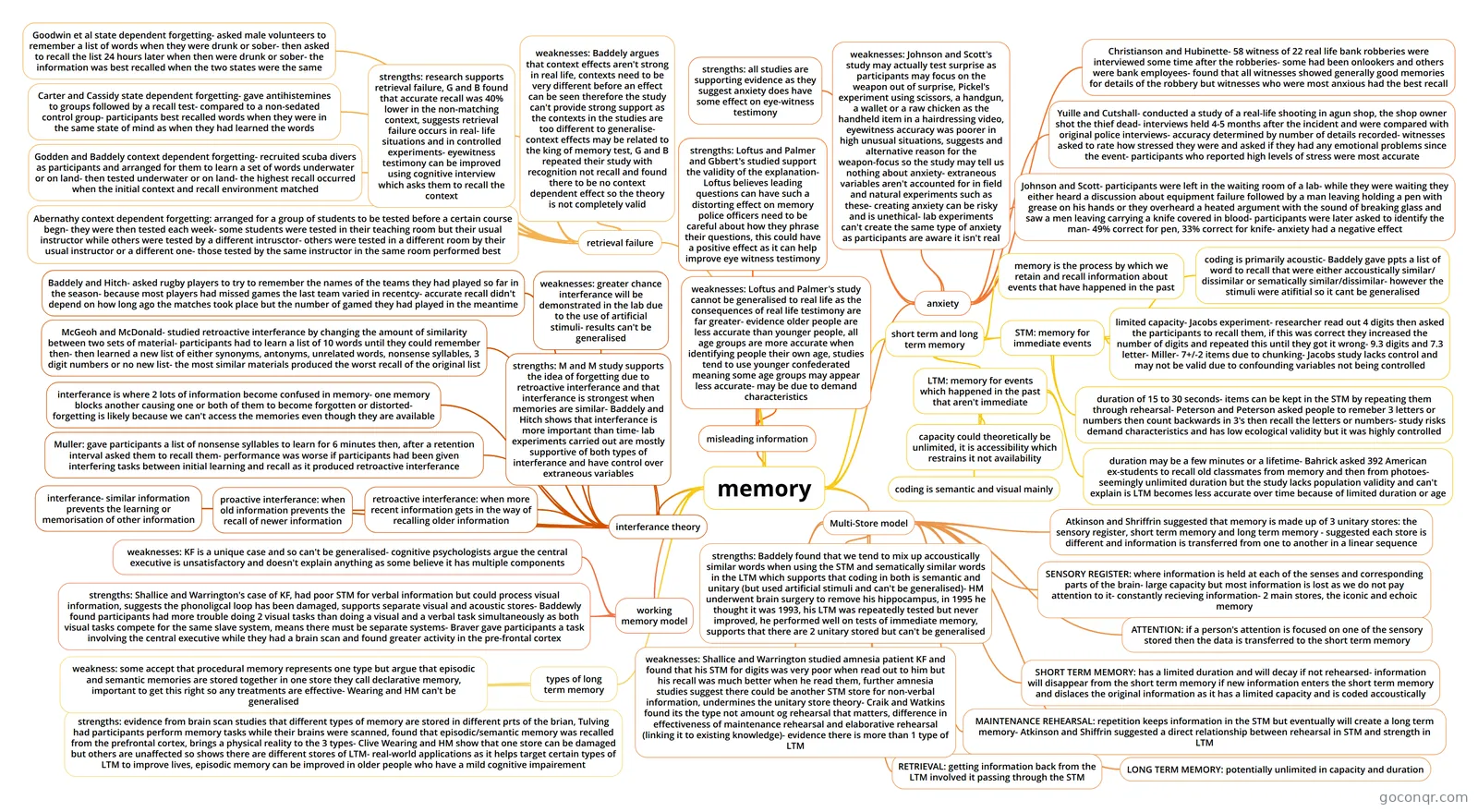
Mind map: memory
Conteúdo do mapa
memory
short term and long term memory
- memory is the process by which we retain and recall information about events that have happened in the past
- STM: memory for immediate events
- limited capacity- Jacobs experiment- researcher read out 4 digits then asked the participants to recall them, if this was correct they increased the number of digits and repeated this until they got it wrong- 9.3 digits and 7.3 letter- Miller- 7+/-2 items due to chunking- Jacobs study lacks control and may not be valid due to confounding variables not being controlled
- duration of 15 to 30 seconds- items can be kept in the STM by repeating them through rehearsal- Peterson and Peterson asked people to remeber 3 letters or numbers then count backwards in 3's then recall the letters or numbers- study risks demand characteristics and has low ecological validity but it was highly controlled
- coding is primarily acoustic- Baddely gave ppts a list of word to recall that were either accoustically similar/ dissimilar or sematically similar/dissimilar- however the stimuli were atifitial so it cant be generalised
- LTM: memory for events which happened in the past that aren't immediate
- capacity could theoretically be unlimited, it is accessibility which restrains it not availability
- duration may be a few minutes or a lifetime- Bahrick asked 392 American ex-students to recall old classmates from memory and then from photoes- seemingly unlimited duration but the study lacks population validity and can't explain is LTM becomes less accurate over time because of limited duration or age
- coding is semantic and visual mainly
Multi-Store model
- Atkinson and Shriffrin suggested that memory is made up of 3 unitary stores: the sensory register, short term memory and long term memory - suggested each store is different and information is transferred from one to another in a linear sequence
- SENSORY REGISTER: where information is held at each of the senses and corresponding parts of the brain- large capacity but most information is lost as we do not pay attention to it- constantly recieving information- 2 main stores, the iconic and echoic memory
- ATTENTION: if a person's attention is focused on one of the sensory stored then the data is transferred to the short term memory
- SHORT TERM MEMORY: has a limited duration and will decay if not rehearsed- information will disappear from the short term memory if new information enters the short term memory and dislaces the original information as it has a limited capacity and is coded accoustically
- MAINTENANCE REHEARSAL: repetition keeps information in the STM but eventually will create a long term memory- Atkinson and Shiffrin suggested a direct relationship between rehearsal in STM and strength in LTM
- LONG TERM MEMORY: potentially unlimited in capacity and duration
- RETRIEVAL: getting information back from the LTM involved it passing through the STM
- strengths: Baddely found that we tend to mix up accoustically similar words when using the STM and sematically similar words in the LTM which supports that coding in both is semantic and unitary (but used artificial stimuli and can't be generalised)- HM underwent brain surgery to remove his hippocampus, in 1995 he thought it was 1993, his LTM was repeatedly tested but never improved, he performed well on tests of immediate memory, supports that there are 2 unitary stored but can't be generalised
- weaknesses: Shallice and Warrington studied amnesia patient KF and found that his STM for digits was very poor when read out to him but his recall was much better when he read them, further amnesia studies suggest there could be another STM store for non-verbal information, undermines the unitary store theory- Craik and Watkins found its the type not amount og rehearsal that matters, difference in effectiveness of maintenance rehearsal and elaborative rehearsal (linking it to existing knowledge)- evidence there is more than 1 type of LTM
types of long term memory
- strengths: evidence from brain scan studies that different types of memory are stored in different prts of the brian, Tulving had participants perform memory tasks while their brains were scanned, found that episodic/semantic memory was recalled from the prefrontal cortex, brings a physical reality to the 3 types- Clive Wearing and HM show that one store can be damaged but others are unaffected so shows there are different stores of LTM- real-world applications as it helps target certain types of LTM to improve lives, episodic memory can be improved in older people who have a mild cognitive impairement
- weakness: some accept that procedural memory represents one type but argue that episodic and semantic memories are stored together in one store they call declarative memory, important to get this right so any treatments are effective- Wearing and HM can't be generalised
working memory model
- strengths: Shallice and Warrington's case of KF, had poor STM for verbal information but could process visual information, suggests the phonoligcal loop has been damaged, supports separate visual and acoustic stores- Baddewly found participants had more trouble doing 2 visual tasks than doing a visual and a verbal task simultaneously as both visual tasks compete for the same slave system, means there must be separate systems- Braver gave participants a task involving the central executive while they had a brain scan and found greater activity in the pre-frontal cortex
- weaknesses: KF is a unique case and so can't be generalised- cognitive psychologists argue the central executive is unsatisfactory and doesn't explain anything as some believe it has multiple components
interferance theory
- interferance- similar information prevents the learning or memorisation of other information
- proactive interferance: when old information prevents the recall of newer information
- retroactive interferance: when more recent information gets in the way of recalling older information
- Muller: gave participants a list of nonsense syllables to learn for 6 minutes then, after a retention interval asked them to recall them- performance was worse if participants had been given interfering tasks between initial learning and recall as it produced retroactive interferance
- interferance is where 2 lots of information become confused in memory- one memory blocks another causing one or both of them to become forgotten or distorted- forgetting is likely because we can't access the memories even though they are available
- McGeoh and McDonald- studied retroactive interferance by changing the amount of similarity between two sets of material- participants had to learn a list of 10 words until they could remember then- then learned a new list of either synonyms, antonyms, unrelated words, nonsense syllables, 3 digit numbers or no new list- the most similar materials produced the worst recall of the original list
- Baddely and Hitch- asked rugby players to try to remember the names of the teams they had played so far in the season- because most players had missed games the last team varied in recentcy- accurate recall didn't depend on how long ago the matches took place but the number of gamed they had played in the meantime
- strengths: M and M study supports the idea of forgetting due to retroactive interferance and that interferance is strongest when memories are similar- Baddely and Hitch shows that interferance is more important than time- lab experiments carried out are mostly supportive of both types of interferance and have control over extraneous variables
- weaknesses: greater chance interferance will be demonstrated in the lab due to the use of artificial stimuli- results can't be generalised
retrieval failure
- Abernathy context dependent forgetting: arranged for a group of students to be tested before a certain course begn- they were then tested each week- some students were tested in their teaching room but their usual instructor while others were tested by a different intrusctor- others were tested in a different room by their usual instructor or a different one- those tested by the same instructor in the same room performed best
- Godden and Baddely context dependent forgetting- recruited scuba divers as participants and arranged for them to learn a set of words underwater or on land- then tested underwater or on land- the highest recall occurred when the initial context and recall environment matched
- Carter and Cassidy state dependent forgetting- gave antihistemines to groups followed by a recall test- compared to a non-sedated control group- participants best recalled words when they were in the same state of mind as when they had learned the words
- Goodwin et al state dependent forgetting- asked male volunteers to remember a list of words when they were drunk or sober- then asked to recall the list 24 hours later when then were drunk or sober- the information was best recalled when the two states were the same
- strengths: research supports retrieval failure, G and B found that accurate recall was 40% lower in the non-matching context, suggests retrieval failure occurs in real- life situations and in controlled experiments- eyewitness testimony can be improved using cognitive interview which asks them to recall the context
- weaknesses: Baddely argues that context effects aren't strong in real life, contexts need to be very different before an effect can be seen therefore the study can't provide strong support as the contexts in the studies are too different to generalise- context effects may be related to the king of memory test, G and B repeated their study with recognition not recall and found there to be no context dependent effect so the theory is not completely valid
misleading information
- strengths: Loftus and Palmer and Gbbert's studied support the validity of the explanation- Loftus believes leading questions can have such a distorting effect on memory police officers need to be careful about how they phrase their questions, this could have a positive effect as it can help improve eye witness testimony
- weaknesses: Loftus and Palmer's study cannot be generalised to real life as the consequences of real life testimony are far greater- evidence older people are less accurate than younger people, all age groups are more accurate when identifying people their own age, studies tend to use younger confederated meaning some age groups may appear less accurate- may be due to demand characteristics
anxiety
- Johnson and Scott- participants were left in the waiting room of a lab- while they were waiting they either heard a discussion about equipment failure followed by a man leaving holding a pen with grease on his hands or they overheard a heated argument with the sound of breaking glass and saw a men leaving carrying a knife covered in blood- participants were later asked to identify the man- 49% correct for pen, 33% correct for knife- anxiety had a negative effect
- Yuille and Cutshall- conducted a study of a real-life shooting in agun shop, the shop owner shot the thief dead- interviews held 4-5 months after the incident and were compared with original police interviews- accuracy determined by number of details recorded- witnesses asked to rate how stressed they were and asked if they had any emotional problems since the event- participants who reported high levels of stress were most accurate
- Christianson and Hubinette- 58 witness of 22 real life bank robberies were interviewed some time after the robberies- some had been onlookers and others were bank employees- found that all witnesses showed generally good memories for details of the robbery but witnesses who were most anxious had the best recall
- strengths: all studies are supporting evidence as they suggest anxiety does have some effect on eye-witness testimony
- weaknesses: Johnson and Scott's study may actually test surprise as participants may focus on the weapon out of surprise, Pickel's experiment using scissors, a handgun, a wallet or a raw chicken as the handheld item in a hairdressing video, eyewitness accuracy was poorer in high unusual situations, suggests and alternative reason for the weapon-focus so the study may tell us nothing about anxiety- extraneous variables aren't accounted for in field and natural experiments such as these- creating anxiety can be risky and is unethical- lab experiments can't create the same type of anxiety as participants are aware it isn't real
Informações
- Descrição
- A level psychology Mapa Mental sobre memory, criado por harriet bagguley em 18-02-2021.
- Criado por
- harriet bagguley
- Visualizações
- 0
- Avaliação