
Mapa mental
RM - 1
Conteúdo do mapa
RM - 1
TYPES OF EXPERIMENT
- LAB
- - highly controlled environ - researcher manipulates IV to see effect on DV - control over EVs
- High control over EVs = High int. val. Easily replicable
- Lack generalisability = low ext. val. DCs. Lack mundane realism
- FIELD
- - Natural setting. - researcher manipulates IV and records effect on DV
- Higher mundane realism than lab = more valid + authentic behaviour = high ext. val
- Ethical issues if not consenting. Less control over EVs = difficult to establish cause/effect
- NATURAL
- Effect of a PRE-EXISTING IV on the DV (the variable would have occurred anyway)
- Opportunities for research that otherwise can't happen due to ethical/practical reasons. High ext. val (real life).
- Naturally occuring event occurs rarely = limited scope for generalising. Cannot randomly allocate = particiapt variables may affect = low int. val
- QUASI
- Already existing IV that isn't manipulated (age/gender)
- Often carried out under controlled conditions = high int. val
- No random allocation = confounding variables
- LAB
OBSERVATIONAL TECHNIQUES
- NATURALISTIC AND CONTROLLED
- Naturalistic
- Observing in natural environment where beh would normally occur
- High ext. val
- Lacks replicability, can't control EVs
- Controlled
- Observing in a controlled/structured environment
- Control EVs, easily replicable
- Lack generalisability ext. val
- Naturalistic
- COVERT AND OVERT
- Covert : P's don't know they are being watched/recorded
- Removes participant reactivity, increases int. val
- Ethics questioned
- Overt: P's Know they are being observed + give consent + OBSERVER IS VISIBLE
- More ethically acceptable
- Participant reactivity
- Covert : P's don't know they are being watched/recorded
- PARTICIPANT AND NON PARTICIPANT
- Participant: researcher becomes part of the group they are observing
- Insight into lives of P's
- Researcher may identify too strongly with P's but lose objectivity
- Non Participant: Researcher remains out of the group they are observing
- Can remain objective
- May lose insight into P's lives if they are too far removed
- Participant: researcher becomes part of the group they are observing
- NATURALISTIC AND CONTROLLED
SELF REPORT TECHNIQUES
- QUESTIONNAIRE
- Written set of qs used to asses someone's thoughts/experiences. can be used as part of an experiment to asses DV
- Open qs: no fixed range of answers - QUALITATIVE DATA. rich in depth data but hard to analyse
- Closed qs: fixed responses 'yes/no' (qual) or rating 1-10 (quantitative). Easy to analyse but lack depth/detail
- Cost effective, quickly gather lots of data, researcher doesn't need to be present, easy analysis
- DCs, Social desirability bias, response bias (aquiescence bias), lack of understanding
- INTERVIEW
- 'Live' encounter, interviewer asks set of qs to assess P's thoughts/experiences
- STRUCTURED: Pre determined set of qs in a fixed order
- Easy replication, reduces differences between interviewers
- No option for elaboration or deviation from topic
- UNSTRUCTURED: no set qs, general topic, free flowing interaction, elaboration of answers
- More flexible, can follow up points and gain insight
- Hard to analyse the data and draw conclusions
- Risk of social desirability bias (unless a skilled interview can build a rapport for a truthful answer)
- QUESTIONNAIRE
CORRELATIONS
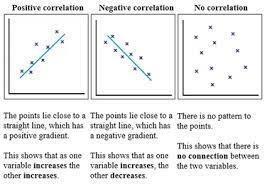
- Illustrate strength + direction of an association between co-variables. Plotted on a scattergram
- CORRELATION VS EXPERIMENT
- E - manipulation of IV to measure effect on DV. C - no manipulation of variable.
- Useful as preliminary tool for research which can be used for future research, quick, economical, less time consuming as 2dnary data can be used
- Don't demonstrate cause-effect between variables, third factor (intervening variable) could be causing the relationship, correlations can be misinterpretted
CONTENT ANALYSIS
- analysing data into themes or categories (indirect study of behaviour)
- collect data, familiarise with it, identify coding units, analyse using coding units, tally in each time the category occurs
- CODING: categorising
- THEMATIC ANALYSIS
- coding and identifying themes once the data has been coded - the themes are likely to be more descriptive than the coding units
- can avoid ethical issues normally associated with psychological research (public info doesn't need permission), high ext. val, flexible in producing qual+quant data
- Indirectly studying people out of the context it occured = researcher bias may occur, lack of objectivity, no causality
- analysing data into themes or categories (indirect study of behaviour)
CASE STUDIES
- in-depth study of one person or a group of people over time. usually carried out in the real world. idiographic and very individualistic.
- Rich + detailed insights into atypical beh, contribute to understanding of 'normal' functioning, can generate hypotheses for future study
- Hard to generalise, info often based on retrospective data (may not be accurate),difficult to replicate
Imagens e arquivos do mapa
Informações
- Descrição
- Experimental method. Types of experiment • Observational techniques • Self-report techniques • Correlations • Content analysis. • Case studies
- Criado por
- Neha P
- Visualizações
- 4
- Avaliação