
Mapa mental
The Nucleus
Conteúdo do mapa
The Nucleus
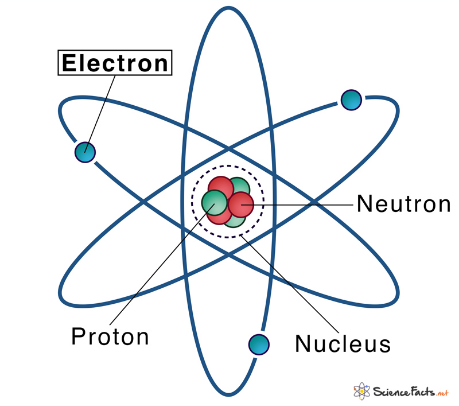
Structure of the Atom
- Rutherford shot a beam of alpha particles at a thin sheet of gold. He noticed that some of the particles were deflected through small angles and some were deflected straight back. He concluded that the nucleus of an atom is very small compared to the rest of the element
- The bohr model of an element shows the nucleus that contains protons and neutrons and shows electrons orbiting it in shells
- The emission line spectrum is when light from a luminous source undergoes dispersion and the resulting pattern is the emission line spectrum
- A continuous spectrum is produced by an incandescent solid or liquid. A line emission spectrum is when a gaseous element gives out a coloured gas
- Spectroscopy is used in science to determine the element as every element has its own line spectrum and can be identified
- The energy level is the fixed amount of energy an electron can have in an atom
- hf = E2 - E1
Structure of the Nucleus
- The atomic number (Z) of an element is the number of protons in the nucleus of the element
- The mass number (A) is the total number of protons and neutrons in the element
- An isotope is an atom of an element that has the same atomic number but different mass numbers
Radioactivity
- Radioactivity is the disintegration or decay of the nuclei of certain atoms with the emission of one or more types of radiation
- Alpha radiation
- Alpha radiation is fast moving helium nuclei ejected from the nuclei of radioactive atoms
- If a nucleus emits an alpha particle, its atomic number decreases by 2 and its mass number decreases by 4
- Beta radiation
- Bets radiation is high speed electrons ejected from the nuclei of radioactive atoms
- If a nucleus emits a beta particle, the atomic number of the daughter nucleus is 1 greater than the parent nucleus
- Gamma radiation
- Gamma radiation is high frequency electromagnetic radiation emitted from the nucleus of a radioactive atom
- When gamma rays are emitted from a nucleus, the structure of the nucleus remains the same but it will have lost energy and will be more stable
- Usually emitted from a nucleus that has already emitted an alpha or beta particle
- Experiment to demonstrate the penetrating power of alpha, beta and gamma radiation pg. 348
- Experiment to demonstrate the ionising effect of nuclear radiation pg. 349
- GM Tube pg. 353
Radioactive decay
- The number of nuclei of a radioactive sample decaying per second is called the activity
- The Becquerel is equal to one radioactive disintegration per second
- The law of radioactive decay states that the number of nuclei decaying per second (the activity) is directly proportional to the number of nuclei undecayed
- The half-life of a radioactive isotope is the time taken for half of the undecayed atoms to undergo decay
- T = ln2/λ
- Rate of decay = λN
- The number of nuclei of a radioactive sample decaying per second is called the activity
Nuclear Energy
- Nuclear fission is the splitting up of a large nucleus into 2 smaller nuclei
- Nuclear fusion is the joining of 2 nuclei to form one larger nucleus
- U-235 + n = Ba-144 = Kr-90 +2n + ke
- Fission reactor
- Fuel - uranium
- Moderator - slows down the neutrons so further fission will occur
- Control rod - absorb neutrons
- Shielding - stops radiation escaping
- Environmental impacts of fission reactors - mining of uranium, containing radioactive material, radioactive waste
- Advantages of fusion - less radioactive waste, no possibility of uncontrolled reaction, deutreium readily available in oceans
- E = mc²
- E = energy
- m = mass
- c = speed of light
Health risks
- Health hazards include - skin burns, cataracts, leukemia, genetic defets, death
- When using radioactive sources, lead shielding and tongs should be used, minimise time in contact
- Background radiation can be measured using a GM tube and counting the amount of radiation in the air
- Radon in houses can rise up through the ground and cause lung cancer
- Nuclear waste should be disposed of in lead barrels under ground
Imagens e arquivos do mapa
Informações
- Descrição
- - Physics (LC) Mapa Mental sobre The Nucleus, criado por Riona Stevenson em 26-11-2021.
- Criado por
- Riona Stevenson
- Visualizações
- 0
- Avaliação