
Mapa mental
Behavioural Approach
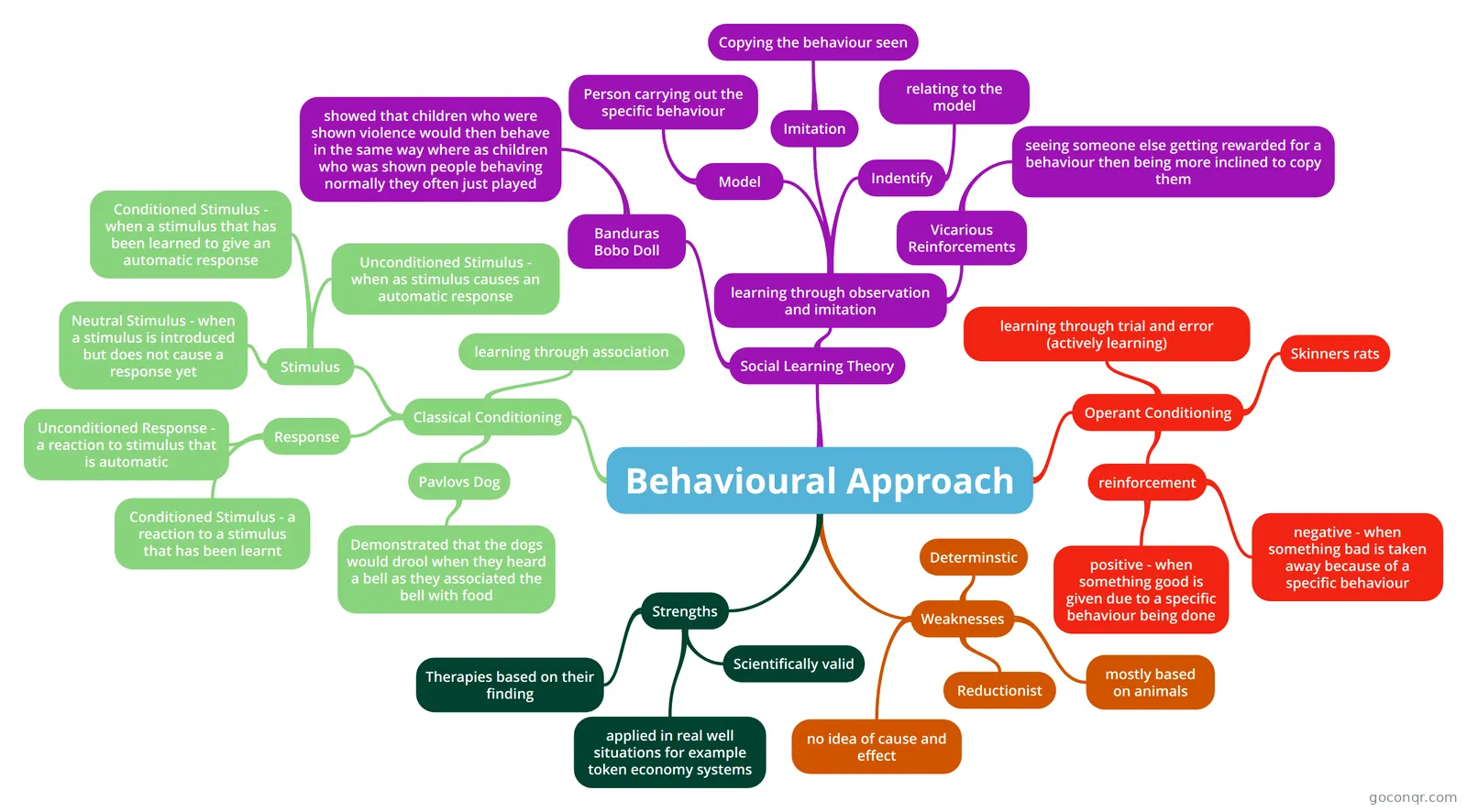
Mind map: Behavioural approach
Conteúdo do mapa
Behavioural Approach
Social Learning Theory
- learning through observation and imitation
- Vicarious Reinforcements
- seeing someone else getting rewarded for a behaviour then being more inclined to copy them
- Model
- Person carrying out the specific behaviour
- Indentify
- relating to the model
- Imitation
- Copying the behaviour seen
- Vicarious Reinforcements
- Banduras Bobo Doll
- showed that children who were shown violence would then behave in the same way where as children who was shown people behaving normally they often just played
- learning through observation and imitation
Operant Conditioning
- learning through trial and error (actively learning)
- Skinners rats
- reinforcement
- positive - when something good is given due to a specific behaviour being done
- negative - when something bad is taken away because of a specific behaviour
Classical Conditioning
- learning through association
- Pavlovs Dog
- Demonstrated that the dogs would drool when they heard a bell as they associated the bell with food
- Stimulus
- Unconditioned Stimulus - when as stimulus causes an automatic response
- Conditioned Stimulus - when a stimulus that has been learned to give an automatic response
- Neutral Stimulus - when a stimulus is introduced but does not cause a response yet
- Response
- Unconditioned Response - a reaction to stimulus that is automatic
- Conditioned Stimulus - a reaction to a stimulus that has been learnt
Strengths
- Scientifically valid
- Therapies based on their finding
- applied in real well situations for example token economy systems
Weaknesses
- Reductionist
- Determinstic
- mostly based on animals
- no idea of cause and effect