
Mapa mental
Chapter 4: Sensation & Perception
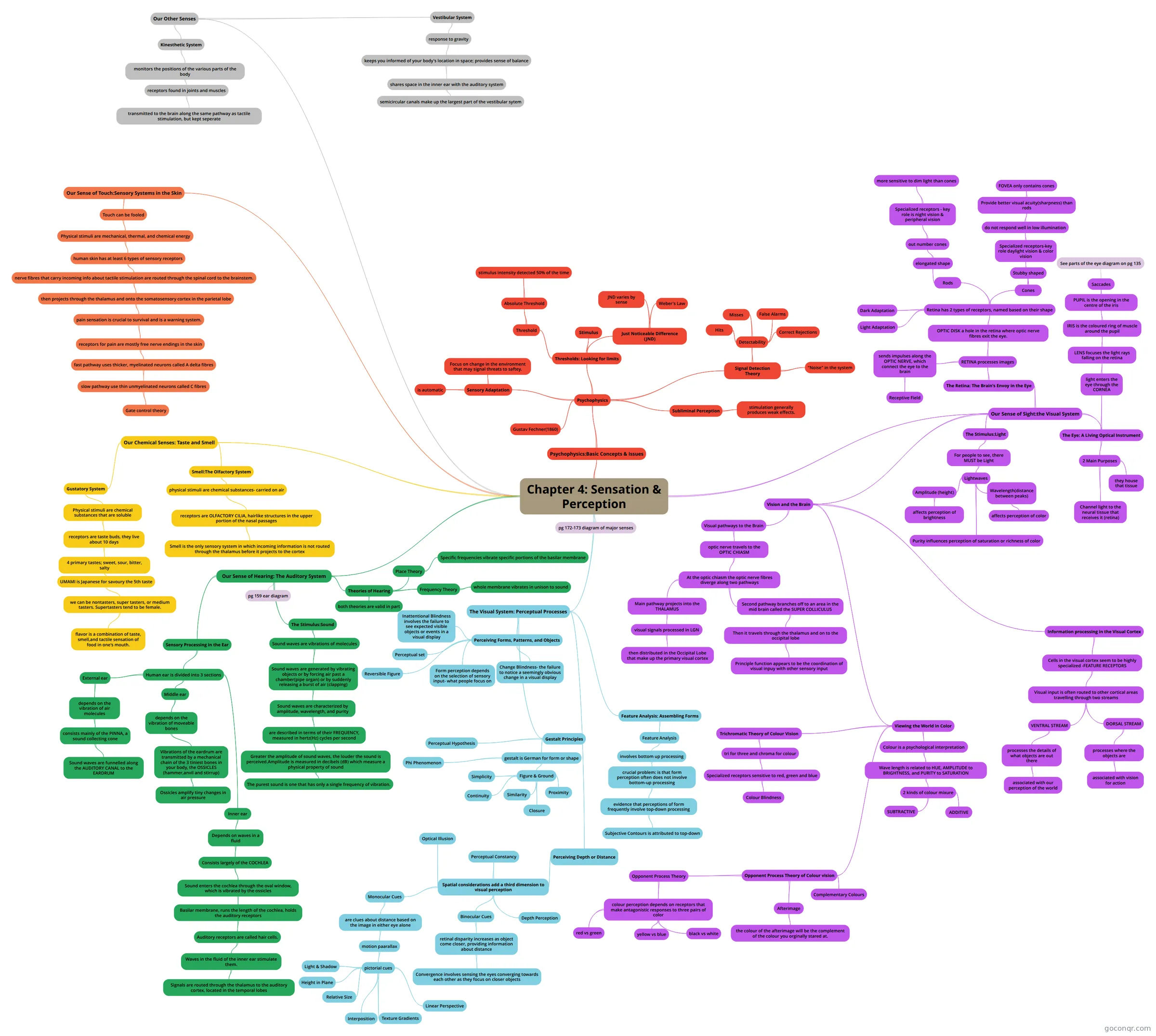
Mind map: Sensation and perception
Conteúdo do mapa
Chapter 4: Sensation & Perception
Psychophysics:Basic Concepts & Issues
- Psychophysics
- is the study of how physical stimuli are translated into psychological experience.
- Gustav Fechner(1860)
- Wanted to know: For any given sense, what is the weakest detectable stimulus?
- Thresholds: Looking for limits
- Stimulus
- Any detectable input from the environment. subjectable...
- Threshold
- - is a dividing point between energy levels that do and do not have a detectable effect.
- Absolute Threshold
- -an absolute threshold for a specific type of sensory input is the minimum amount of stimulation that an organism can detect. -define the boundaries of an organism's sensory capabilities. -stimulus intensity increases, subject's probability of responding to stimuli gradually increases
- stimulus intensity detected 50% of the time
- Just Noticeable Difference (JND)
- - is the smallest difference in the amount of stimulation that a specific sense can detect.
- JND varies by sense
- Weber's Law
- -states that the size of the Just Noticeable Difference is a constant proportion of the size of the initial stimulus. -this constant proportion is called the WEBER FRACTION
- Stimulus
- Signal Detection Theory
- -proposes that the detection of stimuli involves decision processes as well as sensory processes, which are both influenced by a variety of factors besides stimulus intensity.
- Detectability
- - is measured in terms of probability and depends on decision making processes as well as sensory processes
- Hits
- detecting signals when they are present
- Misses
- failing to detect signals when they are present
- False Alarms
- detecting signals when they are not present
- Correct Rejections
- not detecting signals when they are absent
- "Noise" in the system
- -performance will also depend on the level of "noise" in the system. -Noise comes from all of the irrelevant stimuli in the environment and the neural activity they elicit. -analogous to background static on the radio station.
- Subliminal Perception
- - The registration of sensory input without conscious awareness. -LIMEN is another term for threshold, so subliminal means below threshold
- stimulation generally produces weak effects.
- Sensory Adaptation
- - is a gradual decline in sensitivity due to prolong stimulation
- is automatic
- - is a built in process that keeps people tuned into the changes rather than the constants in their sensory input.
- Focus on change in the environment that may signal threats to saftey.
- Psychophysics
Our Sense of Sight:the Visual System
- The Stimulus:Light
- For people to see, there MUST be Light
- Lightwaves
- Amplitude (height)
- affects perception of brightness
- Wavelength(distance between peaks)
- affects perception of color
- Purity influences perception of saturation or richness of color
- How varied the mix of light waves is.
- Amplitude (height)
- Lightwaves
- For people to see, there MUST be Light
- The Eye: A Living Optical Instrument
- 2 Main Purposes
- Channel light to the neural tissue that receives it (retina)
- they house that tissue
- light enters the eye through the CORNEA
- -the cornea and lens(located behind it) form an upside down image of objects on the retina.
- LENS focuses the light rays falling on the retina
- capable of adjustments that facilitate a process called ACCOMMODATION. -Accommodation occurs when the curvature of the lens adjusts to alter visual focus.
- IRIS is the coloured ring of muscle around the pupil
- PUPIL is the opening in the centre of the iris
- - it helps regulate the amount of light passing into the rear chamber of the eye -it constricts to let less light into the eye but sharpens the image falling on the retina -it dilates to let more light in but the image is less sharp.
- Saccades
- When we are looking at something, our eyes are scanning the visual environment and making brief fixations at various parts of the stimuli these movements are saccades.
- See parts of the eye diagram on pg 135
- PUPIL is the opening in the centre of the iris
- 2 Main Purposes
- The Retina: The Brain's Envoy in the Eye
- RETINA processes images
- - the RETINA is the neural tissue lining the inside back surface of the eye; it absorbs light, processes images and sends visual information to the brain. -part of the central nervous system -paper thin sheet of neural tissue.
- OPTIC DISK a hole in the retina where optic nerve fibres exit the eye.
- -Axons that run from the retina to the brain converge here -Because the optic disk is a hole in the retina, you cannot see the part of an image that falls on it. therefore it is known as the blind spot. -each eye compensates for the blind spot of the other
- Retina has 2 types of receptors, named based on their shape
- Rods
- elongated shape
- out number cones
- Specialized receptors - key role is night vision & peripheral vision
- more sensitive to dim light than cones
- Specialized receptors - key role is night vision & peripheral vision
- out number cones
- elongated shape
- Cones
- Stubby shaped
- Specialized receptors-key role daylight vision & color vision
- do not respond well in low illumination
- Provide better visual acuity(sharpness) than rods
- FOVEA only contains cones
- -is a tiny spot in the centre of the retina that contains only cones;visual acuity is greatest here
- FOVEA only contains cones
- Provide better visual acuity(sharpness) than rods
- do not respond well in low illumination
- Dark Adaptation
- the process in which the eyes become more sensitive to light in low illumination
- Light Adaptation
- is the process whereby the eyes become less sensitive to light in high illumination
- Rods
- sends impulses along the OPTIC NERVE, which connect the eye to the brain
- Receptive Field
- the receptive field of a visual cell is the retinal area that, when stimulated, affects the firing of that cell.
- Receptive Field
- RETINA processes images
- Vision and the Brain
- visual input is meaningless until it is processed in the brain
- Visual pathways to the Brain
- optic nerve travels to the OPTIC CHIASM
- - the point at which the optic nerves from the inside half of each eye cross over and then project to the opposite half of the brain. - this arrangement ensures that signals from both eyes go to both hemispheres of the brain.
- At the optic chiasm the optic nerve fibres diverge along two pathways
- Main pathway projects into the THALAMUS
- Here about 90% of the axons from the retinas synapse in the (LGN) lateral geniculate nucleus
- visual signals processed in LGN
- then distributed in the Occipital Lobe that make up the primary visual cortex
- Second pathway branches off to an area in the mid brain called the SUPER COLLICULUS
- Then it travels through the thalamus and on to the occipital lobe
- Principle function appears to be the coordination of visual inpuy with other sensory input
- Then it travels through the thalamus and on to the occipital lobe
- Main pathway projects into the THALAMUS
- optic nerve travels to the OPTIC CHIASM
- Information processing in the Visual Cortex
- Cells in the visual cortex seem to be highly specialized -FEATURE RECEPTORS
- are neurons that respond selectively to very specific features of more complex stimuli
- Visual input is often routed to other cortical areas travelling through two streams
- VENTRAL STREAM
- processes the details of what objects are out there
- eg the perception of form and color
- associated with our perception of the world
- processes the details of what objects are out there
- DORSAL STREAM
- processes where the objects are
- eg perception of motion and depth
- associated with vision for action
- - control of goal directed movements
- processes where the objects are
- VENTRAL STREAM
- Cells in the visual cortex seem to be highly specialized -FEATURE RECEPTORS
- Viewing the World in Color
- Colour is a psychological interpretation
- - it is NOT a physical property of light itself
- Wave length is related to HUE, AMPLITUDE to BRIGHTNESS, and PURITY to SATURATION
- 2 kinds of colour mixure
- SUBTRACTIVE
- subtractive colour mixing works by removing some of the wavelengths of light, leaving less light than was originally there. mixing yellow and blue to get green
- ADDITIVE
- additive colour mixing works by superimposing lights, putting more light in the mixture than exists in any one light by itself.
- SUBTRACTIVE
- 2 kinds of colour mixure
- Trichromatic Theory of Colour Vision
- Holds that the human eye has three types of receptors with differing sensitivities to different light wavelengths.
- tri for three and chroma for colour
- Specialized receptors sensitive to red, green and blue
- Colour Blindness
- encompasses a variety of deficiencies in the ability to distinguish among colours More frequent in males than females
- Colour Blindness
- Specialized receptors sensitive to red, green and blue
- Opponent Process Theory of Colour vision
- Complementary Colours
- are pairs of colors that produce grey tones when mixed together.
- Afterimage
- a visual image that persists after a stimulus is removed
- the colour of the afterimage will be the complement of the colour you orginally stared at.
- Opponent Process Theory
- colour perception depends on receptors that make antagonistic responses to three pairs of color
- red vs green
- yellow vs blue
- black vs white
- colour perception depends on receptors that make antagonistic responses to three pairs of color
- Complementary Colours
- Colour is a psychological interpretation
- The Stimulus:Light
The Visual System: Perceptual Processes
- Perceiving Forms, Patterns, and Objects
- Reversible Figure
- - a drawing that is compatible with two interpretations that can shift back and forth
- Perceptual set
- is a readiness to perceive a stimulus in a particular way creates a slate in how someone interprets sensory input
- Form perception depends on the selection of sensory input- what people focus on
- Change Blindness- the failure to notice a seemingly obvious change in a visual display
- Inattentional Blindness involves the failure to see expected visible objects or events in a visual display
- Reversible Figure
- Feature Analysis: Assembling Forms
- Feature Analysis
- is the process of detecting specific elements in visual input and assembling them into a more complex form
- involves bottom up processing
- a progression from individual elements to the whole
- crucial problem: is that form perception often does not involve bottom-up processing
- evidence that perceptions of form frequently involve top-down processing
- a progression from the whole to the elements
- Subjective Contours is attributed to top-down
- is the perceptionof contours where non actually exist.
- evidence that perceptions of form frequently involve top-down processing
- Feature Analysis
- Gestalt Principles
- gestalt is German for form or shape
- Phi Phenomenon
- is the illusion of movement created by presenting visual stimuli in rapid succession objects merely take slightly different positions in successive frames
- Figure & Ground
- figure is the thing being looked at and ground is the background against which it stands
- Proximity
- things that are close to one another seem to belong together
- Closure
- people often group elements to create a sense of closure or completeness
- Similarity
- People also tend to group stimuli that are similar
- Simplicity
- most general principle the law of Pragnanz, translates as good form. people tend to organize forms in the simplest ways possible
- Continuity
- reflect's people's tendency to follow in whatever direction they've been led
- Phi Phenomenon
- Perceptual Hypothesis
- is an inference about which distal stimuli could be responsible for the proximal stimuli sensed.
- gestalt is German for form or shape
- Perceiving Depth or Distance
- Spatial considerations add a third dimension to visual perception
- Depth Perception
- involves interpretation of visual cues that indicate how near or far away objects are
- Binocular Cues
- are cues are clues about distance based on the differing views of the 2 eyes 3D movies use this fact
- retinal disparity increases as object come closer, providing information about distance
- Convergence involves sensing the eyes converging towards each other as they focus on closer objects
- Monocular Cues
- are clues about distance based on the image in either eye alone
- motion paarallax
- involves images of objects at different distances moving across the retina at different rates.
- pictorial cues
- clues about distance that can be given in a flat picture
- Linear Perspective
- is a depth cue reflecting the fact that lines converge in the distance
- Texture Gradients
- can provide information on depth.
- Interposition
- If an object comes between you and another object, it must be closer to you.
- Relative Size
- closer objects appear larger
- Height in Plane
- distant objects appear higher in a picture
- Light & Shadow
- motion paarallax
- are clues about distance based on the image in either eye alone
- Perceptual Constancy
- is a tendency to experience a stable perception in the face of continually changing sensory input.
- Optical Illusion
- involves an apparently inexplicable discrepancy between the appearance of a visual stimulus and its physical reality perceptions are based on inappropriate assumptions
- Depth Perception
- Spatial considerations add a third dimension to visual perception
- Perceiving Forms, Patterns, and Objects
Our Sense of Hearing: The Auditory System
- The Stimulus:Sound
- Sound waves are vibrations of molecules
- Sound waves are generated by vibrating objects or by forcing air past a chamber(pipe organ) or by suddenly releasing a burst of air (clapping)
- Sound waves are characterized by amplitude, wavelength, and purity
- are described in terms of their FREQUENCY, measured in hertz(Hz) cycles per second
- Greater the amplitude of sound waves, the louder the sound is perceived.Amplitude is measured in decibels (dB) which measure a physical property of sound
- The purest sound is one that has only a single frequency of vibration.
- Greater the amplitude of sound waves, the louder the sound is perceived.Amplitude is measured in decibels (dB) which measure a physical property of sound
- are described in terms of their FREQUENCY, measured in hertz(Hz) cycles per second
- Sound waves are characterized by amplitude, wavelength, and purity
- Sound waves are generated by vibrating objects or by forcing air past a chamber(pipe organ) or by suddenly releasing a burst of air (clapping)
- Sound waves are vibrations of molecules
- Sensory Processing in the Ear
- Human ear is divided into 3 sections
- External ear
- depends on the vibration of air molecules
- consists mainly of the PINNA, a sound collecting cone
- Sound waves are funnelled along the AUDITORY CANAL to the EARDRUM
- eardrum is a taut membrane that vibrates in response.
- Sound waves are funnelled along the AUDITORY CANAL to the EARDRUM
- consists mainly of the PINNA, a sound collecting cone
- depends on the vibration of air molecules
- Middle ear
- depends on the vibration of moveable bones
- Vibrations of the eardrum are transmitted by a mechanical chain of the 3 tiniest bones in your body, the OSSICLES (hammer,anvil and stirrup)
- Ossicles amplify tiny changes in air pressure
- Vibrations of the eardrum are transmitted by a mechanical chain of the 3 tiniest bones in your body, the OSSICLES (hammer,anvil and stirrup)
- depends on the vibration of moveable bones
- Inner ear
- Depends on waves in a fluid
- Consists largely of the COCHLEA
- Cochlea is a fluid filled, coiled tunnel that contains the receptors for hearing. term comes from Greek meaning spiral-shelled snail
- Sound enters the cochlea through the oval window, which is vibrated by the ossicles
- Basilar membrane, runs the length of the cochlea, holds the auditory receptors
- Auditory receptors are called hair cells.
- Waves in the fluid of the inner ear stimulate them.
- Signals are routed through the thalamus to the auditory cortex, located in the temporal lobes
- Waves in the fluid of the inner ear stimulate them.
- Auditory receptors are called hair cells.
- Basilar membrane, runs the length of the cochlea, holds the auditory receptors
- Consists largely of the COCHLEA
- Depends on waves in a fluid
- External ear
- Human ear is divided into 3 sections
- Theories of Hearing
- Place Theory
- holds that perception of pitch corresponds to the vibration of different portions, or places along the basilar membrane
- Specific frequencies vibrate specific portions of the basilar membrane
- Frequency Theory
- holds that perception of pitch corresponds to the rate or frequency at which the entire basilar membrane vibrates
- whole membrane vibrates in unison to sound
- both theories are valid in part
- Place Theory
- pg 159 ear diagram
- The Stimulus:Sound
Our Chemical Senses: Taste and Smell
- Gustatory System
- Physical stimuli are chemical substances that are soluble
- receptors are taste buds, they live about 10 days
- 4 primary tastes; sweet, sour, bitter, salty
- UMAMI is Japanese for savoury the 5th taste
- we can be nontasters, super tasters, or medium tasters. Supertasters tend to be female.
- non tasters have a sensitivity to PTC or PROP
- flavor is a combination of taste, smell,and tactile sensation of food in one's mouth.
- we can be nontasters, super tasters, or medium tasters. Supertasters tend to be female.
- UMAMI is Japanese for savoury the 5th taste
- 4 primary tastes; sweet, sour, bitter, salty
- receptors are taste buds, they live about 10 days
- Physical stimuli are chemical substances that are soluble
- Smell:The Olfactory System
- physical stimuli are chemical substances- carried on air
- receptors are OLFACTORY CILIA, hairlike structures in the upper portion of the nasal passages
- Smell is the only sensory system in which incoming information is not routed through the thalamus before it projects to the cortex
- receptors are OLFACTORY CILIA, hairlike structures in the upper portion of the nasal passages
- physical stimuli are chemical substances- carried on air
- Gustatory System
Our Sense of Touch:Sensory Systems in the Skin
- Touch can be fooled
- Physical stimuli are mechanical, thermal, and chemical energy
- human skin has at least 6 types of sensory receptors
- nerve fibres that carry incoming info about tactile stimulation are routed through the spinal cord to the brainstem.
- then projects through the thalamus and onto the somatosensory cortex in the parietal lobe
- pain sensation is crucial to survival and is a warning system.
- receptors for pain are mostly free nerve endings in the skin
- fast pathway uses thicker, myelinated neurons called A delta fibres
- slow pathway use thin unmyelinated neurons called C fibres
- Gate control theory
- holds that incoming pain sensations must pass through a "gate'in the spinal cord that can be closed, thus blocking ascending pain signals
- Gate control theory
- slow pathway use thin unmyelinated neurons called C fibres
- fast pathway uses thicker, myelinated neurons called A delta fibres
- receptors for pain are mostly free nerve endings in the skin
- pain sensation is crucial to survival and is a warning system.
- then projects through the thalamus and onto the somatosensory cortex in the parietal lobe
- nerve fibres that carry incoming info about tactile stimulation are routed through the spinal cord to the brainstem.
- human skin has at least 6 types of sensory receptors
- Physical stimuli are mechanical, thermal, and chemical energy
- Touch can be fooled
Our Other Senses
- Kinesthetic System
- monitors the positions of the various parts of the body
- receptors found in joints and muscles
- transmitted to the brain along the same pathway as tactile stimulation, but kept seperate
- receptors found in joints and muscles
- monitors the positions of the various parts of the body
- Vestibular System
- response to gravity
- keeps you informed of your body's location in space; provides sense of balance
- shares space in the inner ear with the auditory system
- semicircular canals make up the largest part of the vestibular sytem
- shares space in the inner ear with the auditory system
- keeps you informed of your body's location in space; provides sense of balance
- response to gravity
- Kinesthetic System
pg 172-173 diagram of major senses
Informações
- Descrição
- 104 Psychology Mapa Mental sobre Chapter 4: Sensation & Perception, criado por Michelle Lamb em 21-02-2016.
- Criado por
- Michelle Lamb
- Visualizações
- 7
- Avaliação