
Mapa mental
Supporting Research - Memory
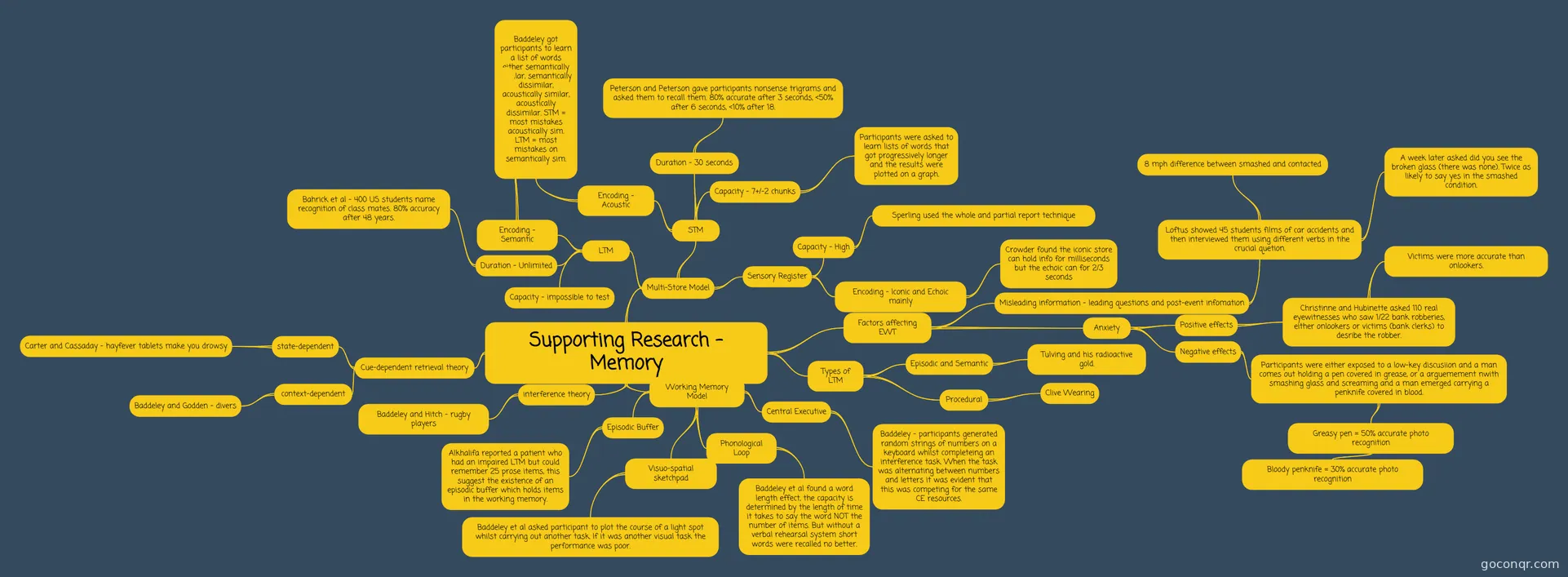
Mind map: Memory supporting research
Conteúdo do mapa
Supporting Research - Memory
Multi-Store Model
- Sensory Register
- Capacity - High
- Sperling used the whole and partial report technique
- Encoding - Iconic and Echoic mainly
- Crowder found the iconic store can hold info for milliseconds but the echoic can for 2/3 seconds
- Capacity - High
- STM
- Capacity - 7+/-2 chunks
- Participants were asked to learn lists of words that got progressively longer and the results were plotted on a graph.
- Duration - 30 seconds
- Peterson and Peterson gave participants nonsense trigrams and asked them to recall them. 80% accurate after 3 seconds, <50% after 6 seconds, <10% after 18.
- Encoding - Acoustic
- Baddeley got participants to learn a list of words either semantically similar, semantically dissimilar, acoustically similar, acoustically dissimilar. STM = most mistakes acoustically sim. LTM = most mistakes on semantically sim.
- Capacity - 7+/-2 chunks
- LTM
- Encoding - Semantic
- Duration - Unlimited
- Bahrick et al - 400 US students name recognition of class mates. 80% accuracy after 48 years.
- Capacity - impossible to test
- Encoding - Semantic
- Sensory Register
Types of LTM
- Episodic and Semantic
- Tulving and his radioactive gold.
- Procedural
- Clive Wearing
- Episodic and Semantic
Working Memory Model
- Central Executive
- Baddeley - participants generated random strings of numbers on a keyboard whilst completeing an interference task. When the task was alternating between numbers and letters it was evident that this was competing for the same CE resources.
- Phonological Loop
- Baddeley et al found a word length effect, the capacity is determined by the length of time it takes to say the word NOT the number of items. But without a verbal rehearsal system short words were recalled no better.
- Visuo-spatial sketchpad
- Baddeley et al asked participant to plot the course of a light spot whilst carrying out another task. If it was another visual task the performance was poor.
- Episodic Buffer
- Alkhalifa reported a patient who had an impaired LTM but could remember 25 prose items, this suggest the existence of an episodic buffer which holds items in the working memory.
- Central Executive
interference theory
- Baddeley and Hitch - rugby players
Cue-dependent retrieval theory
- context-dependent
- Baddeley and Godden - divers
- state-dependent
- Carter and Cassaday - hayfever tablets make you drowsy
- context-dependent
Factors affecting EWT
- Misleading information - leading questions and post-event infomation
- Loftus showed 45 students films of car accidents and then interviewed them using different verbs in tihe crucial quetion.
- 8 mph difference between smashed and contacted
- A week later asked did you see the broken glass (there was none). Twice as likely to say yes in the smashed condition.
- Loftus showed 45 students films of car accidents and then interviewed them using different verbs in tihe crucial quetion.
- Anxiety
- Positive effects
- Christinne and Hubinette asked 110 real eyewitnesses who saw 1/22 bank robberies, either onlookers or victims (bank clerks) to desribe the robber.
- Victims were more accurate than onlookers.
- Christinne and Hubinette asked 110 real eyewitnesses who saw 1/22 bank robberies, either onlookers or victims (bank clerks) to desribe the robber.
- Negative effects
- Participants were either exposed to a low-key discusiion and a man comes out holding a pen covered in grease, or a arguemement nwith smashing glass and screaming and a man emerged carrying a penknife covered in blood.
- Greasy pen = 50% accurate photo recognition
- Bloody penknife = 30% accurate photo recognition
- Greasy pen = 50% accurate photo recognition
- Participants were either exposed to a low-key discusiion and a man comes out holding a pen covered in grease, or a arguemement nwith smashing glass and screaming and a man emerged carrying a penknife covered in blood.
- Positive effects
- Misleading information - leading questions and post-event infomation
Informações
- Descrição
- AS - Level Psychology Mapa Mental sobre Supporting Research - Memory, criado por Hannah Jones em 21-02-2016.
- Criado por
- Hannah Jones
- Visualizações
- 0
- Avaliação