
Mapa mental
Evolutionary Factors
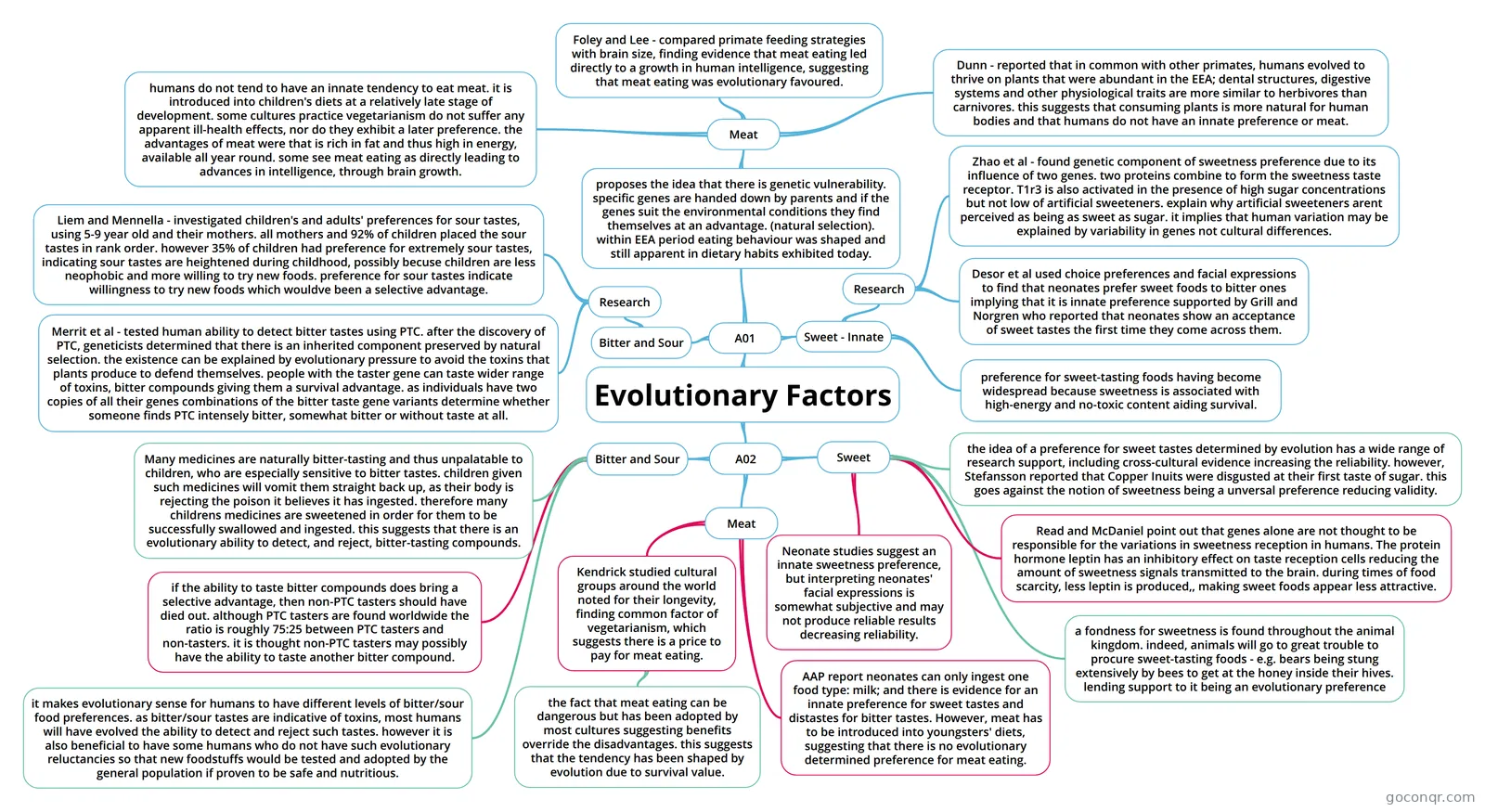
Mind map: Evolutionary factors
Conteúdo do mapa
Evolutionary Factors
A02
- Meat
- Kendrick studied cultural groups around the world noted for their longevity, finding common factor of vegetarianism, which suggests there is a price to pay for meat eating.
- the fact that meat eating can be dangerous but has been adopted by most cultures suggesting benefits override the disadvantages. this suggests that the tendency has been shaped by evolution due to survival value.
- AAP report neonates can only ingest one food type: milk; and there is evidence for an innate preference for sweet tastes and distastes for bitter tastes. However, meat has to be introduced into youngsters' diets, suggesting that there is no evolutionary determined preference for meat eating.
- Kendrick studied cultural groups around the world noted for their longevity, finding common factor of vegetarianism, which suggests there is a price to pay for meat eating.
- Sweet
- the idea of a preference for sweet tastes determined by evolution has a wide range of research support, including cross-cultural evidence increasing the reliability. however, Stefansson reported that Copper Inuits were disgusted at their first taste of sugar. this goes against the notion of sweetness being a unversal preference reducing validity.
- Read and McDaniel point out that genes alone are not thought to be responsible for the variations in sweetness reception in humans. The protein hormone leptin has an inhibitory effect on taste reception cells reducing the amount of sweetness signals transmitted to the brain. during times of food scarcity, less leptin is produced,, making sweet foods appear less attractive.
- Neonate studies suggest an innate sweetness preference, but interpreting neonates' facial expressions is somewhat subjective and may not produce reliable results decreasing reliability.
- a fondness for sweetness is found throughout the animal kingdom. indeed, animals will go to great trouble to procure sweet-tasting foods - e.g. bears being stung extensively by bees to get at the honey inside their hives. lending support to it being an evolutionary preference
- Bitter and Sour
- Many medicines are naturally bitter-tasting and thus unpalatable to children, who are especially sensitive to bitter tastes. children given such medicines will vomit them straight back up, as their body is rejecting the poison it believes it has ingested. therefore many childrens medicines are sweetened in order for them to be successfully swallowed and ingested. this suggests that there is an evolutionary ability to detect, and reject, bitter-tasting compounds.
- if the ability to taste bitter compounds does bring a selective advantage, then non-PTC tasters should have died out. although PTC tasters are found worldwide the ratio is roughly 75:25 between PTC tasters and non-tasters. it is thought non-PTC tasters may possibly have the ability to taste another bitter compound.
- it makes evolutionary sense for humans to have different levels of bitter/sour food preferences. as bitter/sour tastes are indicative of toxins, most humans will have evolved the ability to detect and reject such tastes. however it is also beneficial to have some humans who do not have such evolutionary reluctancies so that new foodstuffs would be tested and adopted by the general population if proven to be safe and nutritious.
- Meat
A01
- Sweet - Innate
- preference for sweet-tasting foods having become widespread because sweetness is associated with high-energy and no-toxic content aiding survival.
- Research
- Zhao et al - found genetic component of sweetness preference due to its influence of two genes. two proteins combine to form the sweetness taste receptor. T1r3 is also activated in the presence of high sugar concentrations but not low of artificial sweeteners. explain why artificial sweeteners arent perceived as being as sweet as sugar. it implies that human variation may be explained by variability in genes not cultural differences.
- Desor et al used choice preferences and facial expressions to find that neonates prefer sweet foods to bitter ones implying that it is innate preference supported by Grill and Norgren who reported that neonates show an acceptance of sweet tastes the first time they come across them.
- Bitter and Sour
- Research
- Merrit et al - tested human ability to detect bitter tastes using PTC. after the discovery of PTC, geneticists determined that there is an inherited component preserved by natural selection. the existence can be explained by evolutionary pressure to avoid the toxins that plants produce to defend themselves. people with the taster gene can taste wider range of toxins, bitter compounds giving them a survival advantage. as individuals have two copies of all their genes combinations of the bitter taste gene variants determine whether someone finds PTC intensely bitter, somewhat bitter or without taste at all.
- Liem and Mennella - investigated children's and adults' preferences for sour tastes, using 5-9 year old and their mothers. all mothers and 92% of children placed the sour tastes in rank order. however 35% of children had preference for extremely sour tastes, indicating sour tastes are heightened during childhood, possibly becuse children are less neophobic and more willing to try new foods. preference for sour tastes indicate willingness to try new foods which wouldve been a selective advantage.
- Research
- proposes the idea that there is genetic vulnerability. specific genes are handed down by parents and if the genes suit the environmental conditions they find themselves at an advantage. (natural selection). within EEA period eating behaviour was shaped and still apparent in dietary habits exhibited today.
- Meat
- Foley and Lee - compared primate feeding strategies with brain size, finding evidence that meat eating led directly to a growth in human intelligence, suggesting that meat eating was evolutionary favoured.
- Dunn - reported that in common with other primates, humans evolved to thrive on plants that were abundant in the EEA; dental structures, digestive systems and other physiological traits are more similar to herbivores than carnivores. this suggests that consuming plants is more natural for human bodies and that humans do not have an innate preference or meat.
- humans do not tend to have an innate tendency to eat meat. it is introduced into children's diets at a relatively late stage of development. some cultures practice vegetarianism do not suffer any apparent ill-health effects, nor do they exhibit a later preference. the advantages of meat were that is rich in fat and thus high in energy, available all year round. some see meat eating as directly leading to advances in intelligence, through brain growth.
- Meat
- Sweet - Innate
Informações
- Descrição
- A-Level Psychology (Printed) Mapa Mental sobre Evolutionary Factors, criado por Sophie Edroff em 04-04-2016.
- Criado por
- Sophie Edroff
- Visualizações
- 0
- Avaliação