
Mapa mental
Chapter Seven
Conteúdo do mapa
Chapter Seven
Encoding: Forming a memory code
- Attention: Focusing awareness on narrowed range of stimuli or events.
- Selective attention critical to everyday functioning
- Filter that screens out potential stimuli while allowing select few to pass to conscious awareness
- Cocktail party phenomenon: attention involves late selection bases on meaning
- Location of attention filter if flexible, depends on cognitive load
- Filter that screens out potential stimuli while allowing select few to pass to conscious awareness
- Selective attention critical to everyday functioning
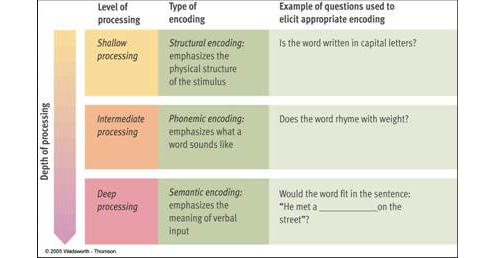
- Levels of processing theory: deeper levels of processing result in longer lasting memory codes
- Elaboration: linking stimulus to other information at time of encoding
- Dual coding theory: memory enhanced by forming visual codes
- Self referent encoding: deciding how information is personally relevant
- Attention: Focusing awareness on narrowed range of stimuli or events.
Storage: Maintaining encoded info in memory over time
- Sensory memory: preserves information in original sensory form for a brief time (fraction of a second)
- Additional time to recognize stimuli
- Short term memory: limited capacity store that can maintain info for about 20 seconds without rehearsal
- Rehearsal - help store short term memories
- Maintenance - maintaining info in consciousness
- Elaborative - increasing probability you will retain info
- Limited capacity (4 items plus/minus one)
- Working memory: limited capacity storage system that maintains info by providing an interface between perception, memory, and action
- Phonological loop - evolved to facilitate acquisition of language
- Visuospatial sketchpad - temporarily holds visual images
- Central executive system - controls development of attention
- Rehearsal - help store short term memories
- Long term memory: unlimited capacity store that can hold info over long periods of time
- Flashbulb memories - vivid and detailed recollections of momentous events
- Organization
- clustering: tendency to remember similar or related items in groups
- conceptual hierarchy: multilevel classification system based on common properties among items
- schemas: organized cluster of knowledge about subject or event abstracted from previous experience
- Semantic network: nodes representing concepts, joined together by pathways that link related concepts
- Connectionist networks (how neural networks handle info) and parallel distributed processing (stimultanious processing same info spread across networks) assume cognitive processes depend on patterns of activation in highly interconnected networks
- Sensory memory: preserves information in original sensory form for a brief time (fraction of a second)
Retrieval: Recovering info from memory stores
- tip of the tongue phenomenon - temporary inability to remember something you know accompanied by a feeling that its just out of reach
- encoding specificity principle - memory for info would be better when conditions during encoding and retrieval were similar
- Reinstating context can facilitate recall
- Misinformation effect - recall an event they witnessed is altered by introducing misleading postevent info
- Reality monitoring - process of deciding whether memories are based on external sources (perception of actual events) or internal sources (imagination)
- Source monitoring - involves making attributions about origin of memories
- Source monitoring error- occurs when a memory derived from one source is missattributed to another source
- Destination memory - recalling to whom one has told what
Forgetting
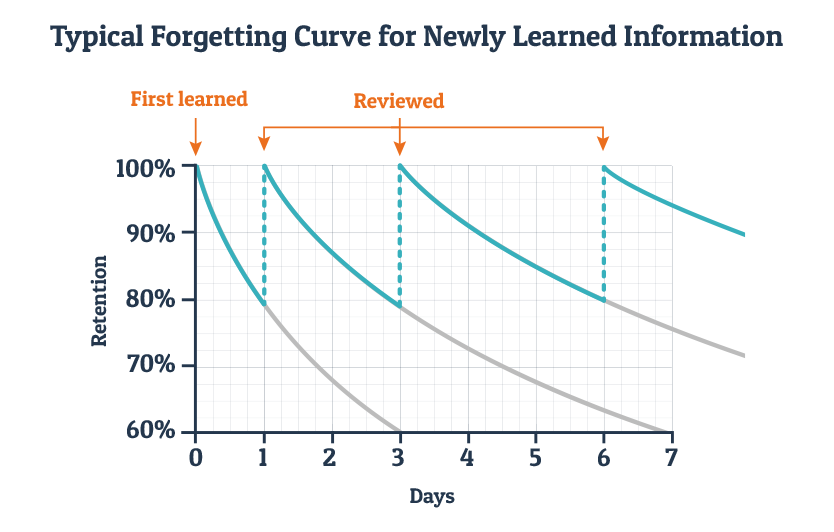
- forgetting curve - graphs retention and forgetting over time
- Measures
- retention - proportion of material retained
- recall - measure of retention requires subjects to reproduce info on own without cues
- recognition - measure of retention requires subjects to select previously learned info from array of options
- relearning - requires subject to memorize info a second time to determine how much time are saved
- ineffective encoding - info may have never been inserted into memory in the first place
- Decay - forgetting occurs because memory traces fade with time
- interference - people forget info because of competition from other material
- retroactive interference - new info impairs retention of previously learned info
- proactive interference - previously learned info interferes with retention of new info
- retrieval failure
- encoding specificity principle - value of retrieval cue depends on how it corresponds to memory code
- transfer appropriate processing - initial processing of info is similar to type of processing required by subsequent measure of retention
- repression - keeping distressing thoughts buried in unconscious
- memories recovered spontaneously are more likely to be authentic compared to memories recovered in therapy
- Schacter's seven sins of failed memory - transience, absentmindedness, blocking, misattribution, suggestibility, bias, and persistence
Physiology
- long term potential - long lasting increase in neural excitability at synapses along specific neural pathway
- neurogenesis - formation of new neurons that may contribute to sculpting circuits that underlie memory
- anatomy
- retrograde amnesia - involves loss of memory for events that occurred prior to onset amnesia
- anterograde amnesia - loss of memories for events that occur after onset amnesia
- consolidation - gradual conversion of info into durable memory codes stored in long term memory
Types
- implicit memory - apparent when retention is exhibited on a task that does no require intentional remembering
- perceptual and motor skills
- cerebellum
- unconscious and unintentional
- unaffected by amnesia, age, drugs, and manipulation of interference
- explicit memory - intentional recollection of previous memories
- facts and events
- hippocampus and temporal lobe
- conscious and deliberate
- declarative memory - handles factual info (definitions, names, dates, etc)
- conscious, effortful processes
- medial temporal lobe
- nondeclarative/procedural - memory for actions, skills, operations and conditioned responses
- automatic
- cerebellum and amygdala
- episodic - chronological recollection of personal experiences
- personal facts
- semantic - general knowledge not tied to time
- retrospective memory - remembering events from past
- prospective memory - remember to do actions in the future
- implicit memory - apparent when retention is exhibited on a task that does no require intentional remembering
Imagens e arquivos do mapa
Informações
- Descrição
- Psychology Mapa Mental sobre Chapter Seven, criado por Mackenzie Fabbro em 26-02-2017.
- Criado por
- Mackenzie Fabbro
- Visualizações
- 1
- Tags
- Avaliação