
Mapa mental
Aggression
Conteúdo do mapa
Aggression
Biological exp: hormonal and neural mechanisms
- Neural factors
- Limbic system- associated with emotions. Helps coordinate behaviours linked with innate motivational and emotional drives, e.g. aggression. 2 structures in the system.
- Amygdala- temporal lobe. Involved in expression of many emotions, evaluates importance of sensory information & promoting response to threats. When electrically stimulated, aggressive responses show (e.g. snarling). If theres areas are surgically removed then no responses to stimuli that would've previously caused aggression. Kluver-Bucy syndrome- taming effect found in rhesus monkeys by removing part of temporal lobe = destroying amygdala.
- Hippocampus- formation of LT memories & allows comparisons of threatening conditions with past experiences. Impaired hippocampal functioning prevents the CNS from assessing the meaningful context and cause amygdala to respond aggressively.
- Charles Whittman climbed clock tower & hot 12 people, last of many aggressive attacks. Post-mortem showed tumour pressing on limbic system. Criminals with violent tendencies have reduced sized amygdala.
- Limbic system- associated with emotions. Helps coordinate behaviours linked with innate motivational and emotional drives, e.g. aggression. 2 structures in the system.
- Biochemicals
- Serotonin- calming effect. It inhibits the firing of amygdala which controls fear and anger & low levels associated with agg. Serotonin deficiency hypothesis- low levels remove the inhibitory effect so you are less able to control impulsive behaviour. Low serotonin = agg as shown in monkeys.
- Hormones
- Chemicals produced by glands via blood stream that affect brain activity & organs.
- Testosterone- produced in testes & seen as cause of aggression as greater in most cultures in male. Levels peak in young males. Increases amygdala reactivity during processing of social threat.
- Castrated male mice & agg reduced. Later injected mice with testosterone which re-established agg. Castration now used to calm farm animals & proven to work.
- Too simplistic- deindividuation
- Deterministic
- Neural factors
Biological exp; genetics
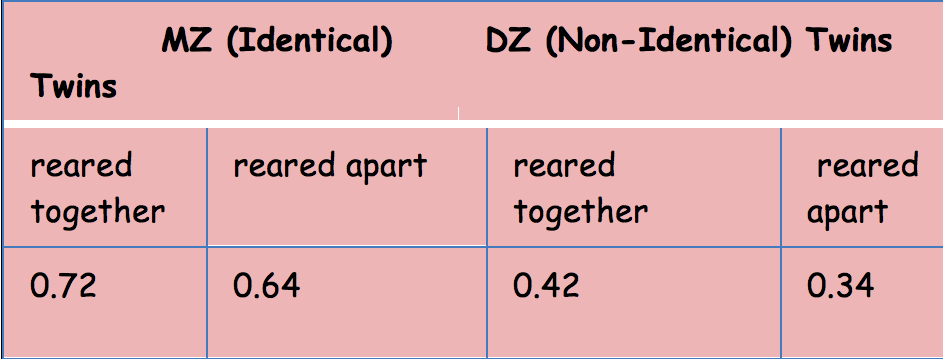
- Twin studies: MZ (identical). compare concordance rates between twin sets. Agg rates are high between MZ than DZs ... genetic factor.
- Miles & carey meta-analysis of 24 twins and adoption studies. Concluded generic influence could account fof 50% variance in agg.
- MAOA gene- people with low activity (MAOA-L) are more likely to be agg when provoked. Regulates enzymes in the in the brain that break down excess neurotransmitters. This helps neutrons to communicate more efficiently. Excess of neurotransmitters can cause people to react excessively aggy to stress (dopamine).
- Only men affected as it is carried in the X chromosome, but in women second X carries a good copy of the gene.
- Brunner- male members of are dutch family who repeatedly involved in violence e.g. rape. Had abnormally low levels of MAOA in brains.
- Criminality rather than aggression- largest effect actually for non-violent crimes. Also share same environment.
- Reductionist--SLT
- Deterministic
Ethological exp. of aggression (bio)
- Key assumptions; agg is adaptive. All members of same species have natural instinct to be aggy without need for learning- innate & genetically determined. Beneficial for survival & defence- establish dominance hierarchies, higher social status & better mate choice.
- MAOA gene- dutch family all have same natural instinct
- Ritualistic agg. (agg displays carried out in set order) in form of threat displays or appeasement gestures. Used to intimidate an opponent to prevent agg behaviour.
- Chimps in a 4 year war. Male chimps slaughtered members of another group- continued despite signals. Contradicts Lorenzos theory as attack continued.
- An IRM (innate releasing mechanism) is a built in structure (network of neutrons in the brain). Stimuli from sensory recognition (e.g. facial expressions) triggers IRM to release specific behaviours called fixed action pattern (FAP). through communication between motor control circuits.
- Tinbergen presented sticklebacks with series of wooden models of diff shapes. They get territorial during mating season & if see another male FAP is initiated, red spot is trigger. If a model had a red spot, stickleback show agg and attack it regardless of shape.The FAPs stayed the same for each agg encounter.
- Cultural agg is not universal. North-South divide in US for homicide rates- killings more common among white males in souther states as seen as 'culture of honour' where agg is reactive ... learnt. Southern white males more likely to be agg after insult in lab study rather than northern.
- Animal studies
- Key assumptions; agg is adaptive. All members of same species have natural instinct to be aggy without need for learning- innate & genetically determined. Beneficial for survival & defence- establish dominance hierarchies, higher social status & better mate choice.
Evolutionary exp of agg as an adaptive response
- Agg for resources & breeding- agg males would get more resources and attract more women as capable of supporting family, Darwin- agg indies more likely to survive & breed. Genes passed on and more common in gene pool through natural selection.
- Motivation for male agg is status- deter rival males. Threat to male but attractive to female.
- Sexual competition
- Men- never certain that child is theres. Evolution suggests that males would respond more aggy towards infidelity as bringing up another males child & not their genes for next generation & parental investment. Agg towards women to prevent further unfaithfulness.
- Women- infidelity is scary as lose resources needed for her & child to live. Better to be aggy to other female by gossiping which may put the man off leaving her.More aggy = more successful in acquiring mates & greater chance of transmitting genes.
- Buss compared male & female responses of thought of partner being unfaithful. Males showed much greater stress response when imaging physical and women more stress when imagining emotional cheating. Males jealousy innately triggered by threat of uncertainty of being the paren whereas women threatened by emotional & left for another woman. - low ecological validity as imagine situations & social desirability.
- Sexual jealousy
- Cuckoldry (man using resources to bring up other mans child). Males have strategies evolved specifically as male retention e.g. use of violence to prevent her from straying & violence towards perceived rival.
- Female-female- jealous of others getting resource-rich men. One way is to complete physically. Unlikely to show physical agg as become less attractive to men, so more likely to be verbal.
- Male-male - jealous of other men with better women. Direct physical agg to get rid of physical rivals. Jealousy again males who have partners if he doesn't.
- Reductionist & Determinist
- Agg for resources & breeding- agg males would get more resources and attract more women as capable of supporting family, Darwin- agg indies more likely to survive & breed. Genes passed on and more common in gene pool through natural selection.
Social psychological theories: frustration-agg hyp.
- Dollard- frustration leads to arousal of agg drive. Frustration is necessary for agg. Agg urges relieved through agg behaviour ... catharsis effect on individual.
- Cause & effect between agg, frust & catharsis. Frustration happens when you are prevented from achieving your goals.Contextual factors e.g. threat of punishment = agg.
- Pastor showed unjustified frustration cause higher levels of aggression.
- Reversed frust-agg hyp, Berkowitz. Frus not necessary nor sufficient for agg. Can happen in absence of frust & down not always lead to agg. Student shocked & could return shock to confederate. More shocks when gun present in the room- weapon effect supports that presence of agg environmental ces stimulate agg.
- Unpleasant exp created negative effect. Frustrating event is less important than how negative is the resulting effect. Negative feelings that trigger agg. Agg is not an automatic response from frustration. Bandura & SLT determines how arousal effects individual. Leanrs when to produce agg & when it is successful.
- To experience catharsis, scapegoat needed. Often inappropriate to be agg to frustration source. 'kicking dog effect'. agh displayed on something else.
- Other exp e.g. media influences
- Real world- swedish football fans. frustration was changing league position, agh was throwing missiles. If team performed worse than expected then more stuff thrown on pitch- more likely to fight opposition (more agg when frustrated).
- Bushman- agg behaviour keeps agg thoughts in the memory & makes person more angry. Contradicts catharsis!
- Catharsis- agg reduces arousal so less likely to be aggy.
- Dollard- frustration leads to arousal of agg drive. Frustration is necessary for agg. Agg urges relieved through agg behaviour ... catharsis effect on individual.
Social psychological theories: SLT & social cognitive theory
- Bandura. Direct reinforcement. If one imitates agg and is rewarded they're more likely to repeat. Vicarious reinforcement/punishment- seeing model rewarded/punished.
- Bobo doll- chldren frustrated as shown toy they cannot play with. Children reproduce agg behaviour shown by model, boys more than girls.Shown agg behaviour learnt Much more imitation is model praised. HOWEVER, only learning the game. Cannot generalise as children imitate everything.
- Observation- watching role model & imitating behaviour. Mental rep- only display behaviour as long as reward expected. Learnt script, becomes internalised & most see it happening in their social environment.
- SLT- Social cognitive theory. Self-efficacy- confidence in ability to perform agg behaviour. Goals of observer- only imitate behaviour to fulfil these. Self praise & criticism- no longer completely environmentally determined.
- Nature vs nurture. Twin studies (but not 100% concordance = n & n). Freud said id has agg instincts.
- Other exp e.g. frustration-aggression
- Too simplistic- Watching agg builds up f&f response = agg more likely afterwards (contradicts catharsis) Or catharsis may reduce agg (disinhibition)
- Bandura. Direct reinforcement. If one imitates agg and is rewarded they're more likely to repeat. Vicarious reinforcement/punishment- seeing model rewarded/punished.
Social psychological theories; deindividuation
- Nature- psycholgoical state which inner restraints are lost when individuals are not seen or paid attention to as people. Aroused when join crowds or large groups. Gives 'cloack of anonymity'- diminishes personal consequences. factors- uniform & altered conscience
- Process- anonymous & unaccountable increases behaviour thats normally inhibited. Crowds diminish identity, reduce guilt, minimise corns of others opinions.
- Zimbado- stanford prison study.
- Guards very aggressive & embarrassed prisoners. However, androcentric men more aggressive due to MAOA. BUT real-life, Abu Ghraib.
- SLT
- Baiting crowd- 21 suicidal leaps, 10/21 baiting crowd occurred - large crowd at night & great distance from jumper.
- Culture diff- warriors in 23 societies changed appearance prior to war, more brutal & destructive. However, same can be said for peace rallies!
Institutional aggression
- Situational factors (deprivation model)
- Cooke, situational context. Overcrowding- British prisons inc suicide with this. Job burnout- exhausted from job & careless for colleagues. Heat&noise- Griffitt- students in high temps & pop. = moe negative emotions.
- Violence due to inmates not wanting to seem weak
- Institutional agg is the product of stressful & oppressive conditions of the prison itself.
- Sykes 5 factors that cause this: e.g. loss of liberty, heterosexual relationships.
- Deprivations faced leads to increase in violence.
- Woodhill prison- Wilson. less crowded w/outside view & low temp. eradicated assaults on officers and inmates.
- Determinist- all criminals bad, all prisons have gang culture.
- Dispositional factors (importation model)
- Delisi- 813 juvenile delinquents- dispositional factors eg anger management. suicide more likely, committed more violence as agg produced of indie differences.
- Irwin & Cressey- personal traits and violence. 'code of streets'- informal rules brought in. Toughness is a survival skill both inside and out.
- Cheeseman- men bring in way of behaving with them. Apply behaviour, e.g. anger, to new situation.
- Role of dispositional characteristics: anger- best predictor of violent behaviour in prison Wang- stronger predictor than crime committed. Low self control- lose temper easily good predictor of violence.
- Delisi found that gang members no more likely to be aggy. However, may be because gang members usually isolated from others. Fischer isolated gang members and serious assaults dropped 50%.
- Interactionist model- include both environmental & individual factors- many uncontrollable factors e.g. pop density. Should focus on alleviating the problem, providing support for both the bully and victim.
- Situational factors (deprivation model)
Media influences
- Greitemeyer & Mugge, meat analysis 98 studies, 37,000 ppts.
- Violent video games w/aim to harm another & pro-social w/aim to help others. See how these influenced emotions&cognitions.
- Violent games linked to agg behaviour & decrease in pro-social. Evident regardless experiment type. Pro-social games showed opposite effect.
- Violent computer games
- Longitudinal, eliminates ppt variables (one person)
- But ppt may be exposed to other violent media forms e.g. TV- effects uncertain, lack validity & reliability.
- Anderson et al surveyed 430 children 7-9yrs 2 points in the year. Rated by themselves, peers and teachers.
- More violent video games = more verbally & physically aggy & less pro-social. Could be competitive nature rather than violence.
- Longitudinal, eliminates ppt variables (one person)
- Violent TV & films
- Meta-analysis
- Bushman & Huesmann 431 studies, over 68,000
- Media influence cause agg thoughts, adults ST children LT. Mainly TV, some music & comic.
- Publication bias- 'file drawer effect'. issue for meta-analysis as this usually only includes published materials ... not reliable.
- Lab
- 5-6yr olds randomly assigned to violent or non-violent film. Showed physical aggression to other children.
- Those who watched violent film showed more agg
- Cannot measure real-life, only short-term effects
- Meta-analysis
- Confounding variables- weakens cause & effect. Temperament may explain why some show more agg than others. Ferguson claimed didn't control e.g. mental health or testosterone.
- May be game difficulty as opposed to content. Agh behaviour may be linked to a players experience and frustration of failing during a game opposed to violent content. Problems in design & difficulty. Similar findings shown in control group. Frust-agg hyp.
- Greitemeyer & Mugge, meat analysis 98 studies, 37,000 ppts.
Explanations of media influences
- Desensitisation- repeated exposure to violence reduces levels of physiological & psychological arousal associated with anxiety, making agg more likely- long process. Funk- socially acceptable to resolve conflict with agg. Negative attitude towards violence is weakened & less empathy felt for victims- few consequences.
- Weisz & Earls- lab highlighting desensitisation effects. Showed ppts scenes of rape from film, followed by re-inactment of rape trial & control group. Male views of rape film showed greater acceptance of rape myths and sexual agg. Expressed less sympathy to victim & less likely to find defendant guilty. NOT IN WOMEN.
- Decrease validity as catharsis can cause agg.
- Cognitive priming- Berkowitz- constant exposure to violent media activates throughputs or ideas about violence, which activates other aggy thoughts through their association in memory pathways. Huesmann- game playing provides script about how violent situations may play out. This is stored in the memory when encounter social cues.
- Fischer & Gerittener - male ppts listen to aggy derogatory lyrics about women, control listened to neutral lyrics. Ppts recalled more negative qualities of women and behaved more aggy towards female confederate. Females also had similar results.
- Effective interventions that challenges hostile cognitive biases..
- Disinhibition-normal social constraints of behaviour can be weakened by environmental triggers- behaviours then seem temporarily acceptable & more likely. May have immediate lasting effect. According to this, watching violent media may change these standards of what is acceptable & justify agg. Constraints loosened after exposure to violent media, viewers guilt of concern of consequences reduced & likely to be aggy again.
- Goranson- showed ppt film of boxing match 1) no apparent consequences ( more likely to behave aggy as they do not see loser die) 2)loser of fight dies. Agg more likely when consequences not apparent.
- Dependent on other variables e.g. age. Younger children more likely to be affected.
- Desensitisation- repeated exposure to violence reduces levels of physiological & psychological arousal associated with anxiety, making agg more likely- long process. Funk- socially acceptable to resolve conflict with agg. Negative attitude towards violence is weakened & less empathy felt for victims- few consequences.
Imagens e arquivos do mapa
Informações
- Descrição
- A2 Psychology Mapa Mental sobre Aggression, criado por becky wells em 09-04-2017.
- Criado por
- becky wells
- Visualizações
- 0
- Avaliação