
Mapa mental
Psychodynamic
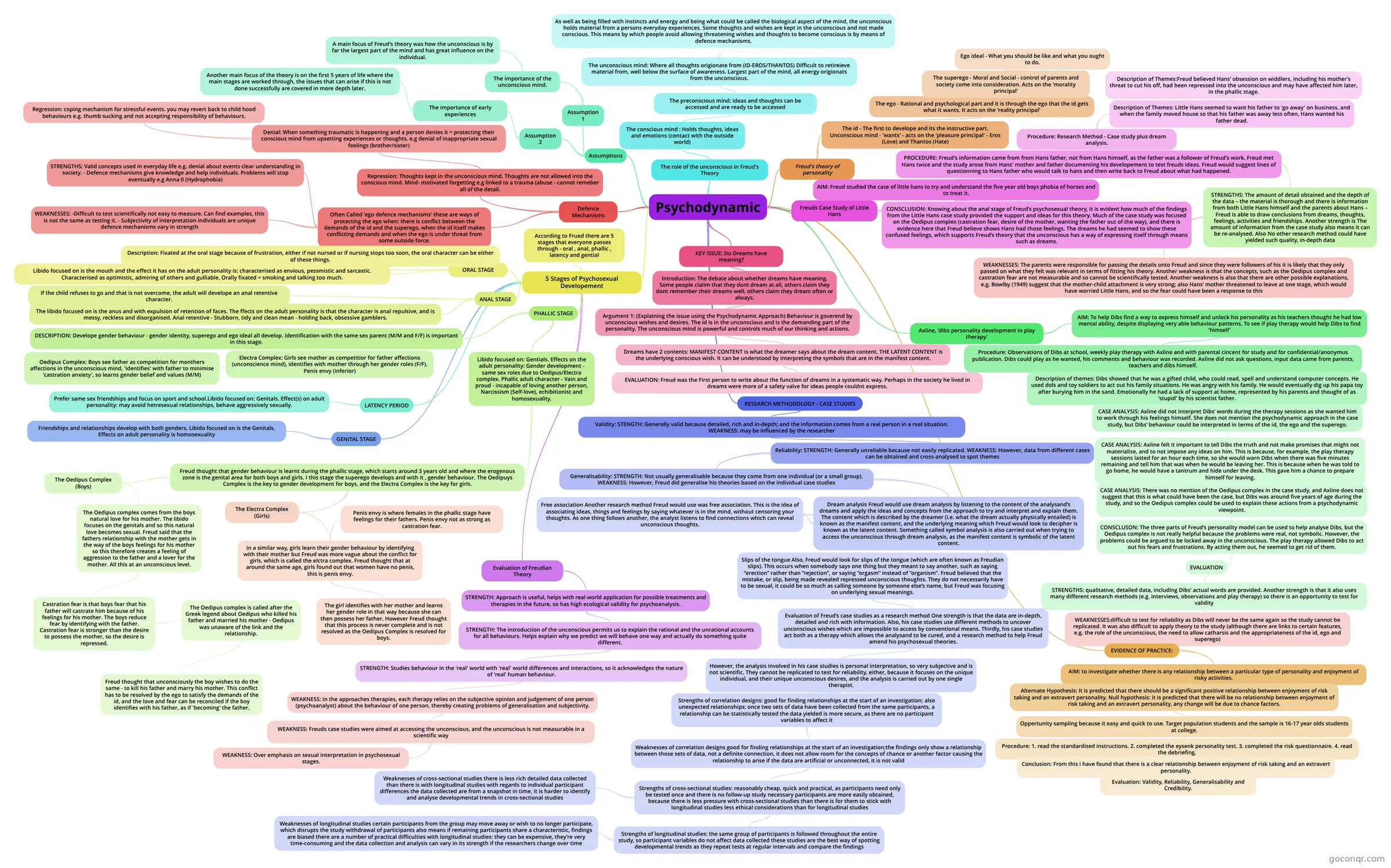
Mind map: Psychodynamic approach
Conteúdo do mapa
Psychodynamic
Assumptions
- Assumption 1
- The importance of the unconscious mind.
- A main focus of Freud's theory was how the unconscious is by far the largest part of the mind and has great influence on the individual.
- The importance of the unconscious mind.
- Assumption 2
- The importance of early experiences
- Another main focus of the theory is on the first 5 years of life where the main stages are worked through, the issues that can arise if this is not done successfully are covered in more depth later.
- The importance of early experiences
- Assumption 1
Freud's theory of personality
- The id - The first to develope and its the instructive part. Unconscious mind - 'wants' - acts on the 'pleasure principal' - Eros (Love) and Thantos (Hate)
- The ego - Rational and psychological part and it is through the ego that the id gets what it wants. It acts on the 'reality principal'
- The superego - Moral and Social - control of parents and society come into consideration. Acts on the 'morality principal'
- Ego ideal - What you should be like and what you ought to do.
- The superego - Moral and Social - control of parents and society come into consideration. Acts on the 'morality principal'
- The ego - Rational and psychological part and it is through the ego that the id gets what it wants. It acts on the 'reality principal'
- The id - The first to develope and its the instructive part. Unconscious mind - 'wants' - acts on the 'pleasure principal' - Eros (Love) and Thantos (Hate)
The role of the unconscious in Freud's Theory
- The conscious mind : Holds thoughts, ideas and emotions (contact with the outside world)
- The preconscious mind: ideas and thoughts can be accessed and are ready to be accessed
- The unconscious mind: Where all thoughts origionate from (ID-EROS/THANTOS) Difficult to retireieve material from, well below the surface of awareness. Largest part of the mind, all energy origionats from the unconscious.
- As well as being filled with instincts and energy and being what could be called the biological aspect of the mind, the unconscious holds material from a persons everyday experiences. Some thoughts and wishes are kept in the unconscious and not made conscious. This means by which people avoid allowing threatening wishes and thoughts to become conscious is by means of defence mechanisms.
- The unconscious mind: Where all thoughts origionate from (ID-EROS/THANTOS) Difficult to retireieve material from, well below the surface of awareness. Largest part of the mind, all energy origionats from the unconscious.
- The preconscious mind: ideas and thoughts can be accessed and are ready to be accessed
- The conscious mind : Holds thoughts, ideas and emotions (contact with the outside world)
Defence Mechanisms
- Often Called 'ego defence mechanisms' these are ways of protecting the ego when: there is conflict between the demands of the id and the superego, when the id itself makes conflicting demands and when the ego is under threat from some outside force.
- STRENGTHS: Valid concepts used in everyday life e.g. denial about events clear understanding in society. - Defence mechanisms give knowledge and help individuals. Problems will stop eventually e.g Anna 0 (Hydrophobia)
- WEAKNESSES: -Difficult to test scientifically not easy to measure. Can find examples, this is not the same as testing it. - Subjectivity of interpretation individuals are unique defence mechanisms vary in strength
- Repression: Thoughts kept in the unconscious mind. Thoughts are not allowed into the conscious mind. Mind- motivated forgetting e.g linked to a trauma (abuse - cannot remeber all of the detail.
- Denial: When something traumatic is happening and a person denies it = protecting their conscious mind from upsetting experiences or thoughts. e.g denial of inappropriate sexual feelings (brother/sister)
- Regression: coping mechanism for stressful events. you may revert back to child hood behaviours e.g. thumb sucking and not accepting responsibility of behaviours.
- Denial: When something traumatic is happening and a person denies it = protecting their conscious mind from upsetting experiences or thoughts. e.g denial of inappropriate sexual feelings (brother/sister)
- Often Called 'ego defence mechanisms' these are ways of protecting the ego when: there is conflict between the demands of the id and the superego, when the id itself makes conflicting demands and when the ego is under threat from some outside force.
5 Stages of Psychosexual Developement
- According to Frued there are 5 stages that everyone passes through - oral , anal, phallic , latency and gential
- ORAL STAGE
- Description: Fixated at the oral stage because of frustration, either if not nursed or if nursing stops too soon, the oral character can be either of these things.
- Libido focused on is the mouth and the effect it has on the adult personality is: characterised as envious, pessmistic and sarcastic. Characterised as optimistic, admiring of others and gulliable. Orally fixated = smoking and talking too much.
- ANAL STAGE
- If the child refuses to go and that is not overcome, the adult will develope an anal retentive character.
- The libido focused on is the anus and with expulsion of retention of faces. The ffects on the adult personality is that the character is anal repulsive, and is messy, reckless and disorganised. Anal retentive - Stubborn, tidy and clean mean - holding back, obsessive gamblers.
- PHALLIC STAGE
- DESCRIPTION: Develope gender behaviour - gender identity, superego and ego ideal all develop. Identification with the same sex parent (M/M and F/F) is important in this stage.
- Oedipus Complex: Boys see father as competition for monthers affections in the unconscious mind, 'identifies' with father to minimise 'castration anxiety', so learns gender belief and values (M/M)
- Electra Complex: Girls see mother as competitior for father affections (unconscience mind), identifies with mother through her gender roles (F/F). Penis envy (inferior)
- Libido focused on: Gentials. Effects on the adult personality: Gender development - same sex roles due to Oedipus/Electra complex. Phallic adult character - Vain and proud - incapable of loving another person, Narcissism (Self-love), echibitionist and homosexuality.
- Freud thought that gender behaviour is learnt during the phallic stage, which starts around 3 years old and where the erogenous zone is the genital area for both boys and girls. I this stage the superego develops and with it , gender behaviour. The Oedipuys Complex is the key to gender development for boys, and the Electra Complex is the key for girls.
- The Oedipus Complex (Boys)
- The Oedipus complex comes from the boys natural love for his mother. The libido focuses on the genitals and so this natural love becomes sexual. Freud said that the fathers relationship with the mother gets in the way of the boys feelings for his mother so this therefore creates a feeling of aggression to the father and a lover for the mother. All this at an unconscious level.
- Castration fear is that boys fear that his father will castrate him because of his feelings for his mother. The boys reduce fear by identifying with the father. Castration fear is stronger than the desire to possess the mother, so the desire is repressed.
- The Oedipus complex is called after the Greek legend about Oedipus who killed his father and married his mother - Oedipus was unaware of the link and the relationship.
- Freud thought that unconsciously the boy wishes to do the same - to kill his father and marry his mother. This conflict has to be resolved by the ego to satisfy the demands of the id, and the love and fear can be reconciled if the boy identifies with his father, as if 'becoming' the father.
- The Oedipus complex is called after the Greek legend about Oedipus who killed his father and married his mother - Oedipus was unaware of the link and the relationship.
- Castration fear is that boys fear that his father will castrate him because of his feelings for his mother. The boys reduce fear by identifying with the father. Castration fear is stronger than the desire to possess the mother, so the desire is repressed.
- The Oedipus complex comes from the boys natural love for his mother. The libido focuses on the genitals and so this natural love becomes sexual. Freud said that the fathers relationship with the mother gets in the way of the boys feelings for his mother so this therefore creates a feeling of aggression to the father and a lover for the mother. All this at an unconscious level.
- The Electra Complex (Girls)
- In a similar way, girls learn their gender behaviour by identifying with their mother but Freud was more vague about the conflict for girls, which is called the elctra complex. Freud thought that at around the same age, girls found out that women have no penis, this is penis envy.
- Penis envy is where females in the phallic stage have feelings for their fathers. Penis envy not as strong as castration fear.
- The girl identifies with her mother and learns her gender role in that way because she can then possess her father. However Freud thought that this process is never complete and is not resolved as the Oedipus Complex is resolved for boys.
- In a similar way, girls learn their gender behaviour by identifying with their mother but Freud was more vague about the conflict for girls, which is called the elctra complex. Freud thought that at around the same age, girls found out that women have no penis, this is penis envy.
- The Oedipus Complex (Boys)
- Freud thought that gender behaviour is learnt during the phallic stage, which starts around 3 years old and where the erogenous zone is the genital area for both boys and girls. I this stage the superego develops and with it , gender behaviour. The Oedipuys Complex is the key to gender development for boys, and the Electra Complex is the key for girls.
- DESCRIPTION: Develope gender behaviour - gender identity, superego and ego ideal all develop. Identification with the same sex parent (M/M and F/F) is important in this stage.
- LATENCY PERIOD
- Prefer same sex friendships and focus on sport and school.Libido focused on: Genitals. Effect(s) on adult personality: may avoid hetresexual relationships, behave aggressively sexually.
- GENITAL STAGE
- Friendships and relationships develop with both genders. Libido focused on is the Genitals. Effects on adult personality is homosexuality
- Evaluation of Freudian Theory
- STRENGTH: Approach is useful, helps with real world application for possible treatments and therapies in the future, so has high ecological validity for psychoanalysis.
- STRENGTH: The introduction of the unconscious permits us to explain the rational and the unrational accounts for all behaviours. Helps explain why we predict we will behave one way and actually do something quite different.
- STRENGTH: Studies behaviour in the 'real' world with 'real' world differences and interactions, so it acknowledges the nature of 'real' human behaviour.
- WEAKNESS: In the approaches therapies, each therapy relies on the subjective opinion and judgement of one person (psychoanalyst) about the behaviour of one person, thereby creating problems of generalisation and subjectivity.
- WEAKNESS: Freuds case studies were aimed at accessing the unconscious, and the unconscious is not measurable in a scientific way
- WEAKNESS: Over emphasis on sexual interpretation in psychosexual stages.
- WEAKNESS: Freuds case studies were aimed at accessing the unconscious, and the unconscious is not measurable in a scientific way
- WEAKNESS: In the approaches therapies, each therapy relies on the subjective opinion and judgement of one person (psychoanalyst) about the behaviour of one person, thereby creating problems of generalisation and subjectivity.
- STRENGTH: Studies behaviour in the 'real' world with 'real' world differences and interactions, so it acknowledges the nature of 'real' human behaviour.
- STRENGTH: The introduction of the unconscious permits us to explain the rational and the unrational accounts for all behaviours. Helps explain why we predict we will behave one way and actually do something quite different.
- STRENGTH: Approach is useful, helps with real world application for possible treatments and therapies in the future, so has high ecological validity for psychoanalysis.
Freuds Case Study of Little Hans
- AIM: Freud studied the case of little hans to try and understand the five year old boys phobia of horses and to treat it.
- PROCEDURE: Freud's information came from from Hans father, not from Hans himself, as the father was a follower of Freud's work. Freud met Hans twice and the study arose from Hans' mother and father documenting his developement to test freuds ideas. Freud would suggest lines of questionning to Hans father who would talk to hans and then write back to Freud about what had happened.
- Procedure: Research Method - Case study plus dream analysis.
- Description of Themes: Little Hans seemed to want his father to 'go away' on business, and when the family moved house so that his father was away less often, Hans wanted his father dead.
- Description of Themes:Freud believed Hans’ obsession on widdlers, including his mother’s threat to cut his off, had been repressed into the unconscious and may have affected him later, in the phallic stage.
- Description of Themes: Little Hans seemed to want his father to 'go away' on business, and when the family moved house so that his father was away less often, Hans wanted his father dead.
- STRENGTHS: The amount of detail obtained and the depth of the data – the material is thorough and there is information from both Little Hans himself and the parents about Hans – Freud is able to draw conclusions from dreams, thoughts, feelings, activities and friendships. Another strength is The amount of information from the case study also means it can be re-analysed. Also No other research method could have yielded such quality, in-depth data
- WEAKNESSES: The parents were responsible for passing the details onto Freud and since they were followers of his it is likely that they only passed on what they felt was relevant in terms of fitting his theory. Another weakness is that the concepts, such as the Oedipus complex and castration fear are not measurable and so cannot be scientifically tested. Another weakness is also that there are other possible explanations, e.g. Bowlby (1949) suggest that the mother-child attachment is very strong; also Hans’ mother threatened to leave at one stage, which would have worried Little Hans, and so the fear could have been a response to this
- Procedure: Research Method - Case study plus dream analysis.
- CONSCLUSION: Knowing about the anal stage of Freud’s psychosexual theory, it is evident how much of the findings from the Little Hans case study provided the support and ideas for this theory. Much of the case study was focused on the Oedipus complex (castration fear, desire of the mother, wanting the father out of the way), and there is evidence here that Freud believe shows Hans had those feelings. The dreams he had seemed to show these confused feelings, which supports Freud’s theory that the unconscious has a way of expressing itself through means such as dreams.
- PROCEDURE: Freud's information came from from Hans father, not from Hans himself, as the father was a follower of Freud's work. Freud met Hans twice and the study arose from Hans' mother and father documenting his developement to test freuds ideas. Freud would suggest lines of questionning to Hans father who would talk to hans and then write back to Freud about what had happened.
- AIM: Freud studied the case of little hans to try and understand the five year old boys phobia of horses and to treat it.
Axline, 'dibs personality development in play therapy'
- AIM: To help Dibs find a way to express himself and unlock his personality as his teachers thought he had low mental ability, despite displaying very able behaviour patterns. To see if play therapy would help Dibs to find 'himself'
- Procedure: Observations of Dibs at school, weekly play therapy with Axline and with parental cincent for study and for confidential/anonymus publication. Dibs could play as he wanted, his comments and behaviour was recorded. Axline did not ask questions, input data came from parents, teachers and dibs himself.
- Description of themes: Dibs showed that he was a gifted child, who could read, spell and understand computer concepts. He used dols and toy soldiers to act out his family situations. He was angry with his family. He would eventually dig up his papa toy after burying him in the sand. Emotionally he had a lack of support at home, represented by his parents and thought of as 'stupid' by his scientist father.
- CASE ANALYSIS: Axline did not interpret Dibs’ words during the therapy sessions as she wanted him to work through his feelings himself. She does not mention the psychodynamic approach in the case study, but Dibs’ behaviour could be interpreted in terms of the id, the ego and the superego.
- CASE ANALYSIS: Axline felt it important to tell Dibs the truth and not make promises that might not materialise, and to not impose any ideas on him. This is because, for example, the play therapy sessions lasted for an hour each time, so she would warn Dibs when there was five minutes remaining and tell him that was when he would be leaving her. This is because when he was told to go home, he would have a tantrum and hide under the desk. This gave him a chance to prepare himself for leaving.
- CASE ANALYSIS: There was no mention of the Oedipus complex in the case study, and Axline does not suggest that this is what could have been the case, but Dibs was around five years of age during the study, and so the Oedipus complex could be used to explain these actions from a psychodynamic viewpoint.
- CONSCLUSON: The three parts of Freud’s personality model can be used to help analyse Dibs, but the Oedipus complex is not really helpful because the problems were real, not symbolic. However, the problems could be argued to be locked away in the unconscious. The play therapy allowed Dibs to act out his fears and frustrations. By acting them out, he seemed to get rid of them.
- EVALUATION
- STRENGTHS: qualitative, detailed data, including Dibs’ actual words are provided. Another strength is that it also uses many different research methods (e.g. interviews, observations and play therapy) so there is an opportunity to test for validity
- WEAKNESSES:difficult to test for reliability as Dibs will never be the same again so the study cannot be replicated. It was also difficult to apply theory to the study (although there are links to certain features, e.g. the role of the unconscious, the need to allow catharsis and the appropriateness of the id, ego and superego)
- STRENGTHS: qualitative, detailed data, including Dibs’ actual words are provided. Another strength is that it also uses many different research methods (e.g. interviews, observations and play therapy) so there is an opportunity to test for validity
- EVALUATION
- CONSCLUSON: The three parts of Freud’s personality model can be used to help analyse Dibs, but the Oedipus complex is not really helpful because the problems were real, not symbolic. However, the problems could be argued to be locked away in the unconscious. The play therapy allowed Dibs to act out his fears and frustrations. By acting them out, he seemed to get rid of them.
- CASE ANALYSIS: There was no mention of the Oedipus complex in the case study, and Axline does not suggest that this is what could have been the case, but Dibs was around five years of age during the study, and so the Oedipus complex could be used to explain these actions from a psychodynamic viewpoint.
- CASE ANALYSIS: Axline felt it important to tell Dibs the truth and not make promises that might not materialise, and to not impose any ideas on him. This is because, for example, the play therapy sessions lasted for an hour each time, so she would warn Dibs when there was five minutes remaining and tell him that was when he would be leaving her. This is because when he was told to go home, he would have a tantrum and hide under the desk. This gave him a chance to prepare himself for leaving.
- CASE ANALYSIS: Axline did not interpret Dibs’ words during the therapy sessions as she wanted him to work through his feelings himself. She does not mention the psychodynamic approach in the case study, but Dibs’ behaviour could be interpreted in terms of the id, the ego and the superego.
- Description of themes: Dibs showed that he was a gifted child, who could read, spell and understand computer concepts. He used dols and toy soldiers to act out his family situations. He was angry with his family. He would eventually dig up his papa toy after burying him in the sand. Emotionally he had a lack of support at home, represented by his parents and thought of as 'stupid' by his scientist father.
- Procedure: Observations of Dibs at school, weekly play therapy with Axline and with parental cincent for study and for confidential/anonymus publication. Dibs could play as he wanted, his comments and behaviour was recorded. Axline did not ask questions, input data came from parents, teachers and dibs himself.
- AIM: To help Dibs find a way to express himself and unlock his personality as his teachers thought he had low mental ability, despite displaying very able behaviour patterns. To see if play therapy would help Dibs to find 'himself'
KEY ISSUE: Do Dreams have meaning?
- Introduction: The debate about whether dreams have meaning. Some people claiim that they dont dream at all, others claim they dont remember their dreams well, others claim they dream often or always.
- Argument 1: (Explaining the issue using the Psychodynamic Approach) Behaviour is goverend by unconscious wishes and desires. The id is in the unconscious and is the demanding part of the personality. The unconscious mind is powerful and controls much of our thinking and actions.
- Dreams have 2 contents: MANIFEST CONTENT is what the dreamer says about the dream content. THE LATENT CONTENT is the underlying conscious wish. It can be understood by interpreting the symbols that are in the manifest content.
- EVALUATION: Freud was the First person to write about the function of dreams in a systematic way. Perhaps in the society he lived in dreams were more of a safety valve for ideas people couldnt express.
- Dreams have 2 contents: MANIFEST CONTENT is what the dreamer says about the dream content. THE LATENT CONTENT is the underlying conscious wish. It can be understood by interpreting the symbols that are in the manifest content.
- Argument 1: (Explaining the issue using the Psychodynamic Approach) Behaviour is goverend by unconscious wishes and desires. The id is in the unconscious and is the demanding part of the personality. The unconscious mind is powerful and controls much of our thinking and actions.
- Introduction: The debate about whether dreams have meaning. Some people claiim that they dont dream at all, others claim they dont remember their dreams well, others claim they dream often or always.
RESEARCH METHODOLOGY - CASE STUDIES
- Validity: STENGTH: Generally valid because detailed, rich and in-depth; and the information comes from a real person in a real situation. WEAKNESS: may be influenced by the researcher
- Reliability: STRENGTH: Generally unreliable because not easily replicated. WEAKNESS: However, data from different cases can be obtained and cross-analysed to spot themes
- Generalisability: STRENGTH: Not usually generalisable because they come from one individual (or a small group). WEAKNESS: However, Freud did generalise his theories based on the individual case studies
- Dream analysis Freud would use dream analysis by listening to the content of the analysand’s dreams and apply the ideas and concepts from the approach to try and interpret and explain them. The content which is described by the dreamer (i.e. what the dream actually physically entailed) is known as the manifest content, and the underlying meaning which Freud would look to decipher is known as the latent content. Something called symbol analysis is also carried out when trying to access the unconscious through dream analysis, as the manifest content is symbolic of the latent content.
- Free association Another research method Freud would use was free association. This is the idea of associating ideas, things and feelings by saying whatever is in the mind, without censoring your thoughts. As one thing follows another, the analyst listens to find connections which can reveal unconscious thoughts.
- Slips of the tongue Also, Freud would look for slips of the tongue (which are often known as Freudian slips). This occurs when somebody says one thing but they meant to say another, such as saying “erection” rather than “rejection”, or saying “orgasm” instead of “organism”. Freud believed that the mistake, or slip, being made revealed repressed unconscious thoughts. They do not necessarily have to be sexual, it could be so much as calling someone by someone else’s name, but Freud was focusing on underlying sexual meanings.
- Evaluation of Freud’s case studies as a research method One strength is that the data are in-depth, detailed and rich with information. Also, his case studies use different methods to uncover unconscious wishes which are impossible to access by conventional means. Thirdly, his case studies act both as a therapy which allows the analysand to be cured, and a research method to help Freud amend his psychosexual theories.
- However, the analysis involved in his case studies is personal interpretation, so very subjective and is not scientific. They cannot be replicated to test for reliability, either, because it focuses on the unique individual, and their unique unconscious desires, and the analysis is carried out by one single therapist.
- Strengths of correlation designs: good for finding relationships at the start of an investigation; also unexpected relationships; once two sets of data have been collected from the same participants, a relationship can be statistically tested the data yielded is more secure, as there are no participant variables to affect it
- Weaknesses of correlation designs good for finding relationships at the start of an investigation;the findings only show a relationship between those sets of data, not a definite connection, it does not allow room for the concepts of chance or another factor causing the relationship to arise if the data are artificial or unconnected, it is not valid
- Strengths of cross-sectional studies: reasonably cheap, quick and practical, as participants need only be tested once and there is no follow-up study necessary participants are more easily obtained, because there is less pressure with cross-sectional studies than there is for them to stick with longitudinal studies less ethical considerations than for longitudinal studies
- Strengths of longitudinal studies: the same group of participants is followed throughout the entire study, so participant variables do not affect data collected these studies are the best way of spotting developmental trends as they repeat tests at regular intervals and compare the findings
- Weaknesses of longitudinal studies certain participants from the group may move away or wish to no longer participate, which disrupts the study withdrawal of participants also means if remaining participants share a characteristic, findings are biased there are a number of practical difficulties with longitudinal studies: they can be expensive, they’re very time-consuming and the data collection and analysis can vary in its strength if the researchers change over time
- Weaknesses of cross-sectional studies there is less rich detailed data collected than there is with longitudinal studies with regards to individual participant differences the data collected are from a snapshot in time, it is harder to identify and analyse developmental trends in cross-sectional studies
- Strengths of longitudinal studies: the same group of participants is followed throughout the entire study, so participant variables do not affect data collected these studies are the best way of spotting developmental trends as they repeat tests at regular intervals and compare the findings
- Strengths of cross-sectional studies: reasonably cheap, quick and practical, as participants need only be tested once and there is no follow-up study necessary participants are more easily obtained, because there is less pressure with cross-sectional studies than there is for them to stick with longitudinal studies less ethical considerations than for longitudinal studies
- Weaknesses of correlation designs good for finding relationships at the start of an investigation;the findings only show a relationship between those sets of data, not a definite connection, it does not allow room for the concepts of chance or another factor causing the relationship to arise if the data are artificial or unconnected, it is not valid
- Strengths of correlation designs: good for finding relationships at the start of an investigation; also unexpected relationships; once two sets of data have been collected from the same participants, a relationship can be statistically tested the data yielded is more secure, as there are no participant variables to affect it
- However, the analysis involved in his case studies is personal interpretation, so very subjective and is not scientific. They cannot be replicated to test for reliability, either, because it focuses on the unique individual, and their unique unconscious desires, and the analysis is carried out by one single therapist.
- Evaluation of Freud’s case studies as a research method One strength is that the data are in-depth, detailed and rich with information. Also, his case studies use different methods to uncover unconscious wishes which are impossible to access by conventional means. Thirdly, his case studies act both as a therapy which allows the analysand to be cured, and a research method to help Freud amend his psychosexual theories.
- Slips of the tongue Also, Freud would look for slips of the tongue (which are often known as Freudian slips). This occurs when somebody says one thing but they meant to say another, such as saying “erection” rather than “rejection”, or saying “orgasm” instead of “organism”. Freud believed that the mistake, or slip, being made revealed repressed unconscious thoughts. They do not necessarily have to be sexual, it could be so much as calling someone by someone else’s name, but Freud was focusing on underlying sexual meanings.
- Free association Another research method Freud would use was free association. This is the idea of associating ideas, things and feelings by saying whatever is in the mind, without censoring your thoughts. As one thing follows another, the analyst listens to find connections which can reveal unconscious thoughts.
- Dream analysis Freud would use dream analysis by listening to the content of the analysand’s dreams and apply the ideas and concepts from the approach to try and interpret and explain them. The content which is described by the dreamer (i.e. what the dream actually physically entailed) is known as the manifest content, and the underlying meaning which Freud would look to decipher is known as the latent content. Something called symbol analysis is also carried out when trying to access the unconscious through dream analysis, as the manifest content is symbolic of the latent content.
- Generalisability: STRENGTH: Not usually generalisable because they come from one individual (or a small group). WEAKNESS: However, Freud did generalise his theories based on the individual case studies
- Reliability: STRENGTH: Generally unreliable because not easily replicated. WEAKNESS: However, data from different cases can be obtained and cross-analysed to spot themes
- Validity: STENGTH: Generally valid because detailed, rich and in-depth; and the information comes from a real person in a real situation. WEAKNESS: may be influenced by the researcher
EVIDENCE OF PRACTICE:
- AIM: to investigate whether there is any relationship between a particular type of personality and enjoyment of risky activities.
- Alternate Hypothesis: It is predicted that there should be a significant positive relationship between enjoyment of risk taking and an extravert personality. Null hypothesis: it is predicted that there will be no relationship between enjoyment of risk taking and an extravert personality, any change will be due to chance factors.
- Oppertunity sampling because it easy and quick to use. Target population students and the sample is 16-17 year olds students at college.
- Procedure: 1. read the standardised instructions. 2. completed the eysenk personality test. 3. completed the risk questionnaire. 4. read the debriefing.
- Conclusion: From this i have found that there is a clear relationship between enjoyment of risk taking and an extravert personality.
- Evaluation: Validity, Reliability, Generalisability and Credibility.
- Conclusion: From this i have found that there is a clear relationship between enjoyment of risk taking and an extravert personality.
- Procedure: 1. read the standardised instructions. 2. completed the eysenk personality test. 3. completed the risk questionnaire. 4. read the debriefing.
- Oppertunity sampling because it easy and quick to use. Target population students and the sample is 16-17 year olds students at college.
- Alternate Hypothesis: It is predicted that there should be a significant positive relationship between enjoyment of risk taking and an extravert personality. Null hypothesis: it is predicted that there will be no relationship between enjoyment of risk taking and an extravert personality, any change will be due to chance factors.
- AIM: to investigate whether there is any relationship between a particular type of personality and enjoyment of risky activities.
Informações
- Descrição
- Mapa Mental sobre Psychodynamic, criado por connorjtench em 15-05-2014.
- Criado por
- connorjtench
- Visualizações
- 45
- Avaliação
Mais sobre Freud's Personality Theory: Id, Ego and Superego