
Mapa mental
Attachment (Formation)
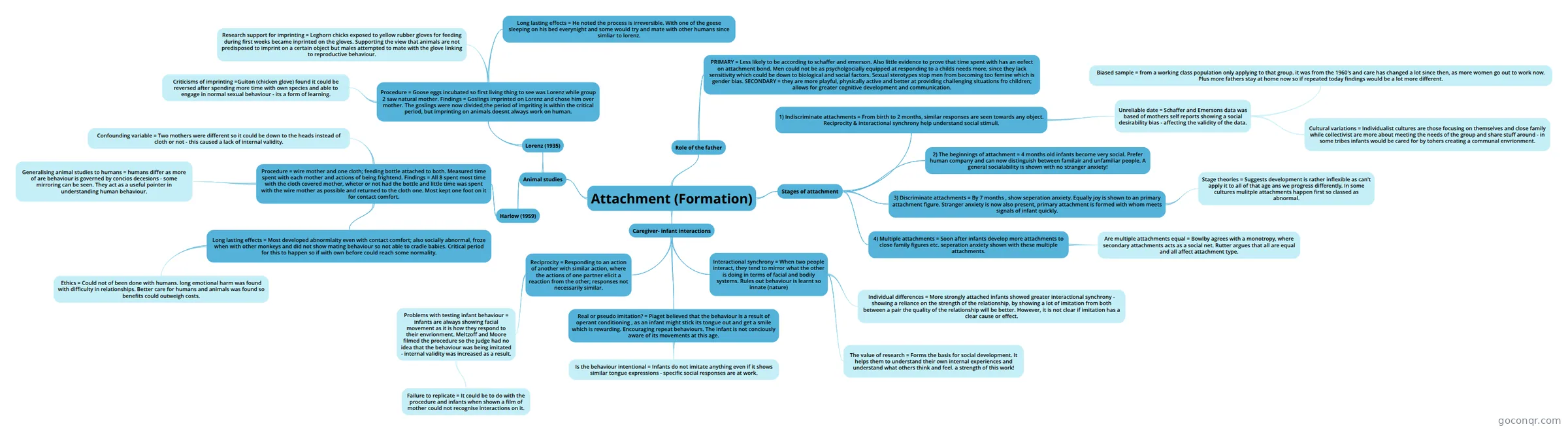
Mind map: Attachment formation psychology
Conteúdo do mapa
Attachment (Formation)
Caregiver- infant interactions
- Reciprocity = Responding to an action of another with similar action, where the actions of one partner elicit a reaction from the other; responses not necessarily similar.
- Problems with testing infant behaviour = infants are always showing facial movement as it is how they respond to their envrionment. Meltzoff and Moore filmed the procedure so the judge had no idea that the behaviour was being imitated - internal validity was increased as a result.
- Failure to replicate = It could be to do with the procedure and infants when shown a film of mother could not recognise interactions on it.
- Problems with testing infant behaviour = infants are always showing facial movement as it is how they respond to their envrionment. Meltzoff and Moore filmed the procedure so the judge had no idea that the behaviour was being imitated - internal validity was increased as a result.
- Interactional synchrony = When two people interact, they tend to mirror what the other is doing in terms of facial and bodily systems. Rules out behaviour is learnt so innate (nature)
- Individual differences = More strongly attached infants showed greater interactional synchrony - showing a reliance on the strength of the relationship, by showing a lot of imitation from both between a pair the quality of the relationship will be better. However, it is not clear if imitation has a clear cause or effect.
- The value of research = Forms the basis for social development. It helps them to understand their own internal experiences and understand what others think and feel. a strength of this work!
- Real or pseudo imitation? = Piaget believed that the behaviour is a result of operant conditioning , as an infant might stick its tongue out and get a smile which is rewarding. Encouraging repeat behaviours. The infant is not conciously aware of its movements at this age.
- Is the behaviour intentional = Infants do not imitate anything even if it shows similar tongue expressions - specific social responses are at work.
- Reciprocity = Responding to an action of another with similar action, where the actions of one partner elicit a reaction from the other; responses not necessarily similar.
Stages of attachment
- 1) Indiscriminate attachments = From birth to 2 months, similar responses are seen towards any object. Reciprocity & interactional synchrony help understand social stimuli.
- Unreliable date = Schaffer and Emersons data was based of mothers self reports showing a social desirability bias - affecting the validity of the data.
- Biased sample = from a working class population only applying to that group. it was from the 1960's and care has changed a lot since then, as more women go out to work now. Plus more fathers stay at home now so if repeated today findings would be a lot more different.
- Cultural variations = Individualist cultures are those focusing on themselves and close family while collectivist are more about meeting the needs of the group and share stuff around - in some tribes infants would be cared for by tohers creating a communal envrionment.
- Unreliable date = Schaffer and Emersons data was based of mothers self reports showing a social desirability bias - affecting the validity of the data.
- 2) The beginnings of attachment = 4 months old infants become very social. Prefer human company and can now distinguish between familair and unfamiliar people. A general socialability is shown with no stranger anxiety!
- 3) Discriminate attachments = By 7 months , show seperation anxiety. Equally joy is shown to an primary attachment figure. Stranger anxiety is now also present, primary attachment is formed with whom meets signals of infant quickly.
- Stage theories = Suggests development is rather inflexible as can't apply it to all of that age ans we progress differently. In some cultures mulitple attachments happen first so classed as abnormal.
- 4) Multiple attachments = Soon after infants develop more attachments to close family figures etc. seperation anxiety shown with these multiple attachments.
- Are multiple attachments equal = Bowlby agrees with a monotropy, where secondary attachments acts as a social net. Rutter argues that all are equal and all affect attachment type.
- 1) Indiscriminate attachments = From birth to 2 months, similar responses are seen towards any object. Reciprocity & interactional synchrony help understand social stimuli.
Role of the father
- PRIMARY = Less likely to be according to schaffer and emerson. Also little evidence to prove that time spent with has an eefect on attachment bond. Men could not be as psycholgocially equipped at responding to a childs needs more, since they lack sensitivity which could be down to biological and social factors. Sexual sterotypes stop men from becoming too femine which is gender bias. SECONDARY = they are more playful, physically active and better at providing challenging situations fro children; allows for greater cognitive development and communication.
Animal studies
- Lorenz (1935)
- Procedure = Goose eggs incubated so first living thing to see was Lorenz while group 2 saw natural mother. Findings = Goslings imprinted on Lorenz and chose him over mother. The goslings were now divided,the period of impriting is within the critical period, but imprinting on animals doesnt always work on human.
- Long lasting effects = He noted the process is irreversible. With one of the geese sleeping on his bed everynight and some would try and mate with other humans since simliar to lorenz.
- Research support for imprinting = Leghorn chicks exposed to yellow rubber gloves for feeding during first weeks became inprinted on the gloves. Supporting the view that animals are not predisposed to imprint on a certain object but males attempted to mate with the glove linking to reproductive behaviour.
- Criticisms of imprinting =Guiton (chicken glove) found it could be reversed after spending more time with own species and able to engage in normal sexual behaviour - its a form of learning.
- Procedure = Goose eggs incubated so first living thing to see was Lorenz while group 2 saw natural mother. Findings = Goslings imprinted on Lorenz and chose him over mother. The goslings were now divided,the period of impriting is within the critical period, but imprinting on animals doesnt always work on human.
- Harlow (1959)
- Procedure = wire mother and one cloth; feeding bottle attached to both. Measured time spent with each mother and actions of being frightend. Findings = All 8 spent most time with the cloth covered mother, wheter or not had the bottle and little time was spent with the wire mother as possible and returned to the cloth one. Most kept one foot on it for contact comfort.
- Long lasting effects = Most developed abnormlaity even with contact comfort; also socially abnormal, froze when with other monkeys and did not show mating behaviour so not able to cradle babies. Critical period for this to happen so if with own before could reach some normality.
- Ethics = Could not of been done with humans. long emotional harm was found with difficulty in relationships. Better care for humans and animals was found so benefits could outweigh costs.
- Confounding variable = Two mothers were different so it could be down to the heads instead of cloth or not - this caused a lack of internal validity.
- Generalising animal studies to humans = humans differ as more of are behaviour is governed by concios decesions - some mirroring can be seen. They act as a useful pointer in understanding human behaviour.
- Long lasting effects = Most developed abnormlaity even with contact comfort; also socially abnormal, froze when with other monkeys and did not show mating behaviour so not able to cradle babies. Critical period for this to happen so if with own before could reach some normality.
- Procedure = wire mother and one cloth; feeding bottle attached to both. Measured time spent with each mother and actions of being frightend. Findings = All 8 spent most time with the cloth covered mother, wheter or not had the bottle and little time was spent with the wire mother as possible and returned to the cloth one. Most kept one foot on it for contact comfort.
- Lorenz (1935)
Informações
- Descrição
- A level Psychology Mapa Mental sobre Attachment (Formation), criado por Connor Liken em 06-06-2017.
- Criado por
- Connor Liken
- Visualizações
- 0
- Avaliação