
Mapa mental
Muscles moving the Axial Skeleton
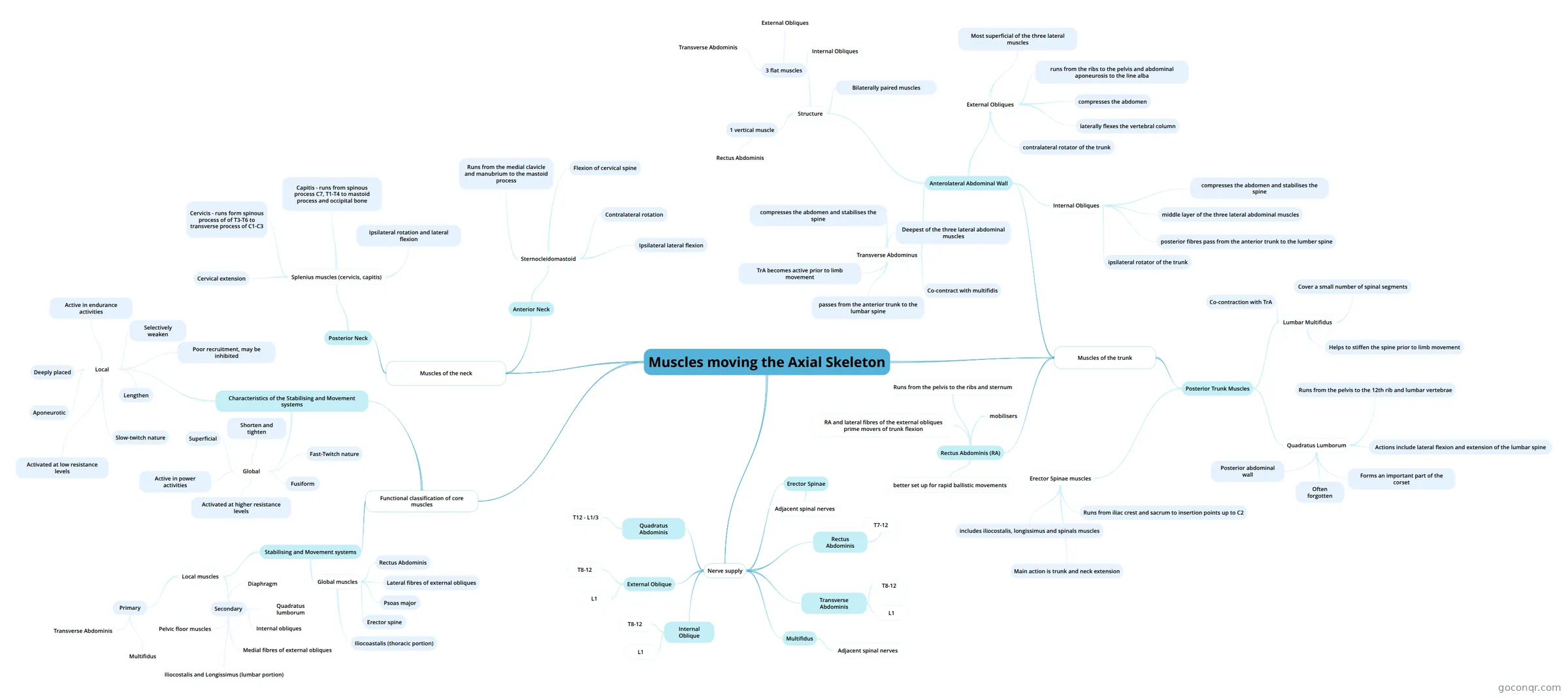
Mind map: Muscles moving the Axial Skeleton
Conteúdo do mapa
Muscles moving the Axial Skeleton
Muscles of the neck
- Anterior Neck
- Sternocleidomastoid
- Runs from the medial clavicle and manubrium to the mastoid process
- Flexion of cervical spine
- Contralateral rotation
- Ipsilateral lateral flexion
- Sternocleidomastoid
- Posterior Neck
- Splenius muscles (cervicis, capitis)
- Cervicis - runs form spinous process of of T3-T6 to transverse process of C1-C3
- Capitis - runs from spinous process C7, T1-T4 to mastoid process and occipital bone
- Cervical extension
- Ipsilateral rotation and lateral flexion
- Splenius muscles (cervicis, capitis)
- Anterior Neck
Muscles of the trunk
- Anterolateral Abdominal Wall
- Structure
- Bilaterally paired muscles
- 3 flat muscles
- External Obliques
- Internal Obliques
- Transverse Abdominis
- 1 vertical muscle
- Rectus Abdominis
- External Obliques
- Most superficial of the three lateral muscles
- runs from the ribs to the pelvis and abdominal aponeurosis to the line alba
- compresses the abdomen
- laterally flexes the vertebral column
- contralateral rotator of the trunk
- Internal Obliques
- middle layer of the three lateral abdominal muscles
- posterior fibres pass from the anterior trunk to the lumber spine
- compresses the abdomen and stabilises the spine
- ipsilateral rotator of the trunk
- Transverse Abdominus
- Deepest of the three lateral abdominal muscles
- passes from the anterior trunk to the lumbar spine
- compresses the abdomen and stabilises the spine
- TrA becomes active prior to limb movement
- Co-contract with multifidis
- Structure
- Rectus Abdominis (RA)
- Runs from the pelvis to the ribs and sternum
- RA and lateral fibres of the external obliques prime movers of trunk flexion
- mobilisers
- better set up for rapid ballistic movements
- Posterior Trunk Muscles
- Quadratus Lumborum
- Posterior abdominal wall
- Often forgotten
- Forms an important part of the corset
- Runs from the pelvis to the 12th rib and lumbar vertebrae
- Actions include lateral flexion and extension of the lumbar spine
- Erector Spinae muscles
- includes iliocostalis, longissimus and spinals muscles
- Runs from iliac crest and sacrum to insertion points up to C2
- Main action is trunk and neck extension
- Lumbar Multifidus
- Cover a small number of spinal segments
- Helps to stiffen the spine prior to limb movement
- Co-contraction with TrA
- Quadratus Lumborum
- Anterolateral Abdominal Wall
Nerve supply
- External Oblique
- T8-12
- L1
- Internal Oblique
- T8-12
- L1
- Transverse Abdominis
- T8-12
- L1
- Rectus Abdominis
- T7-12
- Quadratus Abdominis
- T12 - L1/3
- Erector Spinae
- Adjacent spinal nerves
- Multifidus
- Adjacent spinal nerves
- External Oblique
Functional classification of core muscles
- Stabilising and Movement systems
- Local muscles
- Primary
- Transverse Abdominis
- Multifidus
- Secondary
- Internal obliques
- Medial fibres of external obliques
- Quadratus lumborum
- Diaphragm
- Pelvic floor muscles
- Iliocostalis and Longissimus (lumbar portion)
- Primary
- Global muscles
- Rectus Abdominis
- Lateral fibres of external obliques
- Psoas major
- Erector spine
- Iliocoastalis (thoracic portion)
- Local muscles
- Characteristics of the Stabilising and Movement systems
- Local
- Deeply placed
- Aponeurotic
- Slow-twitch nature
- Active in endurance activities
- Selectively weaken
- Poor recruitment, may be inhibited
- Activated at low resistance levels
- Lengthen
- Global
- Superficial
- Fusiform
- Fast-Twitch nature
- Active in power activities
- Shorten and tighten
- Activated at higher resistance levels
- Local
- Stabilising and Movement systems
Informações
- Descrição
- Sport Science Mapa Mental sobre Muscles moving the Axial Skeleton, criado por Mikayla Winfield em 31-10-2018.
- Criado por
- Mikayla Winfield
- Visualizações
- 1
- Avaliação