
Mapa mental
A critical understanding of policy practice and service
Conteúdo do mapa
A critical understanding of policy practice and service
Changing concepts of what childhood means
- The end of childhood
- Ideas about childhood:-17th century's apprentinceship, 18th c's enlightment fundamental innocence, children seen as people in their own right, 19th c.protection,learner, 20th c.future prosperity and wellbeing of nations
- photographs reflects changes in social attitudes
- Ideas about childhood:-17th century's apprentinceship, 18th c's enlightment fundamental innocence, children seen as people in their own right, 19th c.protection,learner, 20th c.future prosperity and wellbeing of nations
- Social constructionism: knowledge and culture (such as what is the difference between childhood and adulthood) is produced through language and discourse
- Language and discourse vary across time and space:So ideas about childhood as distinct from adulthood are not fixed
- the language we use actively constructs and produces the social world in which we live.
- gender,skin tone, ethnicity,age
- can attain a taken for granted status, reinforced by that eras legislation and policy, prevailing cultural values and societal expectations of men and women, children and adults
- transition to adulthood
- often marked by physiological changes,
- gender,skin tone, ethnicity,age
- the language we use actively constructs and produces the social world in which we live.
- several dominant constructions of children and young people in which they are seen as apprentices, separate from adults, innocent and in need of protection but as part of 'our future'.
- The way in which we see and understand children and young people has an impact on how we treat them, care for them and work with them
- meanings and identities are co-constructed in culturally diverse societies
- Language and discourse vary across time and space:So ideas about childhood as distinct from adulthood are not fixed
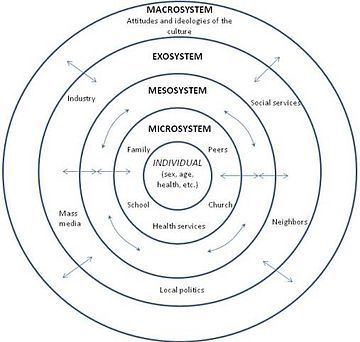
- Social ecological theory :Brofennbrenner
- The end of childhood
families have changed and continue to change
- Ronaldo, nuclear family, extended family, same gender families
- ideas about mothers’ and fathers’ roles have differed
- quality of parenting
- Supporting parenting
- respond to diversity in parenting within practice and assessment
- ideas about mothers’ and fathers’ roles have differed
- Changes in the economy, and society more generally, have accompanied significant changes in family life through the twentieth and into the twenty-first century
- working mothers, better education, higher incomes
- families are seen as fundamental to a society, and families are therefore a focus of public concern and social policy
- it isn’t necessarily what a family looks like but what happens within
- biological or genetic ties are often seen to be important have a powerful impact on how children, young people and adults perceive their families
- give us a sense of belonging to a place and continuity with the past.
- Understanding the importance of ‘roots’ to identity is important in working with children and young people who feel dislocated from their family and its history
- Young carers:children and young people [under 18] who provide or intend to provide a substantial amount of care on a regular basis
- can be reluctant to disclose their situation
- family form does not necessarily determine whether a family is a safe or a hazardous space for children
- working with the whole family, particularly the parents, is a crucial part of caring for children and young people
- important that practitioners are able to assess families where there are difficulties and respond appropriately
- The surveillance of children, young people and families
- not power neutral
- children and young people are monitored in relation to their general development, their behaviour and activities, their health status and their educational attainment
- early (possibly even antenatal) intervention
- when practitioners can intervene in families lives, and the duties that they owe
- Ronaldo, nuclear family, extended family, same gender families