
Mapa mental
Relationship between sexual selection and human reproductive behaviour
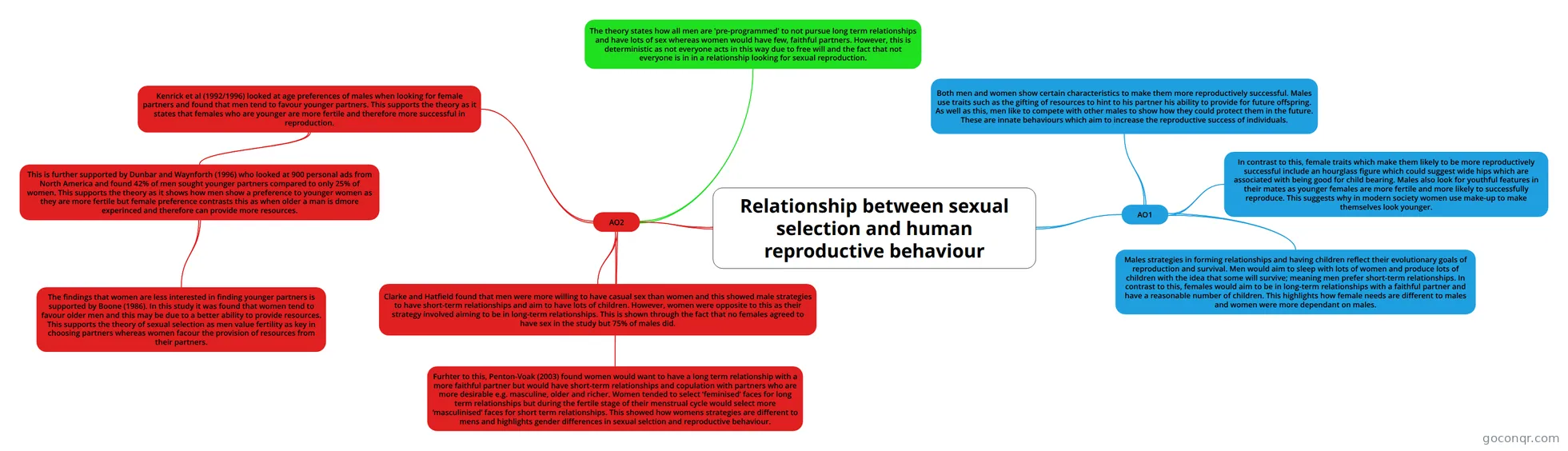
Mind map: sexual selection and human reproductive behaviour
Conteúdo do mapa
Relationship between sexual selection and human reproductive behaviour
AO1
- Both men and women show certain characteristics to make them more reproductively successful. Males use traits such as the gifting of resources to hint to his partner his ability to provide for future offspring. As well as this, men like to compete with other males to show how they could protect them in the future. These are innate behaviours which aim to increase the reproductive success of individuals.
- In contrast to this, female traits which make them likely to be more reproductively successful include an hourglass figure which could suggest wide hips which are associated with being good for child bearing. Males also look for youthful features in their mates as younger females are more fertile and more likely to successfully reproduce. This suggests why in modern society women use make-up to make themselves look younger.
- Males strategies in forming relationships and having children reflect their evolutionary goals of reproduction and survival. Men would aim to sleep with lots of women and produce lots of children with the idea that some will survive; meaning men prefer short-term relationships. In contrast to this, females would aim to be in long-term relationships with a faithful partner and have a reasonable number of children. This highlights how female needs are different to males and women were more dependant on males.
AO2
- Kenrick et al (1992/1996) looked at age preferences of males when looking for female partners and found that men tend to favour younger partners. This supports the theory as it states that females who are younger are more fertile and therefore more successful in reproduction.
- This is further supported by Dunbar and Waynforth (1996) who looked at 900 personal ads from North America and found 42% of men sought younger partners compared to only 25% of women. This supports the theory as it shows how men show a preference to younger women as they are more fertile but female preference contrasts this as when older a man is dmore experinced and therefore can provide more resources.
- The findings that women are less interested in finding younger partners is supported by Boone (1986). In this study it was found that women tend to favour older men and this may be due to a better ability to provide resources. This supports the theory of sexual selection as men value fertility as key in choosing partners whereas women facour the provision of resources from their partners.
- This is further supported by Dunbar and Waynforth (1996) who looked at 900 personal ads from North America and found 42% of men sought younger partners compared to only 25% of women. This supports the theory as it shows how men show a preference to younger women as they are more fertile but female preference contrasts this as when older a man is dmore experinced and therefore can provide more resources.
- Clarke and Hatfield found that men were more willing to have casual sex than women and this showed male strategies to have short-term relationships and aim to have lots of children. However, women were opposite to this as their strategy involved aiming to be in long-term relationships. This is shown through the fact that no females agreed to have sex in the study but 75% of males did.
- Furhter to this, Penton-Voak (2003) found women would want to have a long term relationship with a more faithful partner but would have short-term relationships and copulation with partners who are more desirable e.g. masculine, older and richer. Women tended to select ‘feminised’ faces for long term relationships but during the fertile stage of their menstrual cycle would select more ‘masculinised’ faces for short term relationships. This showed how womens strategies are different to mens and highlights gender differences in sexual selction and reproductive behaviour.
- The theory states how all men are 'pre-programmed' to not pursue long term relationships and have lots of sex whereas women would have few, faithful partners. However, this is deterministic as not everyone acts in this way due to free will and the fact that not everyone is in in a relationship looking for sexual reproduction.
- Kenrick et al (1992/1996) looked at age preferences of males when looking for female partners and found that men tend to favour younger partners. This supports the theory as it states that females who are younger are more fertile and therefore more successful in reproduction.
Informações
- Descrição
- A level PSYA3 Mapa Mental sobre Relationship between sexual selection and human reproductive behaviour, criado por jhough em 28-05-2015.
- Criado por
- jhough
- Visualizações
- 3
- Avaliação
Mais sobre Sexual selection and partner preferences