
Mapa mental
Evaluations: Relationships
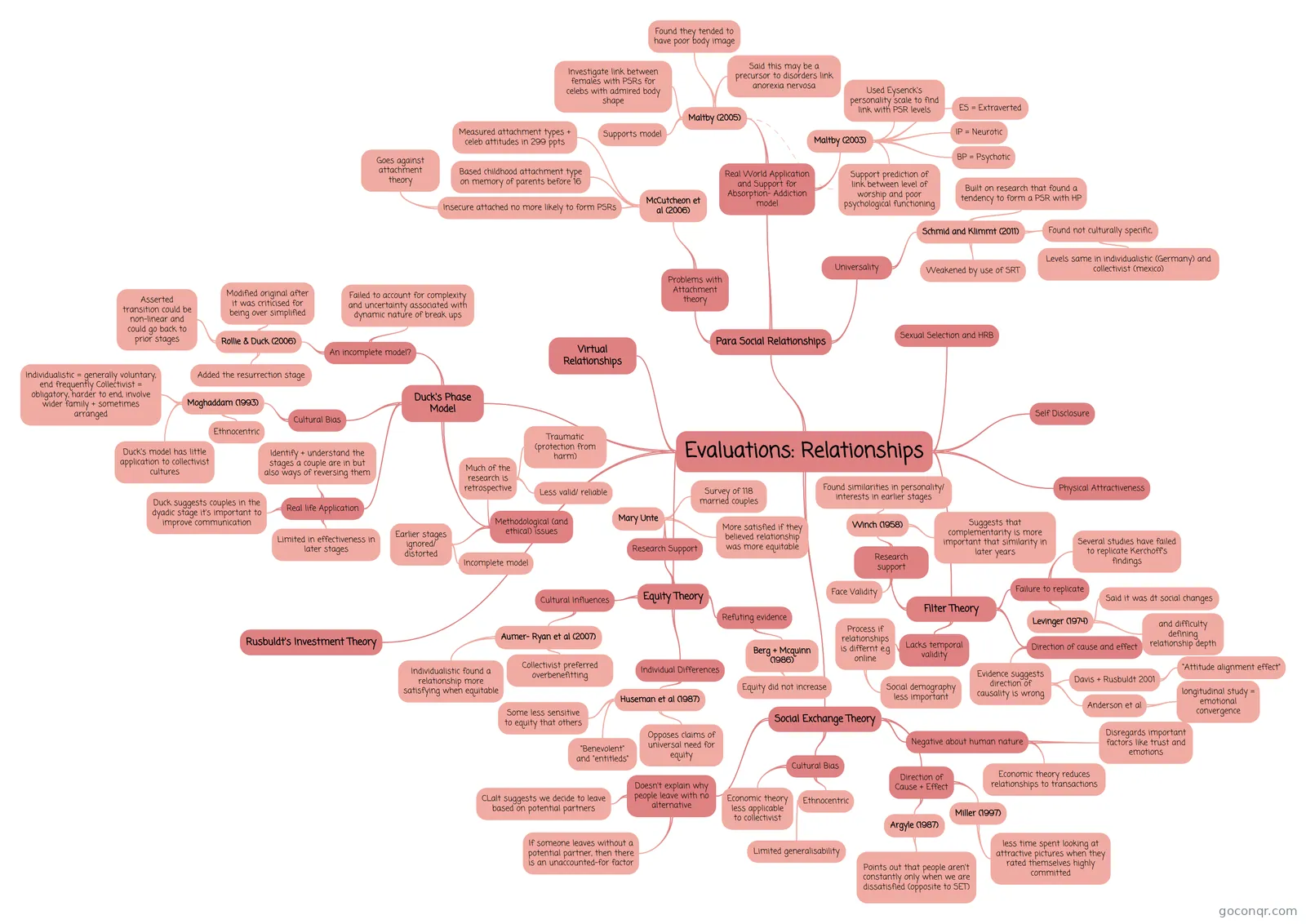
Mind map: evaluations of relationships
Conteúdo do mapa
Evaluations: Relationships
Para Social Relationships
- Real World Application and Support for Absorption- Addiction model
- Maltby (2005)
- Investigate link between females with PSRs for celebs with admired body shape
- Found they tended to have poor body image
- Said this may be a precursor to disorders link anorexia nervosa
- Supports model
- Maltby (2003)
- Used Eysenck's personality scale to find link with PSR levels
- ES = Extraverted
- IP = Neurotic
- BP = Psychotic
- Support prediction of link between level of worship and poor psychological functioning
- Maltby (2005)
- Universality
- Schmid and Klimmt (2011)
- Built on research that found a tendency to form a PSR with HP
- Found not culturally specific,
- Levels same in individualistic (Germany) and collectivist (mexico)
- Weakened by use of SRT
- Schmid and Klimmt (2011)
- Problems with Attachment theory
- McCutcheon et al (2006)
- Measured attachment types + celeb attitudes in 299 ppts
- Based childhood attachment type on memory of parents before 16
- Insecure attached no more likely to form PSRs
- Goes against attachment theory
- McCutcheon et al (2006)
- Real World Application and Support for Absorption- Addiction model
Duck's Phase Model
- An incomplete model?
- Rollie & Duck (2006)
- Modified original after it was criticised for being over simplified
- Added the resurrection stage
- Asserted transition could be non-linear and could go back to prior stages
- Failed to account for complexity and uncertainty associated with dynamic nature of break ups
- Rollie & Duck (2006)
- Cultural Bias
- Moghaddam (1993)
- Individualistic = generally voluntary, end frequently Collectivist = obligatory, harder to end, involve wider family + sometimes arranged
- Duck's model has little application to collectivist cultures
- Ethnocentric
- Moghaddam (1993)
- Real life Application
- Identify + understand the stages a couple are in but also ways of reversing them
- Duck suggests couples in the dyadic stage it's important to improve communication
- Limited in effectiveness in later stages
- Methodological (and ethical) issues
- Much of the research is retrospective
- Traumatic (protection from harm)
- Less valid/ reliable
- Earlier stages ignored/ distorted
- Incomplete model
- Much of the research is retrospective
- An incomplete model?
Virtual Relationships
Rusbuldt's Investment Theory
Social Exchange Theory
- Doesn't explain why people leave with no alternative
- CLalt suggests we decide to leave based on potential partners
- If someone leaves without a potential partner, then there is an unaccounted-for factor
- Cultural Bias
- Economic theory less applicable to collectivist
- Ethnocentric
- Limited generalisability
- Direction of Cause + Effect
- Argyle (1987)
- Points out that people aren't constantly only when we are dissatisfied (opposite to SET)
- Miller (1997)
- less time spent looking at attractive pictures when they rated themselves highly committed
- Argyle (1987)
- Negative about human nature
- Economic theory reduces relationships to transactions
- Disregards important factors like trust and emotions
- Doesn't explain why people leave with no alternative
Equity Theory
- Research Support
- Mary Unte
- Survey of 118 married couples
- More satisfied if they believed relationship was more equitable
- Mary Unte
- Cultural Influences
- Aumer- Ryan et al (2007)
- Individualistic found a relationship more satisfying when equitable
- Collectivist preferred overbenefitting
- Aumer- Ryan et al (2007)
- Individual Differences
- Huseman et al (1987)
- Some less sensitive to equity that others
- "Benevolent" and "entitleds"
- Opposes claims of universal need for equity
- Huseman et al (1987)
- Refuting evidence
- Berg + Mcquinn (1986)
- Equity did not increase
- Berg + Mcquinn (1986)
- Research Support
Filter Theory
- Lacks temporal validity
- Process if relationships is differnt e.g online
- Social demography less important
- Process if relationships is differnt e.g online
- Direction of cause and effect
- Evidence suggests direction of causality is wrong
- Anderson et al
- longitudinal study = emotional convergence
- Davis + Rusbuldt 2001
- "Attitude alignment effect"
- Anderson et al
- Evidence suggests direction of causality is wrong
- Failure to replicate
- Levinger (1974)
- Said it was dt social changes
- and difficulty defining relationship depth
- Several studies have failed to replicate Kerchoff's findings
- Levinger (1974)
- Research support
- Winch (1958)
- Found similarities in personality/ interests in earlier stages
- Suggests that complementarity is more important that similarity in later years
- Face Validity
- Winch (1958)
- Lacks temporal validity
Physical Attractiveness
Self Disclosure
Sexual Selection and HRB
Informações
- Descrição
- A level Psychology (Relationships Y13) Mapa Mental sobre Evaluations: Relationships, criado por Ellie Harvey em 16-11-2022.
- Criado por
- Ellie Harvey
- Visualizações
- 0
- Avaliação