
Mapa mental
Reinforcement Affect Model - Maintenance
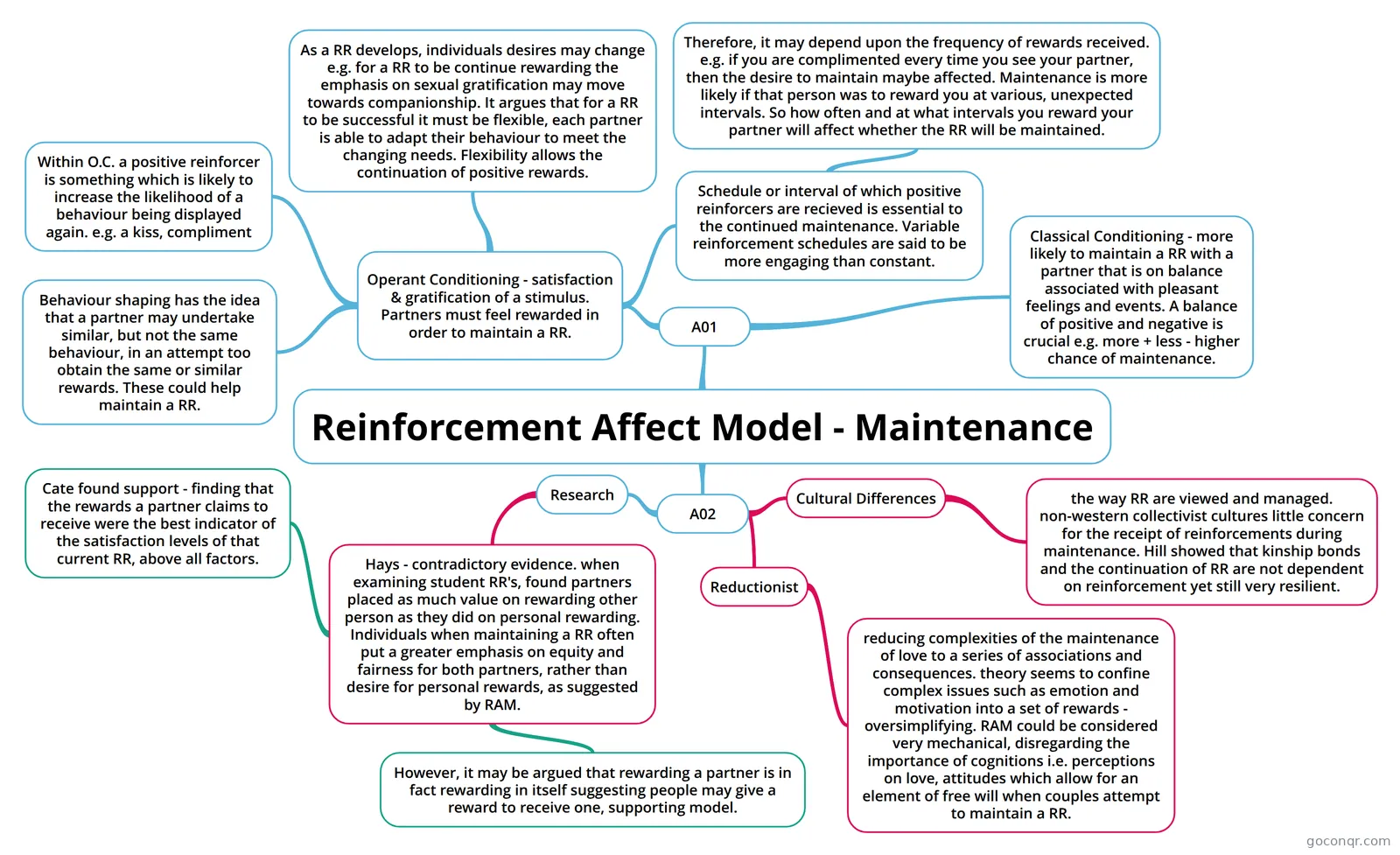
Mind map: Reinforcement affect model maintenance
Conteúdo do mapa
Reinforcement Affect Model - Maintenance
A01
- Classical Conditioning - more likely to maintain a RR with a partner that is on balance associated with pleasant feelings and events. A balance of positive and negative is crucial e.g. more + less - higher chance of maintenance.
- Operant Conditioning - satisfaction & gratification of a stimulus. Partners must feel rewarded in order to maintain a RR.
- As a RR develops, individuals desires may change e.g. for a RR to be continue rewarding the emphasis on sexual gratification may move towards companionship. It argues that for a RR to be successful it must be flexible, each partner is able to adapt their behaviour to meet the changing needs. Flexibility allows the continuation of positive rewards.
- Within O.C. a positive reinforcer is something which is likely to increase the likelihood of a behaviour being displayed again. e.g. a kiss, compliment
- Schedule or interval of which positive reinforcers are recieved is essential to the continued maintenance. Variable reinforcement schedules are said to be more engaging than constant.
- Therefore, it may depend upon the frequency of rewards received. e.g. if you are complimented every time you see your partner, then the desire to maintain maybe affected. Maintenance is more likely if that person was to reward you at various, unexpected intervals. So how often and at what intervals you reward your partner will affect whether the RR will be maintained.
- Behaviour shaping has the idea that a partner may undertake similar, but not the same behaviour, in an attempt too obtain the same or similar rewards. These could help maintain a RR.
A02
- Reductionist
- reducing complexities of the maintenance of love to a series of associations and consequences. theory seems to confine complex issues such as emotion and motivation into a set of rewards - oversimplifying. RAM could be considered very mechanical, disregarding the importance of cognitions i.e. perceptions on love, attitudes which allow for an element of free will when couples attempt to maintain a RR.
- Cultural Differences
- the way RR are viewed and managed. non-western collectivist cultures little concern for the receipt of reinforcements during maintenance. Hill showed that kinship bonds and the continuation of RR are not dependent on reinforcement yet still very resilient.
- Research
- Hays - contradictory evidence. when examining student RR's, found partners placed as much value on rewarding other person as they did on personal rewarding. Individuals when maintaining a RR often put a greater emphasis on equity and fairness for both partners, rather than desire for personal rewards, as suggested by RAM.
- Cate found support - finding that the rewards a partner claims to receive were the best indicator of the satisfaction levels of that current RR, above all factors.
- However, it may be argued that rewarding a partner is in fact rewarding in itself suggesting people may give a reward to receive one, supporting model.
- Hays - contradictory evidence. when examining student RR's, found partners placed as much value on rewarding other person as they did on personal rewarding. Individuals when maintaining a RR often put a greater emphasis on equity and fairness for both partners, rather than desire for personal rewards, as suggested by RAM.
- Reductionist
Informações
- Descrição
- A-Level Psychology (Printed) Mapa Mental sobre Reinforcement Affect Model - Maintenance, criado por Sophie Edroff em 13-11-2015.
- Criado por
- Sophie Edroff
- Visualizações
- 0
- Avaliação