
Mapa mental
Sexual Selection
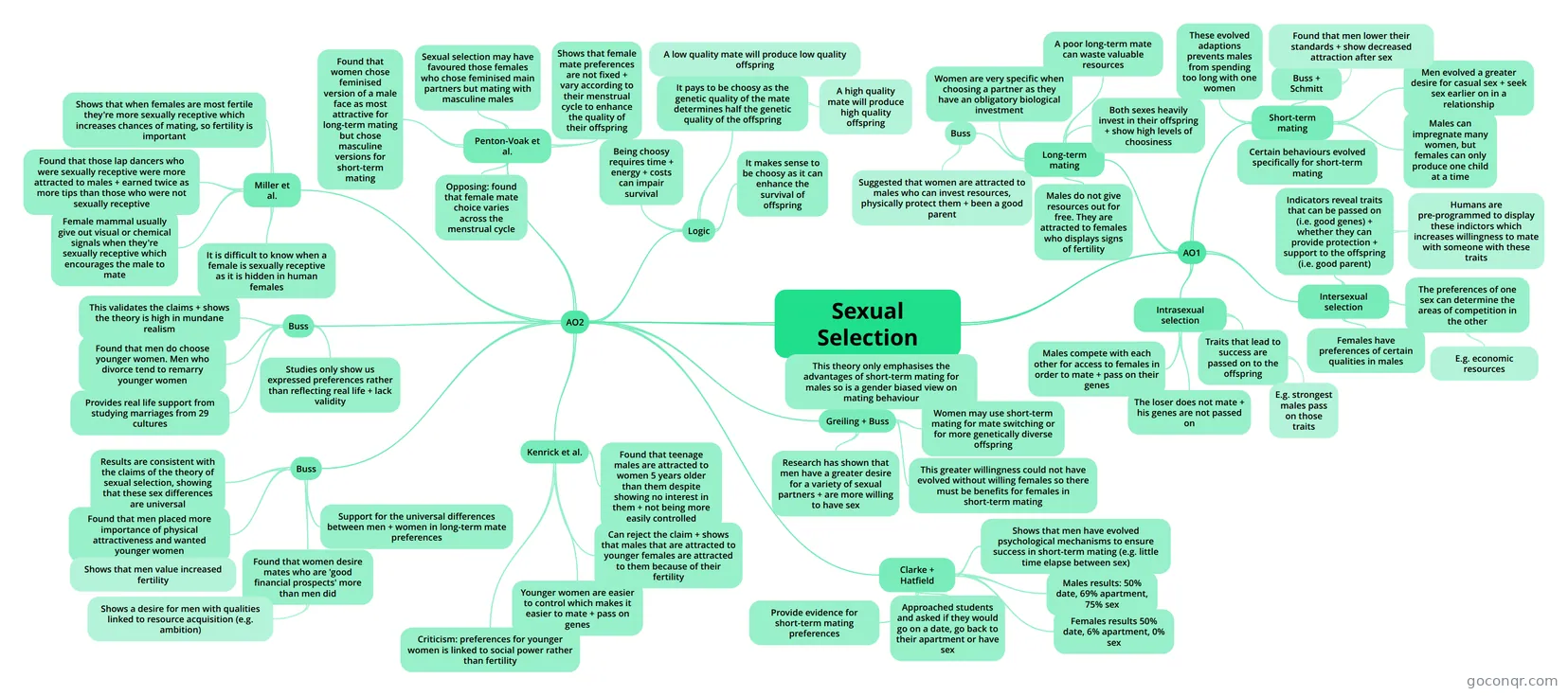
Mind map: Sexual Selection
Conteúdo do mapa
Sexual Selection
AO1
- Intrasexual selection
- Males compete with each other for access to females in order to mate + pass on their genes
- The loser does not mate + his genes are not passed on
- Traits that lead to success are passed on to the offspring
- E.g. strongest males pass on those traits
- Intersexual selection
- Females have preferences of certain qualities in males
- The preferences of one sex can determine the areas of competition in the other
- E.g. economic resources
- Indicators reveal traits that can be passed on (i.e. good genes) + whether they can provide protection + support to the offspring (i.e. good parent)
- Humans are pre-programmed to display these indictors which increases willingness to mate with someone with these traits
- Short-term mating
- Certain behaviours evolved specifically for short-term mating
- Males can impregnate many women, but females can only produce one child at a time
- Men evolved a greater desire for casual sex + seek sex earlier on in a relationship
- Buss + Schmitt
- Found that men lower their standards + show decreased attraction after sex
- These evolved adaptions prevents males from spending too long with one women
- Long-term mating
- Both sexes heavily invest in their offspring + show high levels of choosiness
- A poor long-term mate can waste valuable resources
- Women are very specific when choosing a partner as they have an obligatory biological investment
- Buss
- Suggested that women are attracted to males who can invest resources, physically protect them + been a good parent
- Males do not give resources out for free. They are attracted to females who displays signs of fertility
- Intrasexual selection
AO2
- Buss
- Support for the universal differences between men + women in long-term mate preferences
- Found that women desire mates who are 'good financial prospects' more than men did
- Shows a desire for men with qualities linked to resource acquisition (e.g. ambition)
- Found that men placed more importance of physical attractiveness and wanted younger women
- Shows that men value increased fertility
- Results are consistent with the claims of the theory of sexual selection, showing that these sex differences are universal
- Kenrick et al.
- Criticism: preferences for younger women is linked to social power rather than fertility
- Younger women are easier to control which makes it easier to mate + pass on genes
- Found that teenage males are attracted to women 5 years older than them despite showing no interest in them + not being more easily controlled
- Can reject the claim + shows that males that are attracted to younger females are attracted to them because of their fertility
- Clarke + Hatfield
- Provide evidence for short-term mating preferences
- Approached students and asked if they would go on a date, go back to their apartment or have sex
- Females results 50% date, 6% apartment, 0% sex
- Males results: 50% date, 69% apartment, 75% sex
- Shows that men have evolved psychological mechanisms to ensure success in short-term mating (e.g. little time elapse between sex)
- Buss
- Studies only show us expressed preferences rather than reflecting real life + lack validity
- Provides real life support from studying marriages from 29 cultures
- Found that men do choose younger women. Men who divorce tend to remarry younger women
- This validates the claims + shows the theory is high in mundane realism
- Miller et al.
- It is difficult to know when a female is sexually receptive as it is hidden in human females
- Female mammal usually give out visual or chemical signals when they're sexually receptive which encourages the male to mate
- Found that those lap dancers who were sexually receptive were more attracted to males + earned twice as more tips than those who were not sexually receptive
- Shows that when females are most fertile they're more sexually receptive which increases chances of mating, so fertility is important
- Penton-Voak et al.
- Opposing: found that female mate choice varies across the menstrual cycle
- Found that women chose feminised version of a male face as most attractive for long-term mating but chose masculine versions for short-term mating
- Sexual selection may have favoured those females who chose feminised main partners but mating with masculine males
- Shows that female mate preferences are not fixed + vary according to their menstrual cycle to enhance the quality of their offspring
- Logic
- Being choosy requires time + energy + costs can impair survival
- It pays to be choosy as the genetic quality of the mate determines half the genetic quality of the offspring
- A low quality mate will produce low quality offspring
- A high quality mate will produce high quality offspring
- It makes sense to be choosy as it can enhance the survival of offspring
- Greiling + Buss
- Research has shown that men have a greater desire for a variety of sexual partners + are more willing to have sex
- This greater willingness could not have evolved without willing females so there must be benefits for females in short-term mating
- Women may use short-term mating for mate switching or for more genetically diverse offspring
- This theory only emphasises the advantages of short-term mating for males so is a gender biased view on mating behaviour
- Buss
Informações
- Descrição
- Psychology Mapa Mental sobre Sexual Selection, criado por Balinder em 09-04-2014.
- Criado por
- Balinder
- Visualizações
- 12
- Tags
- Avaliação
Mais sobre Sexual selection and partner preferences