
Mapa mental
The study of Language Functions
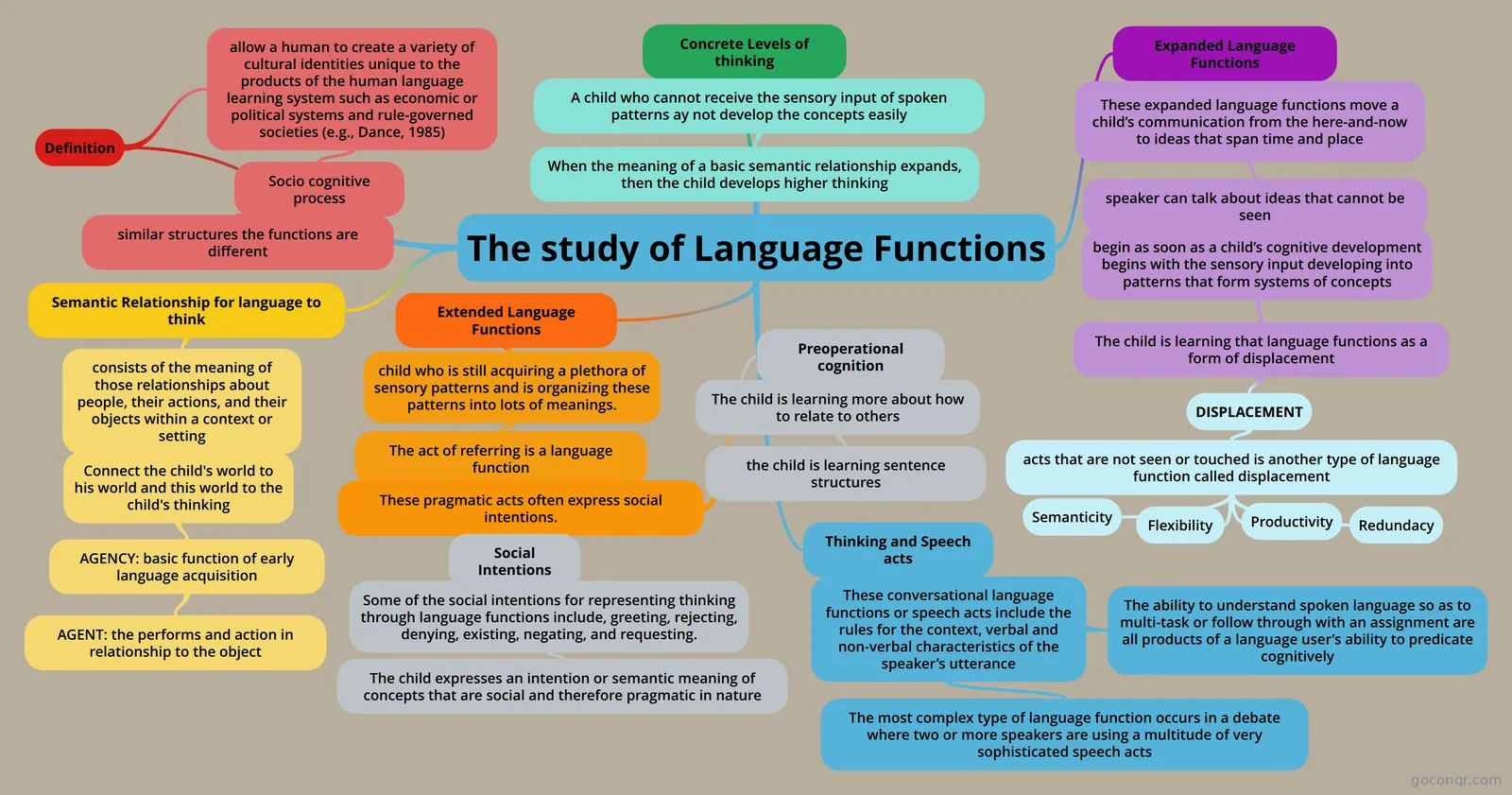
Mind map: The study of language functions
Conteúdo do mapa
The study of Language Functions
Definition
- allow a human to create a variety of cultural identities unique to the products of the human language learning system such as economic or political systems and rule-governed societies (e.g., Dance, 1985)
- Socio cognitive process
- similar structures the functions are different
- Socio cognitive process
- allow a human to create a variety of cultural identities unique to the products of the human language learning system such as economic or political systems and rule-governed societies (e.g., Dance, 1985)
Semantic Relationship for language to think
- consists of the meaning of those relationships about people, their actions, and their objects within a context or setting
- Connect the child's world to his world and this world to the child's thinking
- AGENCY: basic function of early language acquisition
- AGENT: the performs and action in relationship to the object
- AGENCY: basic function of early language acquisition
- Connect the child's world to his world and this world to the child's thinking
- consists of the meaning of those relationships about people, their actions, and their objects within a context or setting
Concrete Levels of thinking
- A child who cannot receive the sensory input of spoken patterns ay not develop the concepts easily
- When the meaning of a basic semantic relationship expands, then the child develops higher thinking
- A child who cannot receive the sensory input of spoken patterns ay not develop the concepts easily
Expanded Language Functions
- These expanded language functions move a child’s communication from the here-and-now to ideas that span time and place
- speaker can talk about ideas that cannot be seen
- begin as soon as a child’s cognitive development begins with the sensory input developing into patterns that form systems of concepts
- The child is learning that language functions as a form of displacement
- DISPLACEMENT
- acts that are not seen or touched is another type of language function called displacement
- Semanticity
- Flexibility
- Productivity
- Redundacy
- acts that are not seen or touched is another type of language function called displacement
- DISPLACEMENT
- The child is learning that language functions as a form of displacement
- begin as soon as a child’s cognitive development begins with the sensory input developing into patterns that form systems of concepts
- speaker can talk about ideas that cannot be seen
- These expanded language functions move a child’s communication from the here-and-now to ideas that span time and place
Extended Language Functions
- child who is still acquiring a plethora of sensory patterns and is organizing these patterns into lots of meanings.
- The act of referring is a language function
- These pragmatic acts often express social intentions.
- Social Intentions
- Some of the social intentions for representing thinking through language functions include, greeting, rejecting, denying, existing, negating, and requesting.
- The child expresses an intention or semantic meaning of concepts that are social and therefore pragmatic in nature
- Some of the social intentions for representing thinking through language functions include, greeting, rejecting, denying, existing, negating, and requesting.
- Preoperational cognition
- The child is learning more about how to relate to others
- the child is learning sentence structures
- The child is learning more about how to relate to others
- Social Intentions
- These pragmatic acts often express social intentions.
- The act of referring is a language function
- child who is still acquiring a plethora of sensory patterns and is organizing these patterns into lots of meanings.
Thinking and Speech acts
- These conversational language functions or speech acts include the rules for the context, verbal and non-verbal characteristics of the speaker’s utterance
- The most complex type of language function occurs in a debate where two or more speakers are using a multitude of very sophisticated speech acts
- The ability to understand spoken language so as to multi-task or follow through with an assignment are all products of a language user’s ability to predicate cognitively
- These conversational language functions or speech acts include the rules for the context, verbal and non-verbal characteristics of the speaker’s utterance
Informações
- Descrição
- languageformsandfunctions
- Criado por
- Daniel Gonzalez
- Visualizações
- 146
- Tags
- Avaliação
Mais sobre Language Functions and Pragmatic Development