
Mapa mental
Crime and Deviance
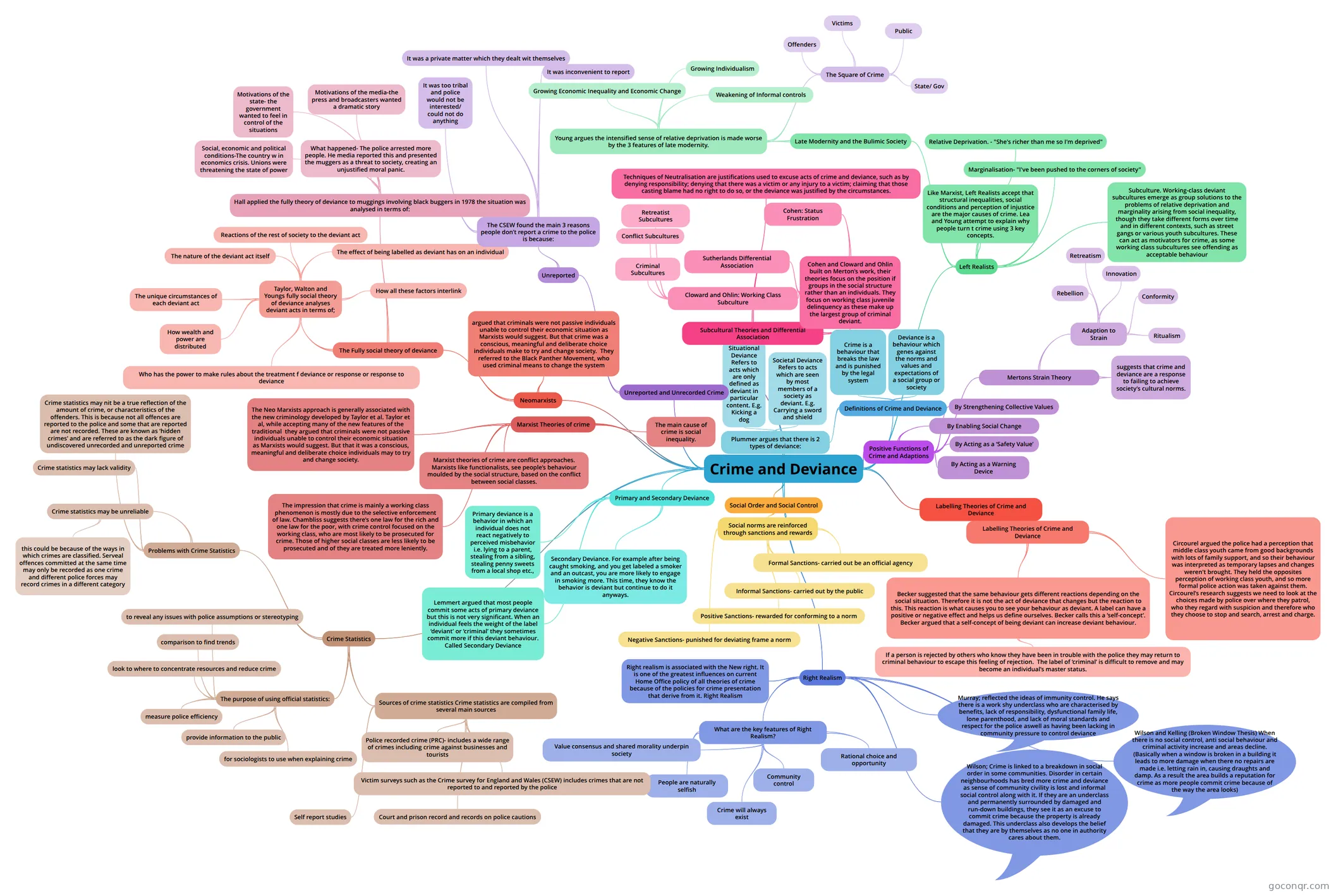
Mind map: Crime and deviance
Conteúdo do mapa
Crime and Deviance
Definitions of Crime and Deviance
- Crime is a behaviour that breaks the law and is punished by the legal system
- Deviance is a behaviour which genes against the norms and values and expectations of a social group or society
- Plummer argues that there is 2 types of deviance:
- Societal Deviance Refers to acts which are seen by most members of a society as deviant. E.g. Carrying a sword and shield
- Situational Deviance Refers to acts which are only defined as deviant in particular content. E.g. Kicking a dog
Social Order and Social Control
- Social norms are reinforced through sanctions and rewards
- Formal Sanctions- carried out be an official agency
- Informal Sanctions- carried out by the public
- Positive Sanctions- rewarded for conforming to a norm
- Negative Sanctions- punished for deviating frame a norm
- Social norms are reinforced through sanctions and rewards
Positive Functions of Crime and Adaptions
- By Strengthening Collective Values
- By Enabling Social Change
- By Acting as a ‘Safety Value’
- By Acting as a Warning Device
- Mertons Strain Theory
- suggests that crime and deviance are a response to failing to achieve society’s cultural norms.
- Adaption to Strain
- Conformity
- Innovation
- Ritualism
- Retreatism
- Rebellion
Subcultural Theories and Differential Association
- Cohen and Cloward and Ohlin built on Merton’s work, their theories focus on the position if groups in the social structure rather than an individuals. They focus on working class juvenile delinquency as these make up the largest group of criminal deviant.
- Cohen: Status Frustration
- Cloward and Ohlin: Working Class Subculture
- Criminal Subcultures
- Conflict Subcultures
- Retreatist Subcultures
- Sutherlands Differential Association
- Techniques of Neutralisation are justifications used to excuse acts of crime and deviance, such as by denying responsibility; denying that there was a victim or any injury to a victim; claiming that those casting blame had no right to do so, or the deviance was justified by the circumstances.
- Cohen and Cloward and Ohlin built on Merton’s work, their theories focus on the position if groups in the social structure rather than an individuals. They focus on working class juvenile delinquency as these make up the largest group of criminal deviant.
Labelling Theories of Crime and Deviance
- Labelling Theories of Crime and Deviance
- Becker suggested that the same behaviour gets different reactions depending on the social situation. Therefore it is not the act of deviance that changes but the reaction to this. This reaction is what causes you to see your behaviour as deviant. A label can have a positive or negative effect and helps us define ourselves. Becker calls this a ‘self-concept’. Becker argued that a self-concept of being deviant can increase deviant behaviour.
- If a person is rejected by others who know they have been in trouble with the police they may return to criminal behaviour to escape this feeling of rejection. The label of ‘criminal’ is difficult to remove and may become an individual’s master status.
- Circourel argued the police had a perception that middle class youth came from good backgrounds with lots of family support, and so their behaviour was interpreted as temporary lapses and changes weren't brought. They held the opposites perception of working class youth, and so more formal police action was taken against them. Circourel’s research suggests we need to look at the choices made by police over where they patrol, who they regard with suspicion and therefore who they choose to stop and search, arrest and charge.
- Becker suggested that the same behaviour gets different reactions depending on the social situation. Therefore it is not the act of deviance that changes but the reaction to this. This reaction is what causes you to see your behaviour as deviant. A label can have a positive or negative effect and helps us define ourselves. Becker calls this a ‘self-concept’. Becker argued that a self-concept of being deviant can increase deviant behaviour.
- Labelling Theories of Crime and Deviance
Primary and Secondary Deviance
- Primary deviance is a behavior in which an individual does not react negatively to perceived misbehavior i.e. lying to a parent, stealing from a sibling, stealing penny sweets from a local shop etc.,
- Lemmert argued that most people commit some acts of primary deviance but this is not very significant. When an individual feels the weight of the label ‘deviant’ or ‘criminal’ they sometimes commit more if this deviant behaviour. Called Secondary Deviance
- Secondary Deviance. For example after being caught smoking, and you get labeled a smoker and an outcast, you are more likely to engage in smoking more. This time, they know the behavior is deviant but continue to do it anyways.
Marxist Theories of crime
- Marxist theories of crime are conflict approaches. Marxists like functionalists, see people’s behaviour moulded by the social structure, based on the conflict between social classes.
- The main cause of crime is social inequality.
- The impression that crime is mainly a working class phenomenon is mostly due to the selective enforcement of law. Chambliss suggests there’s one law for the rich and one law for the poor, with crime control focused on the working class, who are most likely to be prosecuted for crime. Those of higher social classes are less likely to be prosecuted and of they are treated more leniently.
- The Neo Marxists approach is generally associated with the new criminology developed by Taylor et al. Taylor et al, while accepting many of the new features of the traditional they argued that criminals were not passive individuals unable to control their economic situation as Marxists would suggest. But that it was a conscious, meaningful and deliberate choice individuals may to try and change society.
Neomarxists
- argued that criminals were not passive individuals unable to control their economic situation as Marxists would suggest. But that crime was a conscious, meaningful and deliberate choice individuals make to try and change society. They referred to the Black Panther Movement, who used criminal means to change the system
- The Fully social theory of deviance
- Taylor, Walton and Youngs fully social theory of deviance analyses deviant acts in terms of;
- How wealth and power are distributed
- The unique circumstances of each deviant act
- The nature of the deviant act itself
- Reactions of the rest of society to the deviant act
- Who has the power to make rules about the treatment f deviance or response or response to deviance
- The effect of being labelled as deviant has on an individual
- How all these factors interlink
- Hall applied the fully theory of deviance to muggings involving black buggers in 1978 the situation was analysed in terms of:
- Social, economic and political conditions-The country w in economics crisis. Unions were threatening the state of power
- Motivations of the state- the government wanted to feel in control of the situations
- Motivations of the media-the press and broadcasters wanted a dramatic story
- What happened- The police arrested more people. He media reported this and presented the muggers as a threat to society, creating an unjustified moral panic.
- Taylor, Walton and Youngs fully social theory of deviance analyses deviant acts in terms of;
Left Realists
- Like Marxist, Left Realists accept that structural inequalities, social conditions and perception of injustice are the major causes of crime. Lea and Young attempt to explain why people turn t crime using 3 key concepts.
- Relative Deprivation. - "She's richer than me so I'm deprived"
- Marginalisation- "I've been pushed to the corners of society"
- Subculture. Working-class deviant subcultures emerge as group solutions to the problems of relative deprivation and marginality arising from social inequality, though they take different forms over time and in different contexts, such as street gangs or various youth subcultures. These can act as motivators for crime, as some working class subcultures see offending as acceptable behaviour
- Late Modernity and the Bulimic Society
- Young argues the intensified sense of relative deprivation is made worse by the 3 features of late modernity.
- Growing Individualism
- Weakening of Informal controls
- Growing Economic Inequality and Economic Change
- The Square of Crime
- Offenders
- Victims
- Public
- State/ Gov
- Young argues the intensified sense of relative deprivation is made worse by the 3 features of late modernity.
Right Realism
- Right realism is associated with the New right. It is one of the greatest influences on current Home Office policy of all theories of crime because of the policies for crime presentation that derive from it. Right Realism
- What are the key features of Right Realism?
- Value consensus and shared morality underpin society
- People are naturally selfish
- Community control
- Rational choice and opportunity
- Crime will always exist
- Murray; reflected the ideas of immunity control. He says there is a work shy underclass who are characterised by benefits, lack of responsibility, dysfunctional family life, lone parenthood, and lack of moral standards and respect for the police aswell as having been lacking in community pressure to control deviance
- Wilson; Crime is linked to a breakdown in social order in some communities. Disorder in certain neighbourhoods has bred more crime and deviance as sense of community civility is lost and informal social control along with it. If they are an underclass and permanently surrounded by damaged and run-down buildings, they see it as an excuse to commit crime because the property is already damaged. This underclass also develops the belief that they are by themselves as no one in authority cares about them.
- Wilson and Kelling (Broken Window Thesis) When there is no social control, anti social behaviour and criminal activity increase and areas decline. (Basically when a window is broken in a building it leads to more damage when there no repairs are made i.e. letting rain in, causing draughts and damp. As a result the area builds a reputation for crime as more people commit crime because of the way the area looks)
Crime Statistics
- The purpose of using official statistics:
- comparison to find trends
- measure police efficiency
- look to where to concentrate resources and reduce crime
- provide information to the public
- for sociologists to use when explaining crime
- to reveal any issues with police assumptions or stereotyping
- Sources of crime statistics Crime statistics are compiled from several main sources
- Police recorded crime (PRC)- includes a wide range of crimes including crime against businesses and tourists
- Victim surveys such as the Crime survey for England and Wales (CSEW) includes crimes that are not reported to and reported by the police
- Self report studies
- Court and prison record and records on police cautions
- Problems with Crime Statistics
- Crime statistics may be unreliable
- this could be because of the ways in which crimes are classified. Serveal offences committed at the same time may only be recorded as one crime and different police forces may record crimes in a different category
- Crime statistics may lack validity
- Crime statistics may nit be a true reflection of the amount of crime, or characteristics of the offenders. This is because not all offences are reported to the police and some that are reported are not recorded. These are known as ‘hidden crimes’ and are referred to as the dark figure of undiscovered unrecorded and unreported crime
- Crime statistics may be unreliable
- The purpose of using official statistics:
Unreported and Unrecorded Crime
- Unreported
- The CSEW found the main 3 reasons people don’t report a crime to the police is because:
- It was too tribal and police would not be interested/ could not do anything
- It was a private matter which they dealt wit themselves
- It was inconvenient to report
- The CSEW found the main 3 reasons people don’t report a crime to the police is because:
- Unreported
Informações
- Descrição
- A level Psychology Mapa Mental sobre Crime and Deviance, criado por Philippa Hammond em 06-05-2017.
- Criado por
- Philippa Hammond
- Visualizações
- 1
- Avaliação