
Mapa mental
Infection
Conteúdo do mapa
Infection
Viruses
- Virus Structure
- Naked vs Enveloped
- Naked
- made of viral nucleic acid, viral enzymes surrounded by capsid
- stable to temp change, pH change, proteases, detergents and drying
- need to lyse cell to escape so cause more acute infections. can be dry and still spread and can survive gut
- Enveloped
- Same stuff as naked but also has an envelope derived from host cell embedded with viral glycoproteins
- envelope makes vulnerable- destroyed by acid, detergents, drying and heat
- must stay wet to spread, released from the cell by budding so cause more persistent infections
- Naked
- Capsid Structure
- Icosahedral
- 12 vertacies, 20 sides
- 5:3:2 symmetry
- Extremely stable made of capsomeres
- e.g. parvo
- Helical Capsids
- 1 capsid protein structural unit
- Always enveloped e.g. paramyxoviruses
- Complex Capsid
- neither icosahedral nor helical- complex symmetry
- only animal one of any significance is poxviruses
- Icosahedral
- Viral Genome
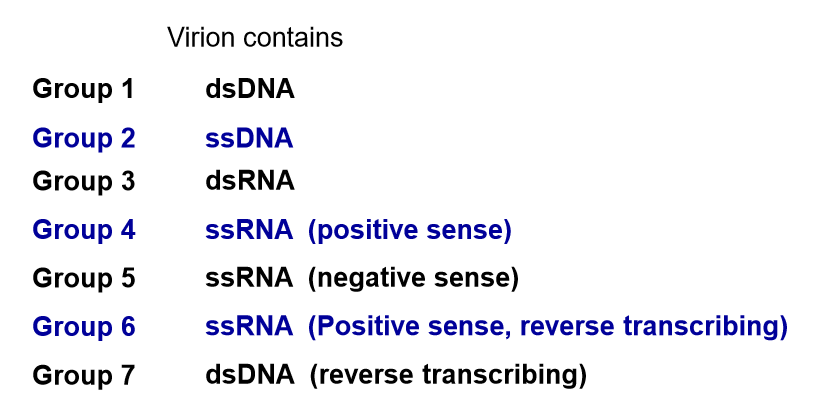
- DNA viruses can be single stranded or double stranded
- RNA viruses (all need RNA dependant RNA polymerase)
- Positive single stranded- can be converted directly into protein
- negative single stranded needs to synthesise positive before it can produce protein
- double stranded
- Viral Proteins
- Structural
- capsid proteins- form capsid to protect nucleic acid. in naked virus it must deliver nucleic acid to host cell so has recptors
- envelope proteins- often glycosylated embedded in membrane from host. contains receptors which allow virus to bind to target cell
- virion associated enzymes
- non-structural
- often enzymes for viral repliacation
- made in infected ell often proteins involved in transcription and translation
- Structural
- Naked vs Enveloped
- Virus Replication
- success= attach, enter, uncoat, synthesise mRNA, replicate nucleic acid, assemble and release
- 1- attachment. viral proteins bind to receptor on cell surface. virus- receptor determines specificity of virus
- 2- Entry= receptor mediated endocytosis. virus then released from endosome sometimes triggered by pH change. some envelopes fuse directly with cell membrane and release capsid into cell. some use direct genetic injection
- 3- Uncoating, release of viral nucleic acid from viral capsid. variable process but must escape endosome.
- sometimes virus capsid only partially disintegrates
- 4-- Synthesis of mRNA
- Double stranded DNA just transcribed to mRNA using host RNA polymerase
- Single stranded DNA viruses use host DNA polymerase to make double stranded DNA which can then be transcribed
- Double stranded RNA undergo transcription via a viral transcriptase (RNA dependant RNA polymerase)
- -ve sense single strand uses RNA dependant RNA polymerase to convert to +sense
- +sense RNA viruses can be transcribed directly
- 5-Nucleic Acid Relication
- make copies of the genome
- DNA viruses in the nucleus
- RNA viruses in cytoplasm using virus encoded enzymes
- 6- Assembly
- package nucleic acid and viral proteins into new viruses
- non enveloped- proteins form procapsid which nucleic acid is added to
- enveloped must get an envelope from the host membrane often done in the budding phase
- 7- release
- Budding from cell- enveloped viruses get envelope
- exocytosis - take advantage of cell pathway
- lysis of cell due to toxic effect (Non enveloped cells)
- Virus Cultures
- could also use live animals or eggs
- need living cells to replicate
- 1-prep sample, take tissue sample and cut into bits, treat with enzymes to break tissue up into cells and set in culture flask with growth medium
- 2- cell culture maintenance- treat with trypsin to detach from plastic
- primary cell culture- fresh from sample, after a few divisions differentiation will prevent further growth
- continuous cell line- immortal cells often from tumours- may lack the receptors viruses need to infect them
- 3- isolate virus from clinical case
- 4- innoculate cultures and wait
- Infectivity Assays
- quantify the amount of infectious virus produced in cell culture, egg or sample from infected animal
- 10 fold dilution steps
- inoculate cell cultures
- TCID tissue culture infective dose. TCID50 = 50% tissue culture infective dose
- or plaque forming units
- Classification
- pathogenesis
- stages of a viral infection
- Entry
- must overcome host immune defences- tend to attack mucosal surfaces
- Skin good barrier unless cut
- Resp tract- ciliated epithelium, mucous, commensal bacteria, immunological defences
- Alimentary tract- pH, Bile, Enzymes, commensal bacteria
- Blood- haemophagus bacteria or iatrogenic
- genital
- trans-placental
- Viral replication and spread
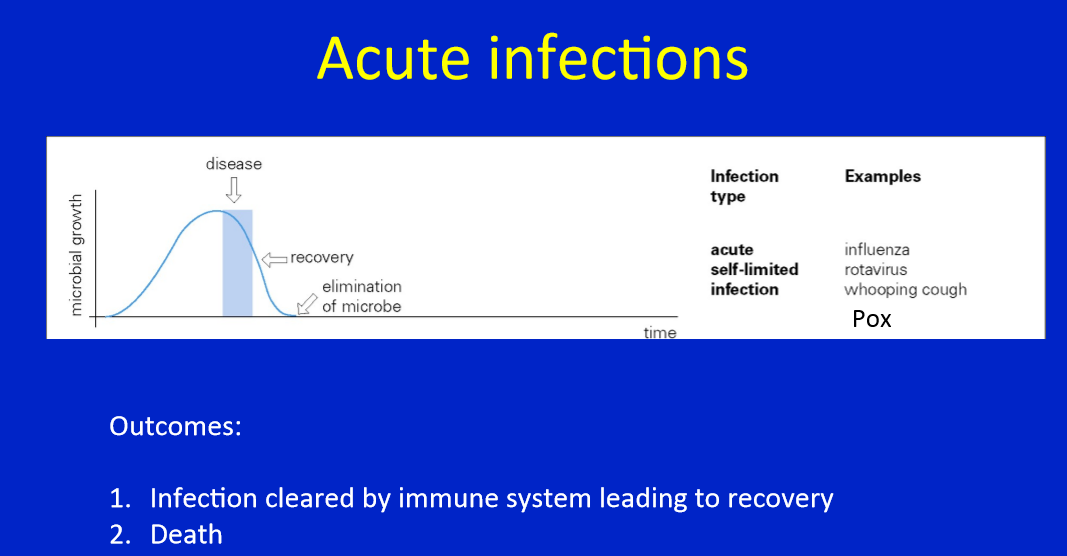
- local- in epithelium of initial infection, site of infection = site of shedding. acute infection
- Systemic- local followed by spread to another site via lymph/ blood/ nerves. allows different entry and exit routes. longer incubation and more severe pathology
- Shedding
- highest viral titre
- critical to find a new host
- Entry
- mechanisms
- cytopathic effects- (visible changes to cell following infection)
- Host cell shut off
- Lysosomal damage
- Cell membrane abnormalities
- syncitia formation
- formation of inclusion bodies (made of viral proteins)
- Cytocidal Effects- cell death
- Cell lysis
- apoptosis
- deadly CPE
- Immune mediated pathology
- immune cytolysis of infected host cells required for recovery
- cytopathic effects- (visible changes to cell following infection)
- factors
- Host: age/ gender/ nutrition/ productivity/ species/ immunity/ origin/ stress
- Virus: Virulence/ endemic/ exotic/ transmission route immuno-suppression/ co infections/ infectiousness
- Environment: contamination, climate, insects, quality of pasture, stocking density, vaccination programs
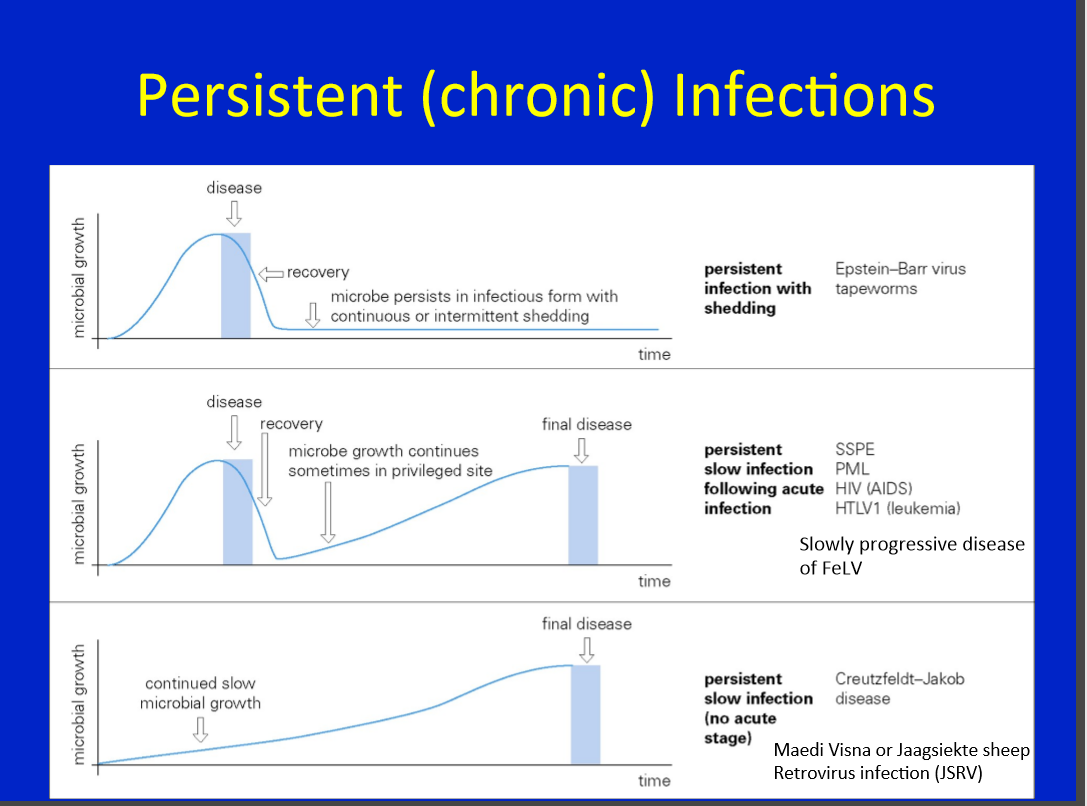
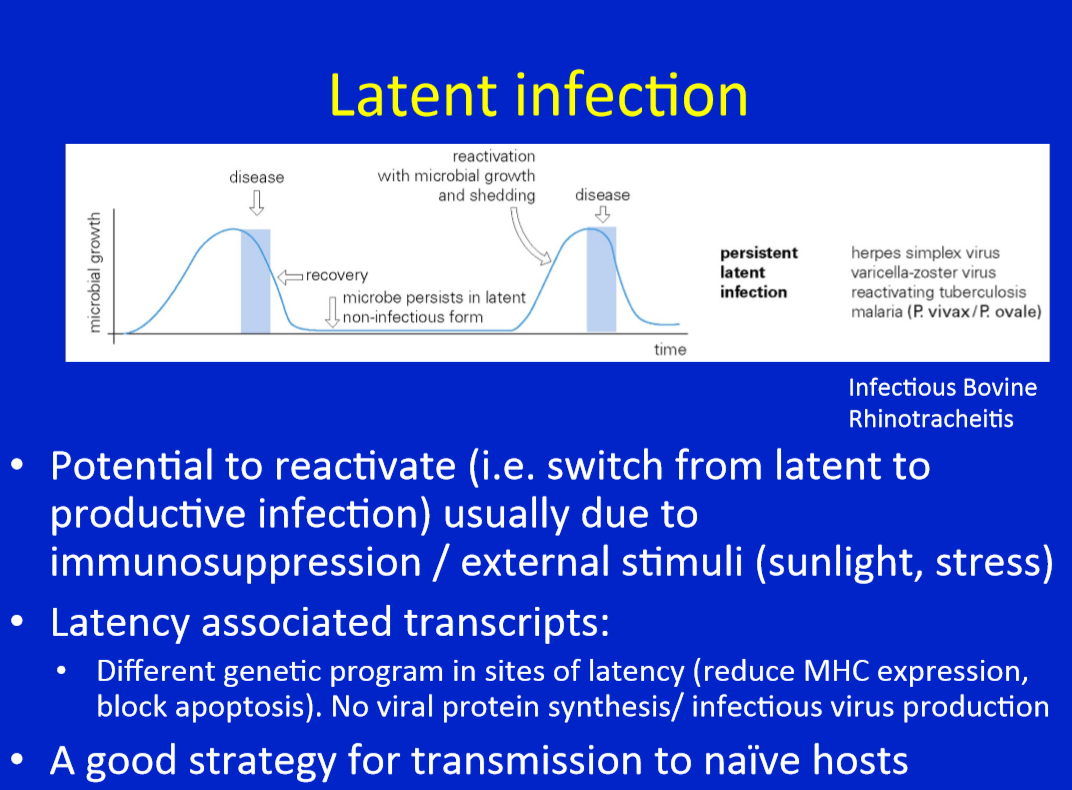
- Acute vs Persistent infections
- stages of a viral infection
- Virus Structure
Bacteria
- Structure and Function
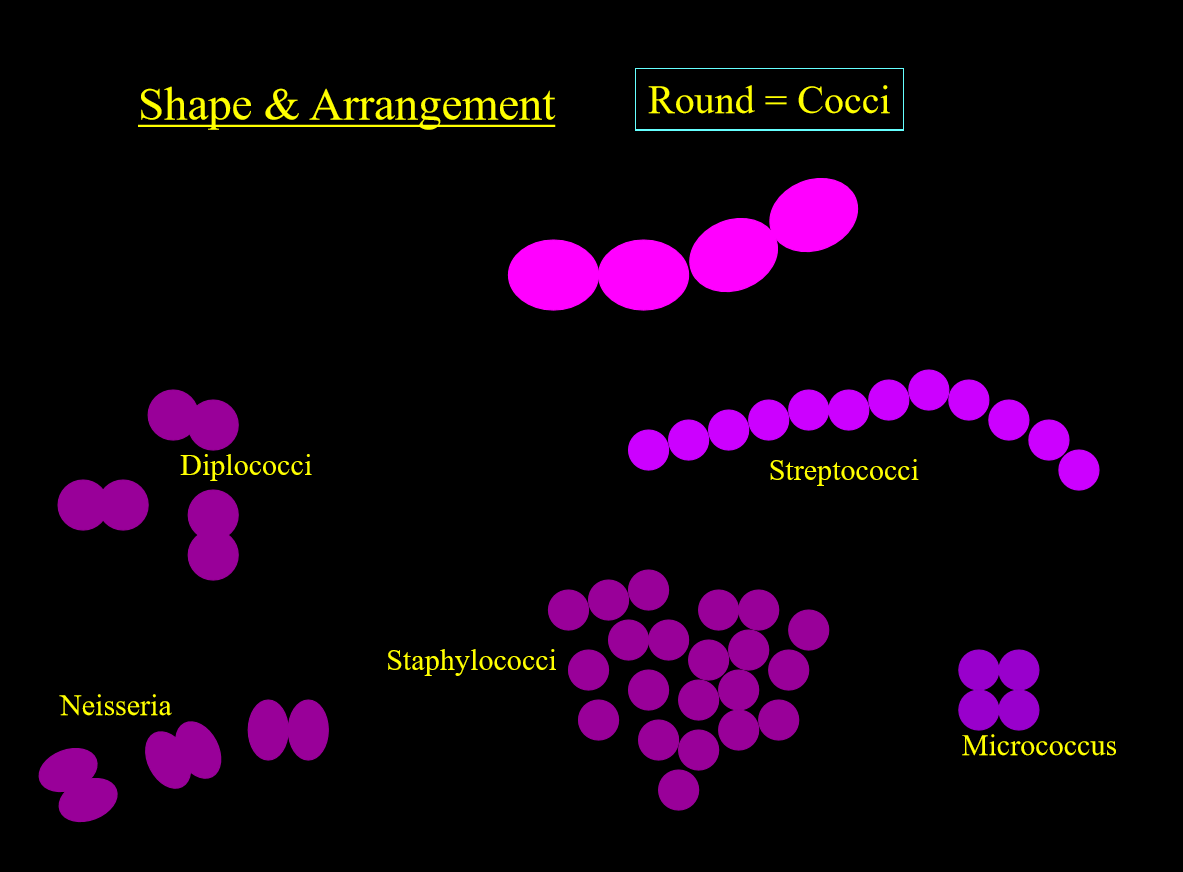
- Round (COCCI)
- long chains of round blobs in same plane= streptococci
- Like a bunch of grapes- dividing in 3 planes (staphylcocci)
- Groups of 4/8 = Micrococcus
- Neisseria are in pairs- diplococci
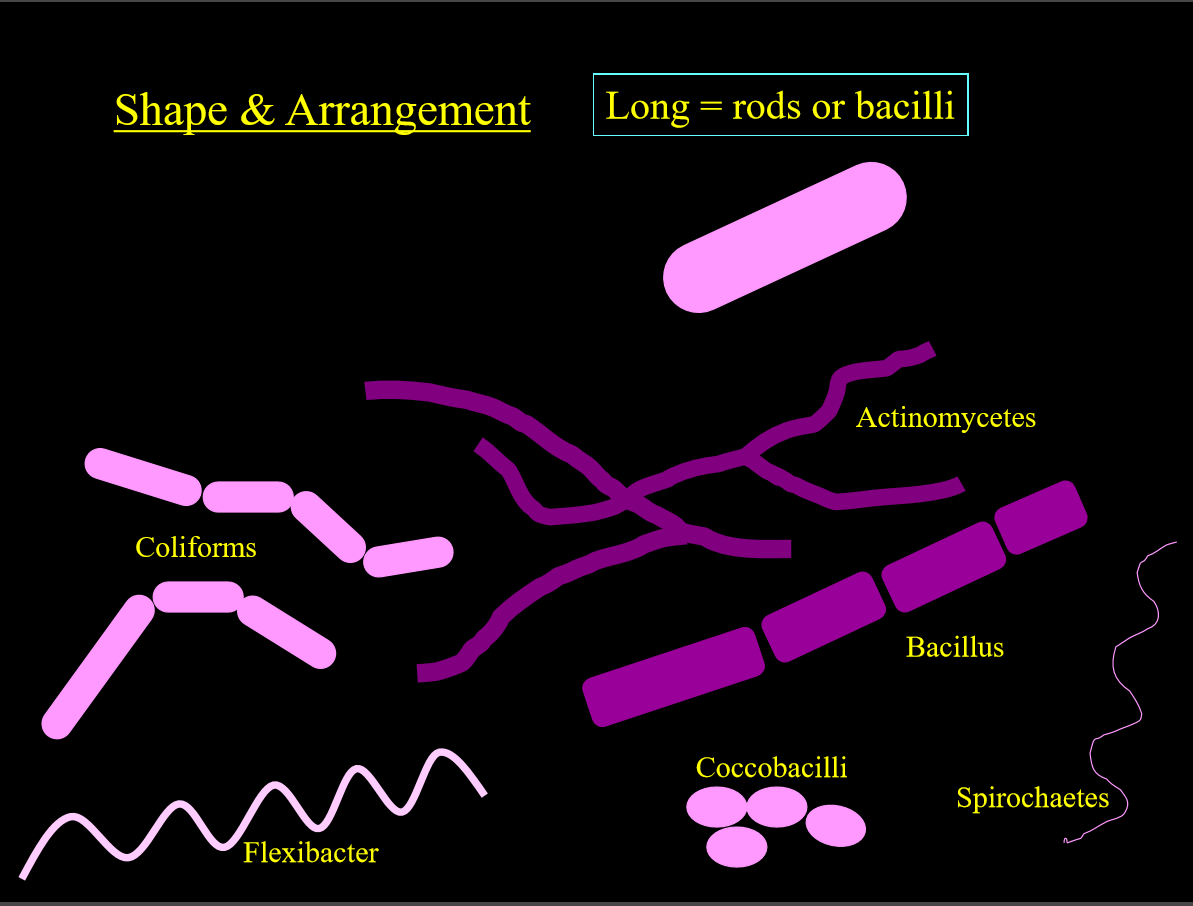
- Rod shaped (bacilli)
- Coliforms- length 2/3 times width simple chain
- Actinomyces -filamentous fibres- long look like fungi
- Bacillus- big thick chains
- Flexibacter- spiral shape v mobile
- coccobacilli- small almost cocci
- spirochaetes- cork screw shape
- GRAM STAINING
- used to classify bacteria- gram positive stain purple gram negative stain
- put bacteria on slide, kill and stain with gram stain
- wash then apply iodine to fix the gram stain
- wash off with solvent- gram stain will be removed from gram negative
- add pink dye so we can still see gram negative
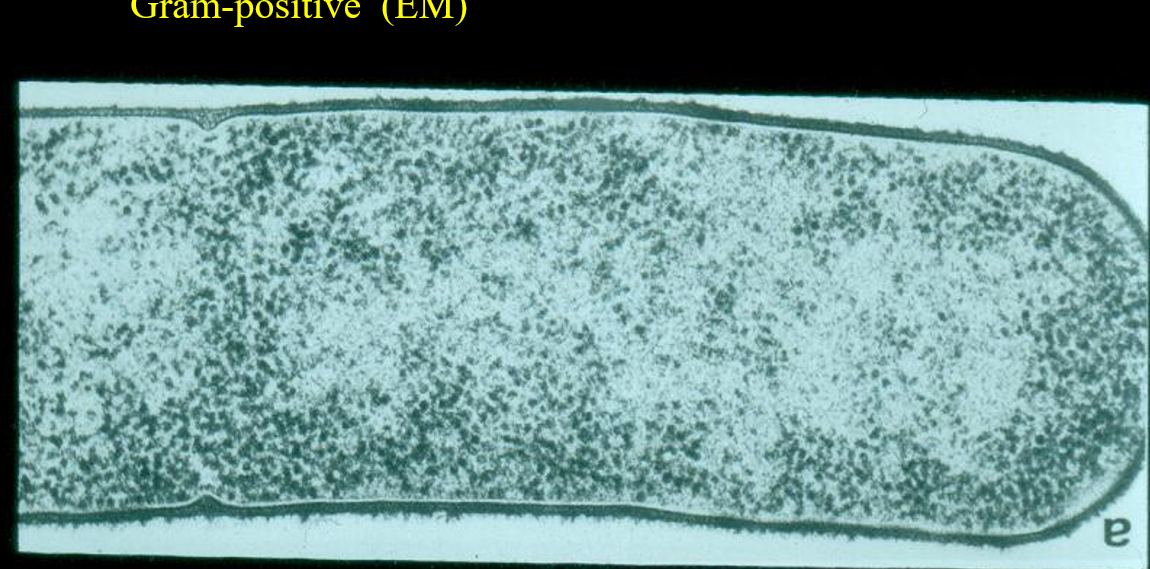
- Gram +ve
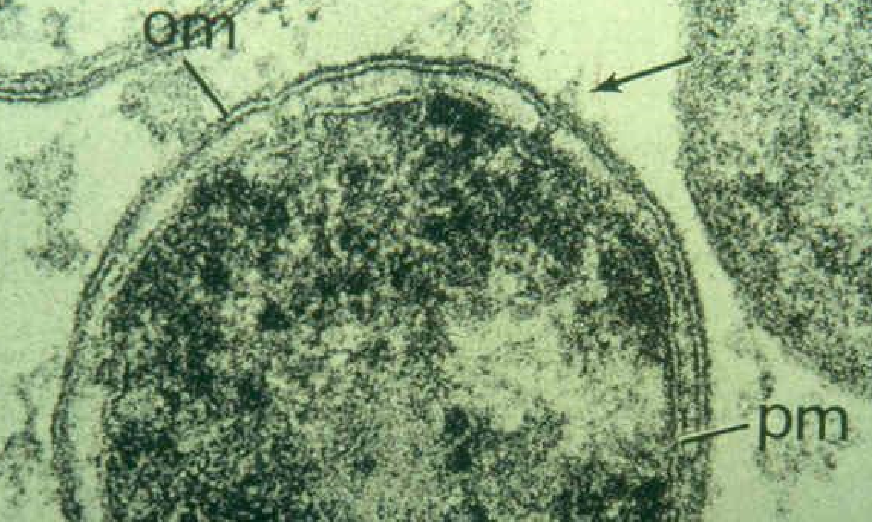
- Gram -ve have Cytoplasmic membrane and outer membrane
- Bacterial Cell Structure
- Cell wall- protect from osmotic pressure etc.
- Mucoid polysaccharide capsule- protect from phagocytosis
- DNA- free floating
- Mesosome- invagination of cell membrane helps in parting daughter chromosomes
- fimbrae- projections help stick to things
- Flagellae- motility
- flagellae are made up of flagellin and increase in length at the top
- Bacterial Envelope
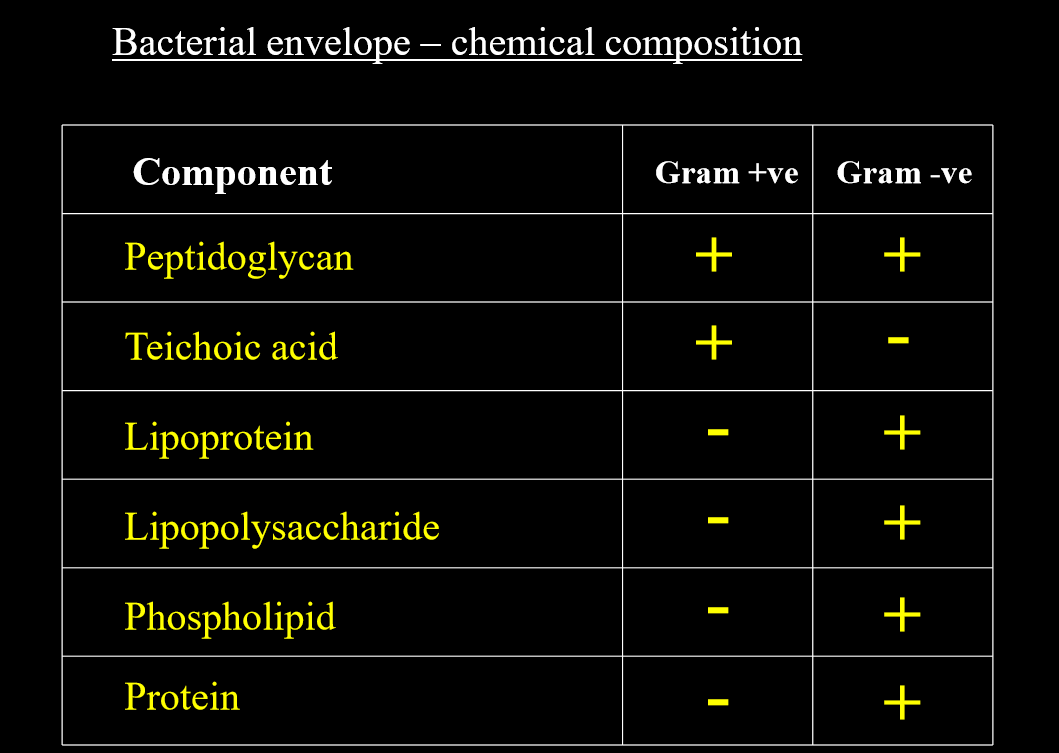
- Peptidoglycan- main component of cell wall. linear glycan chains with peptide side chains joined by covalent cross links
- Lipoprotein only found in gram negative since only found in the outer membrane
- Lipopolysaccharide on outer membrane
- can be an antigen lipid is the toxin in lots of lipopolysachharides
- bacterial spores
- non- reproductive
- Resting inert/ dormant form of bacteria
- only clostridium + bacillus genus
- DNA dehydrated in middle
- Specialised cortex of peptidoglycan and protein coat
- Resistant to drying out, heat, cold, freezing, boiling, radiation/ uv light
- detects if in right conditions and starts to grow active bacteria again
- Round (COCCI)
- growth
- Types of culture + growth mediums
- Batch culture- fixed volume of growth medium- lag, exponential, stationary and decline phase
- continuous culture- continually provide nutrients and remove waste more like a real infection
- Defined Growth Medium- Glucose and buffered salts
- e.g ammonium sulphate
- complex medium- provides more biologically occuring ompounds- for metabolically lazy bacteria
- medium can be liquid broth or solidified in agar
- Temperature
- 37 for most bacteria
- thermophiles grow in really hot
- psychotrophs- like it hot but can survive cooler temp too
- Atmospheric requirements
- experiment to find ideal atmosphere
- innoculate and evenly disperse bacteria in semi solid medium open to environment
- Strict/ Obligate aerobe- will grow at top of container
- e.g. bordetella bronchispetica
- Facultative anaerobe- likes oxygen but has capacity to grow anaerobically, higher conc at top of container but spread through
- E.coli
- microaerophil- needs oxygen but at a reduced tension- grow just above middle of container
- campylobacter
- obligate anaerobe- just ato bottom of container
- fusobacterium necrophorum
- Aerotolerant- doesn't need oxygen to grow but isn't poisoned by it either- grows through whole container
- streptococcus dysgalactae
- pH
- most like neutral
- Acidophillic
- Alkophillic
- Types of culture + growth mediums
- genetics
- Gene transfer- Conjucation
- sometime plasmid integrates in chromosomal DNA
- Donor copies plasmid
- Donor attaches sex pillus to recipient, recipient gets plasmid copy
- Transformation- Uptake of naked DNA, can be natural or induced
- induced example e.coli treat with calcium chloride and ice, then heat shock and put on ice again- will take up DNA
- could also use electrophoration
- transmission- using phages
- Mispackaged bacterial DNA transferred via a bacterial virus
- 1-phage infects bacterium and slices up the bacterial DNA, it makes copies of it's own
- 2- Accidentally packages DNA from bacterial cell into new virus
- 3- new virus infects bacteria, injecting the DNA into the cell. DNA may be taken up into acceptor chromosome. in this case the phase is called a transducing particle
- transposable elements
- specialised insertion sequences with a marker. has transposase and inverted repeats but cannot self replicate
- Restriction and modification
- Restriction enzymes - cut at restriction sites way of protecting bacteria for foreign DNA
- Modification- site specific methylation to protect from restriction enzymes- often part of the same enzyme system
- Gene transfer- Conjucation
- sterilization and disinfection
- vegitative bacteria= non spore forming normally killed at 60/70 heat for 5 mins
- endospores and prions are thermostable very resistant hard to get rid of
- Sterlization
- COMPLETE DESTRUCTION OF ALL LIVING ORGANISMS
- AUTOCLAVE- "WET HEAT"
- steam must be able to penetrate packs and must be allowed to reach appropriate temperature
- Boil water under pressure of 15 pounds per square inch
- 121 degrees for 15 MINUTES
- Testing the autoclave
- 1- autoclave tape goes black when been through cycle- detects heat and steam not quality of cycle
- 2- Browne' s tubes detect appropriate heating and time. GO FROM RED TO GREEN
- 3- Spore strips- try and culture after cycle- if cycle has been effective the spores will not germinate
- DRY HEAT- hot air oven 160 for 45 MINUTES
- can't use on plastics
- Tyndalisation- only on liquids and not used that often
- steam on 3 consecutive days at 100 degrees
- Day 1- vegitatve spores killed and spores activated
- Day 2- germinated spores are killed
- Day 3- just in case
- Radiation- UV used small scale not very penetrating. Gamma uses cobalt 60 source more industrial
- ****Filtration****
- Filter at positive pressure through pores of 0.22 micrometers.
- Not true sterilization since some small bacteria and viruses may pass through
- Chemical
- 10% formaldehyde solution
- Hypochlorite. hypochlorus acid formed powerful oxidising agent
- ethylene oxide gas
- Disinfection
- removal of most infective organisms
- BUT NOT ALL
- heat treatment- boiling at 100 degrees- endospores not killed
- Pasturization- slow 63/66 degrees for 30 mins. fast 73 degrees for 15 SECONDS
- antiseptics are sufficiently non-toxic to apply to skin
- removal of most infective organisms
- Structure and Function
Parasites
- parasitism- intimate relationship between two organism where one lives at the expense of the other
- interaction involves nutritional depndance, immunological defence and integration of life cycles
- Micro parasites multiply inside the host, macro parasites do not multiply in host
- Basic life cycle template
- 1- locate susceptible host using sensors (e.g. heat/light/vibration /carbon dioxide
- 2-be able to survive in environment if host not found- eggs can survive for years, larvae and pupae for months
- 3- invade host when found e.g. ingestion/ innoculation/ skin penitration
- 4- micro- multiply in host e.g. hydatid cyst
- 5-macro- multiply outside of host usually involves intermediate
- 6- survive inside the host if the outside environment is poor (arrested development)
- ARTHROPODS
- split into insets (fleas/ lice/ flies) and acarina (mites, ticks)
- INSECTS
- STRUCTURE AND FUNCTION
- hard exoskeleton
- split into 3 segments: head, thorax and abdomen
- Head
- made of fused plates
- like a football
- compound eyes and simple eyes (ocelli)
- antennae- lots of variation some have bristles called aristae
- mouth parts: Labellae, the lower lip is sponge lke, can't penitrate skin
- Larvae heads have hooks to hold on to surfaces with
- ephalopharyngeal skeleton for identification
- made of fused plates
- Thorax
- split into pro/ meso/ meta. each has a pair of legs= six legs attached by coxa
- normally have 2 pairs of wings but the second may be vestigial/ balancing organs called "halteres"
- wing veination important for ID
- Abdomen
- clearly segmented and soft
- lots of apendages- houses most body systems
- BODY SYSTEMS
- Alimentary tracts. Still has fore mid and hind gut.
- fore- oesophageus, crop and proventriculus
- mid- food storage and digestion
- Hind- water absorption
- Circulatory system- a dorsal "heart" no capillary system instead their organs are bathe din blood, valves only allow blood to move anteriorly
- Nervous system- small brain with a chain of fused ganglia and basic branching nerves
- Fat body- cells containing fat vacuoles line body cavity and act as a food reserve
- Reproductive systems- sexes are separate. female adapted has spermatheca to store sperm and use later
- Alimentary tracts. Still has fore mid and hind gut.
- LIFE CYCLES
- 1-Either lay eggs or live nymphs/ larvae
- Simple metamorphoses- egg->nymph-> adult. (nymph looks like adult but is not mature)
- Complex metamorphoses- egg->larvae->pupa (dormant)-> adult
- insect develops to adult form in pupa before emerging
- EXAMPLES OF VET IMPORTANCE
- Blowfly (lucilia spp.) cause fly strike especially important in sheep
- Warble fly - look like holes have been punched in hide. cause economic losses and drop in milk yield
- Mosquitoes important disease vectors
- fleas- flea allergy dermatitis
- STRUCTURE AND FUNCTION
- ACARINA
- 2 body divisions not 3
- no wings, antennae or compound eyes
- generally smaller than insects
- life cycle
- 1- egg
- 2- larvae 6 legs
- 3- nymph 8 legs
- 4- adult 8 legs
- examples of veterinary importance
- tick (ixodes) vector of disease
- mite (otodectes) common cause of Otitis Externa in dogs
- HELMINTHS
- CESTODES (tape worms)
- Structures
- head= SCOLEX has suckers and hooks
- body = STROBILA
- body segments- PROGLOTTIDS bud from head
- mature segments have both reproductive organs
- mate by cross fertilization
- gravid segments are full of eggs
- the eggs have thick shells and hooks
- 2 groups: pseduophyllidea/ Cyclophyllidea
- life cycle
- 1- Adult tapeworm in final host sheds segments
- 2- eggs swallowed by intermediate host
- 3- larvae develop in intermediate host (metacestodes)
- 4- intermediate host tissues eaten- metacestode swallowed and develop into adult in final host
- METACESTODE TYPES
- Cysticercus- 1 inverted scolex in fluid filled bladder
- Cysticercoid- 1 scolex and fluid filled bladder just not inverted
- strobilocercus - 1 scolex joined to fluid cyst by chain of segments
- coenurus- like cysticercus but multiple inverted scolices
- hydatid cyst- coenurus but thousands of inverted scolices
- Alveolar cyst- hydatid but can have endogenous and exogenous budding
- Structures
- TREMATODES (flukes)
- split into monogeneans and digeneans - mono tend to be parasites on fish focus on di-
- Digeneans- dorsoventrally flattened worms
- 2 suckers- both attach to host but only one has a mouth
- muscular pharynx pumps food into blind ending gut sack
- most are hermaphrodites
- exceptions- Shistosomes- not hermaphrodites- pathogenic when shed
- epidermis is a syncitium and is invovled in nutrient uptake
- also called tegument
- life cycle
- 1 egg
- 2- micacidium first motile stage
- 3- sporocyst----> cercariae free living stages
- 4- metacercaria -> adult
- NEMATODES (roundworm)
- structures
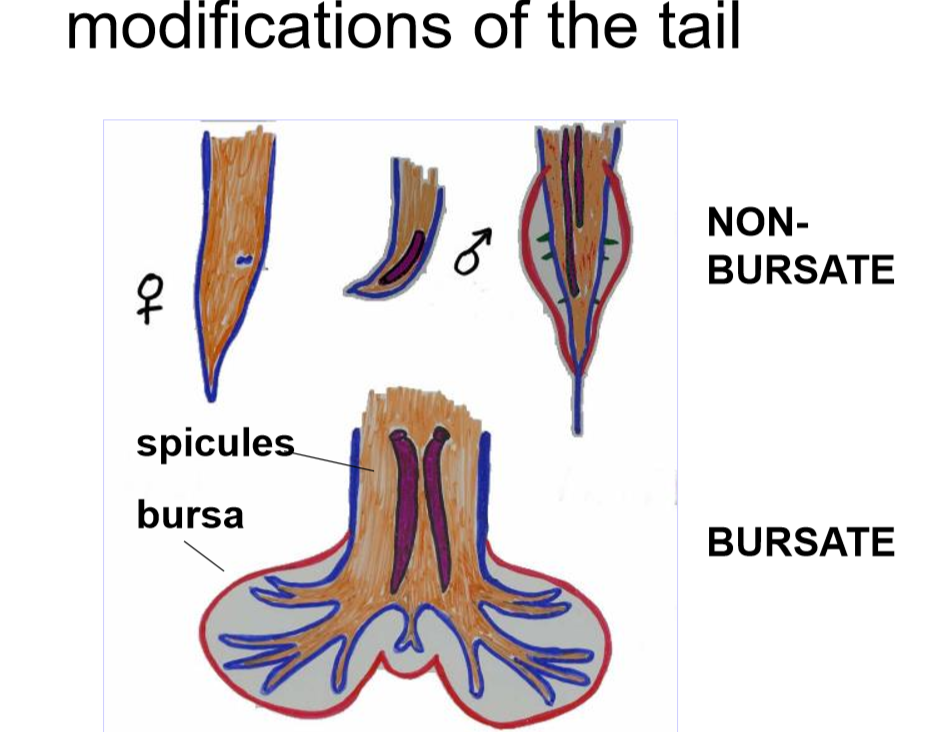
- tail important for identification- bursate vs non bursate
- Cuticle modifications- Alae are wing like structures. Vesicle is a ring like swelling
- think queen elizabeth collar
- head structures
- leaf crown
- teeth
- pharynx
- either plug feeders or blood feeders
- life cycle
- egg- > 3/4 moults-> adult.
- some larvae keep the skin from previous generations
- taxonomy
- non- bursate
- big and fleshy
- 3 lips
- single bulb pharynx
- e.g. ASCARIDS
- Bursate
- Strongloidea + hookworms
- Stout
- complex head structures
- infect small and large intestine
- larvae inside mucosal tissue- cause more damage when they emerge
- Trichostrongloidea
- thread like and simple head
- infect stomach and small intestine
- live in gastric glands/ crypts- cause less damage when they emerge
- Strongloidea + hookworms
- non- bursate
- structures
- CESTODES (tape worms)
- PROTOZOA
- Structure and function
- unicellular
- locomotion
- cilia beat in unison to move or waft food into mouth
- flagellum- contractile fibres often attached to body by undulating membrane
- psedopodia- extensions of cytoplasm. used to move but also to engulf things
- nutrition- phagocytosis or pinocytosis
- reproduction
- homoxenous- one host heteroxenous more than one host facultativley heteroxenous- can have more than one host
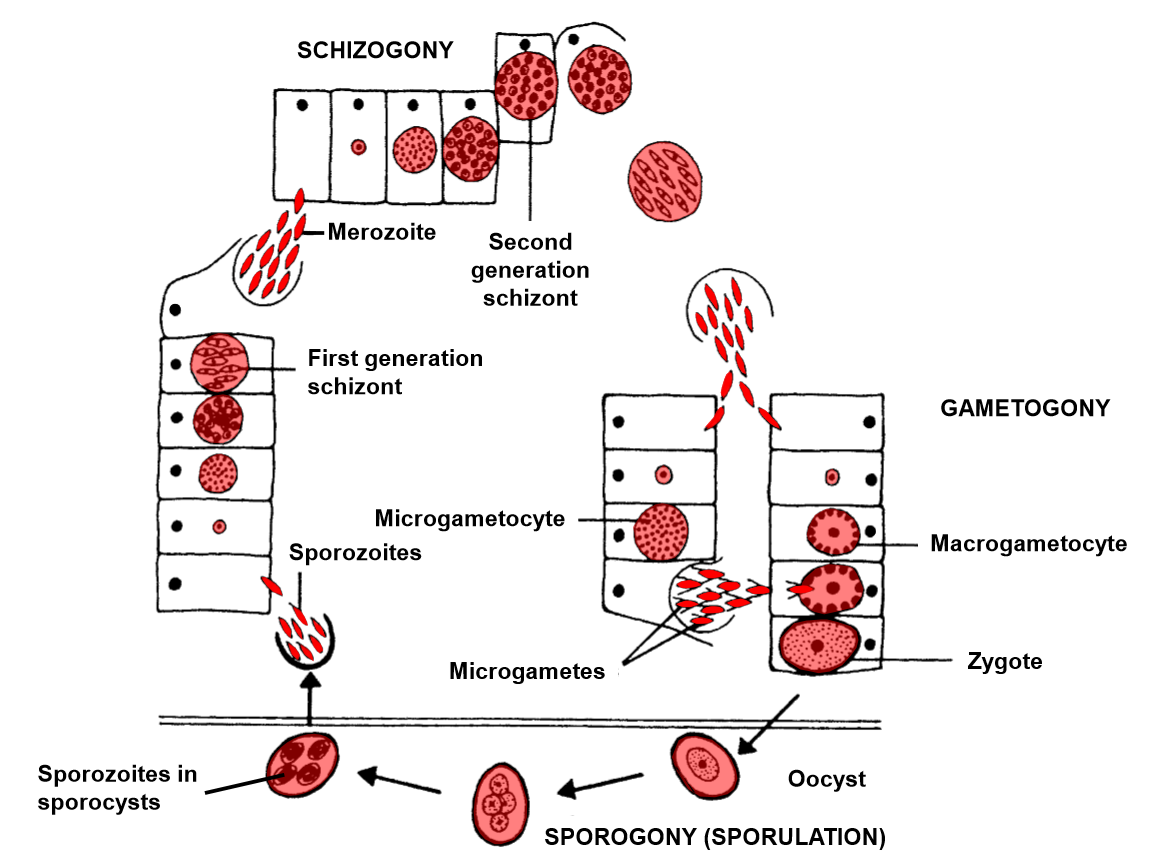
- asexual- can be simple binary fission or Shizogony/ Sporogony
- some are sexual
- examples of veterinary importance
- eimeria spp- coccidosis in poultry
- babesia spp. blood bourne and spread by ticks used to be very common in cattle some cases in dogs now
- toxoplasma- abortion in sheep
- cryptosporidium- infects animals and humans severe humans if immunosuppressed
- Structure and function
- PARASITIC GASTRO-ENTERITIS
- associated with nematode species
- clinical signs- diarrhoea and weight loss
- sub-clinical- poor weight gain
- Ostertagia ostertagi
- causes Ostergaiasis
- primary pathogen of cattle. 1 cm long and thread like
- strongyle worm
- infect abomasum gastric glands (1 larvae per gastric gland)
- clinical disease over 40 thousand adult worms present
- prepatent period 3 weeks (from infection to egg shedding) L3 are infective but sometimes keep the cuticle from L2
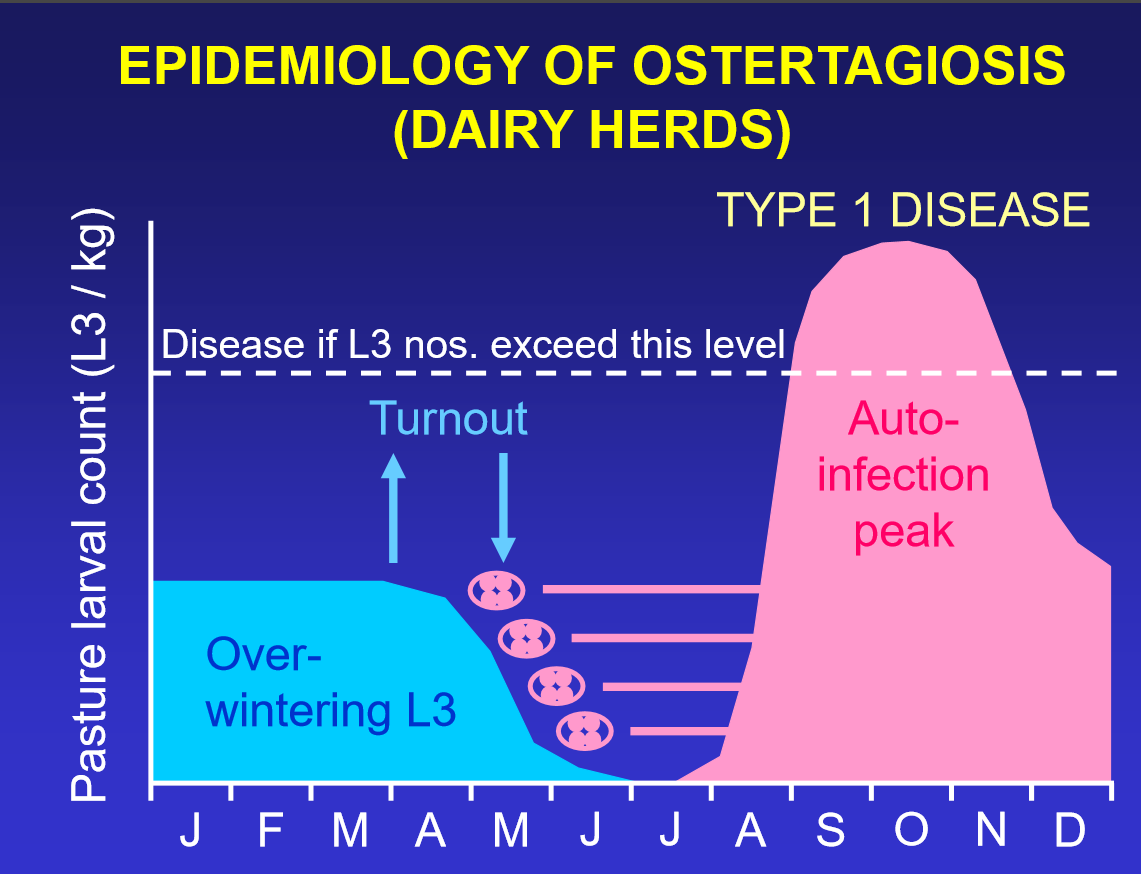
- EPIDEMIOLOGY TYPE 1 DISEASE
- L3 larvae are left on pasture from previous year
- spring calves are turned out and infected by L3 larvae. 3 weeks later they start shedding eggs
- Eggs shed early in the season take longer to develop into L3 than those shed later
- summer auto-infection peak and clinical disease present
- called auto infection because calves that shed the eggs are the same ones that are infected in the summer
- Epidemiology Type 2 disease
- infected calves housed over winter
- L3 larvae feel temp dropping on pasture, infect calves then arrest development (EL4)
- Disease in april/ may
- larvae don't all wake up at one normally in 20% batches. characterised by intermitant diarrhoea
- genetic clock determines when they wake up
- ostertagiasis in BEEF
- Spring Calves- spring mortality occurs before most are turned out, turned out with adult cows who have immunity so v low disease risk
- Autumn calves- graze before spring mortality but still have adult cows with them. higher disease risk than spring calves but still low compared to dairy
- DISEASE CONTROL
- Type 1
- use clean pasture
- turn out after spring mortality
- dose and move to aftermath
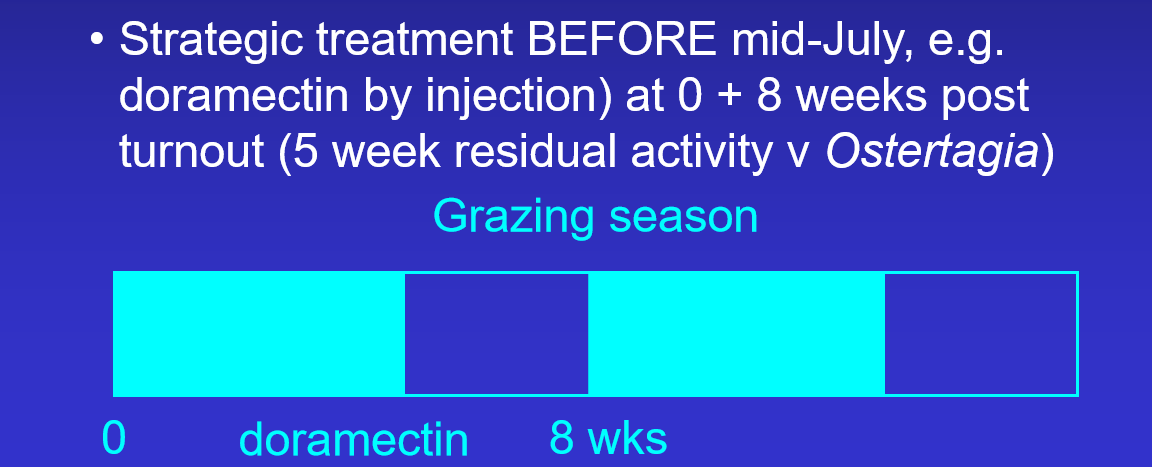
- strategic anthelmintic treatment
- Type 2
- give anthelmintics before in wintering if exposed to high challenge in late autumn
- Type 1
- parasitism- intimate relationship between two organism where one lives at the expense of the other
Imagens e arquivos do mapa
Informações
- Descrição
- Veterinary Medicine Mapa Mental sobre Infection, criado por Elena Gutierrez em 14-06-2017.
- Criado por
- Elena Gutierrez · jun 2017
- Atualizado
- 7 abr 2018
- Visualizações
- 0
- Histórico
-
- Criado por Clodagh Mullins · 20 mai 2017
- Copiado por Elena Gutierrez · 14 jun 2017
- Avaliação