
Invented Traditions project - Scotland
Slides do conjunto (13)
-
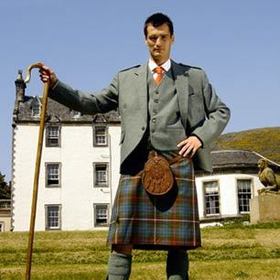

- Legenda: Kilts: As Scottish as......
- Legenda: ..... Sean Connery??
-
Eric Hobsbawm: Invented Traditions
- Hobsbawm defines ‘invented tradition’ as:
- “a set of practices, normally governed by overtly or tacitly accepted rules and of a ritual or symbolic nature, which seek to inculcate certain values and norms of behavior by repetition, which automatically implies continuity with the past”.
- Idea developed in edited book by Eric Hobsbawm and Terrence Ranger . (1983)
- They investigate claims that traditions are old and timehonoured when they have really been recently invented, for political purposes
- “Nations do not make states and nationalisms but the other way round"
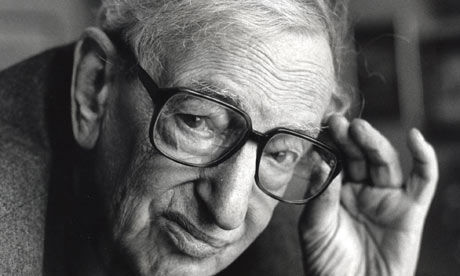
- Legenda: Eric Hobsbawm (1917-2012)
-
The Invention of Tradition 1983

- Chapters in the book include:
- The Highland Tradition of Scotland - Trevor Roper
- The Hunt for the Welsh Past in the Romantic Period - Prys Morgan
- The Context, Perofmance, and Meaning of Ritual (about the Monarchy) - David Cannadine
- Representing Authority in Colonial India - Bernard Cohn
- The Invention of Tradition in Colonial Africa - Terence Ranger
- i.e. the authors see this happening in lots of places around the globe.
-
- More
- recent studies that use this "invention of tradition" concept to
- guide their research
- Mirror of Modernity: Invented
- Traditions of Modern Japan. Edited by Stephen Vlastos (1998)
- Includes essays on diverse 'traditions' such as martial arts, japanese-style
- labor management, and the cult of domesticity
- The Bible and Zionism: Invented Traditions,
- Archaeology and Post-Colonialism in Israel - Palestine by Nur Mashala (2006)
- “Nevruz’ or ‘Newroz’?
- deconstructing the ‘invention’ of a contested tradition in contemporary Turkey” by Lerna Yanik in Middle East Studies (2006)
-
Invention of Tradition and Nationalism
- In his 1990 book Nations and Nationalism Since 1780: programme, myth, reality , Hobsbawm identifies three stages in the development of nationalism:
- A preliminary phase in which the idea of the nation is purely cultural and/or folkloric;
- A pioneering phase wherein political campaigners begin to try and raise awareness and mobilize the nation;
- And finally, the stage at which nationalist movements acquire mass support, an occurrence which can come to pass before or after the birth of the state. (page 12)
- The invention of tradition is mobilized by campaigners in the second phase, as a sense of national identity is promoted.
-
- Hugh Trevor-Roper included a case study of Scotland in Hobsbawm and Ranger's 1983 book The Invention of Tradition
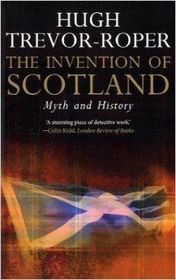
- He extended this in a 2008 book The Invention of Scotland
- He questions what many people would see as some of the key elements of Scottish national identity: like the kilt, and the bagpipe and tartan.
-
- In mid 18th century when political entrepreneurs 'discovered' a Scots-Gaelic epic poet called Ossian who's supposed writing was "discovered" and translated by James Macpherson.
- This popularised the idea that Scottish Highland culture was ancient and noble and distinct from other parts of Britain.
- But actually Roper and others conclude that Macpherson probably just made up all the poems, based on some myths and legends.
- However the poetry was popular so it still contributed to the myth of the Scottish nation

-
- Kilt invented in mid eighteenth century (which is a long time ago but definitely not ancient).
- Invented by Thomas Rawlinson - an ENGLISHMAN!
- People used to wrap fabric around themselves (like a skirt), but he thought it would be handier if it had pleats sewn in.
- In old times people wrapped themselves in fabric but it was not like the modern kilt.

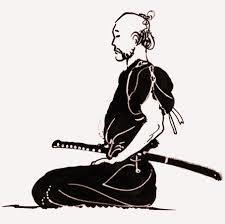
- Legenda: Not a kilt!
-
- Family tartans probably never existed historically.
- Tartan patterns would have varied by region but people would really just wear . What tartan one wore was mainly a decision based on preference or fashion.
- People became interested in Tartan and started having patterns made for their families, but the idea that the patterns reflect ancient clans, Roper says is a myth.
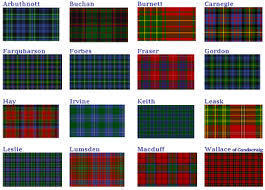
- Legenda: Not Ancient
-
- Functionalism as a sociological perspective emphasizes how different parts of a system contribute to the stability of the whole.
- Durkheim on Suicide
- Merton on Crime
- Following Hobsbawm and Ranger, and Trevor-Roper we can look at how the invention of tradition in Scotland worked in the interests of Scottish nationalists
- Functionalism
-
Effects of invented traditions
- The epic poetry of Ossian contributed to the understanding on the part of people in Scotland that they had a history and culture that was distinct from England, or other parts of what became the United Kingdom. This contributed to a political desire for independence.
- It is important to note that it didn't really matter that Macpherson made things up because the effect of the myth was important - i.e. it was functional.

-
- The tartan and the kilt provided symbols for people to emphasize their Scottish national identity. People could visually represent their "Scottishness", and assess the nationality of others. Having a family tartan provided a sense of legitimacy for powerful families.
- These "traditions" were propagated in a variety of ways. As nationalism coincided with the tourism industry and more global communication, the myth of these 'ancient' traditions spread even further - and contributed to the tourism industry.
- These symbols continue to be important to Scottish national identity, and we can see evidence for this in the 2014 referendum.
- https://www.youtube.com/watch?v=7aiOSwQGsA8 (Incorporar)
-
- https://www.youtube.com/watch?v=46iAL8QS8G8 (Incorporar)
- It also means that when people complain about modern interpretations of tartan, they are failing to recognise that tartan itself is a modern invention, and that kilts were never uniquely Scottish.
Informações
- Descrição
- Presentation for political sociology class - Invented Traditions Scotland - by Mark, Denise, and Sandra
- Criado por
- Denise Draper · nov 2015
- Atualizado
- 18 jan 2017
- Visualizações
- 725
- Tags
- Avaliação