
Localisation of function in the brain
Slides do conjunto (11)
-
Localisation of function in the brain
- KEY TERMS:
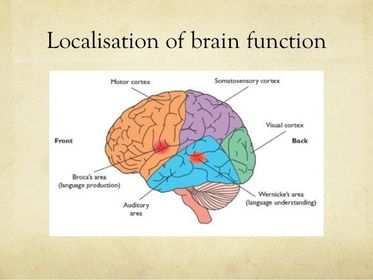
- Localisation of function - the theory that different areas of the brain are responsible for different behaviours, processes or activities.
- Motor area - A region of the frontal lobe involved in regulating movement
- Somatosensory area - An area of the parietal lobe that processes sensory information like touch.
- Visual area - A part of the occipital lobe that receives and processes visual information
- Auditory area - Located in the temporal lobe and concerned with the analysis of speech-based information
- Broca's area - An area of the frontal lobe of the brain in the left hemisphere (in most people) responsible for speech production.
- Wernicke's area - an area of the temporal lobe (encircling the auditory cortex) in the left hemisphere (in most people) responsible for language comprehension
-
-
Localisation vs holistic theory
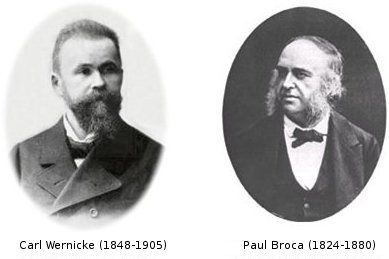
- 19th Century - Broca and Wernicke found that different parts of the have different functions
- Before this, scientists thought every part of the brain was involved in processing thought and action
- If certain areas of the brain are damaged, the function associated with that area is also affected
-
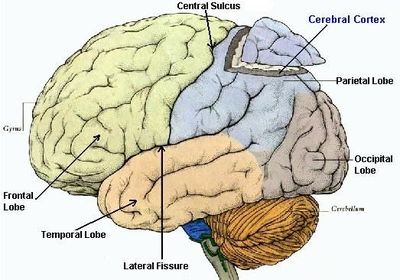
Brain hemispheres and the cerebral cortex
- The brain's divided into the right and the left hemispheres
- Activity on the left-hand side of the body is controlled by the right hemisphere
- Activity on the right-hand side of the body is controlled by the left hemisphere
- The cerebral cortex is the outer layer of the hemispheres, it's about 3 mm thick and is much more developed than animals
- The cortex appears grey due to cell bodies location
-
The motor and somatosensory centre
- Motor area:
- - Back of the frontal lobe
- - Controls voluntary movement in opposite side of body
- - Damage could lead to loss of control over fine movements
- Somatosensory area:
- - Front of both parietal lobes
- - Separated from the motor area by the central sulcus which is like a valley
- - Sensory information from the skin is represented
- - The higher the sensitivity of an area on our body, the larger the amount of somatosensory area it takes up
-
The visual and auditory centres
- Visual area:
- - Occipital lobe at the back of our brain
- - Each eye sends information from the right visual field to the left visual
- - And from the left visual field to the right visual cortex
- - Damage to the left hemisphere, can produce blindness in part of the right visual field of both eyes
- Auditory area:
- - Temporal lobes house the auditory area
- - Analyses speech-based information
- - Depending on the amount of damage, would result in hearing loss
- - Damage to Wernickes area mat affect ability to comprehend language
-
The language area of the brain
- Language is restricted to the left side of the brain
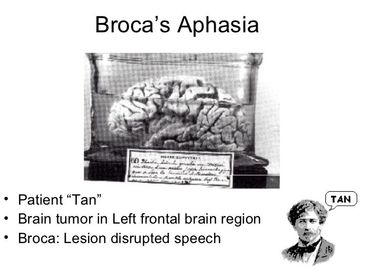
- Broca (1880's) identified a small area of the left frontal lobe responsible for speech production
- Damage to Broca's area causes Broca's aphasia - slow laborious, speech, lacking in fluency
-
Cont. the language area of the brain
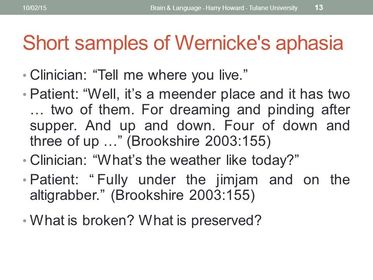
- Wernicke desribed patients who had no problem producting language but struggled understanding it
- Speech they produced was fluent but meaningless
- Wernicke found an area in the left temporal lobe as responsible for language comprehension
Informações
- Descrição
- Psychology year 2 (Biopsychology) Slides sobre Localisation of function in the brain, criado por Mollie Thompson em 03-11-2016.
- Criado por
- Mollie Thompson · nov 2016
- Atualizado
- 12 jan 2017
- Visualizações
- 13
- Avaliação