
Flashcards
Ch.6 Object Recognition
Flashcards do conjunto (42)
- 1Principles of object recognitionPrecision
Unity- Although different pathways code for color and motion, we perceive them coherently
Flexibly Robust- Our recognition of an image is surprisingly stable despite shifts in orientation, time of day, and occlusion by other objects
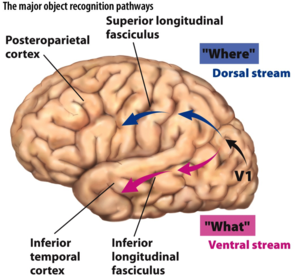
Memory bound- Once we perceive and image, memories are triggered - 2Two pathways for visual perceptionThe "what" ventral pathway- inferior longitudinal fasciculus
The "where" dorsal pathway- superior longitudinal fasciculus - 3Evidence for differences between the visual pathways-Lesion studies with monkeys show difficulty discrimination shapes with temporal lobe lesions and difficulty discriminating location with parietal lobe lesions
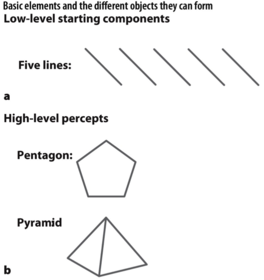
- 4The same basic components can form different items depending on their arrangement
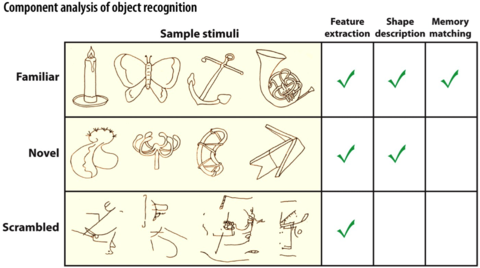
- 5Component analysis of object recognition(a) Stimuli for the three conditions and the mental operations required in each condition. Novel objects are hypothesized to engage processes involved in perception even when verbal labels do not exist. (b) Activation was greater for the familiar and novel objects compared to the scrambled images along the ventral surface of the occipitotemporal cortex.
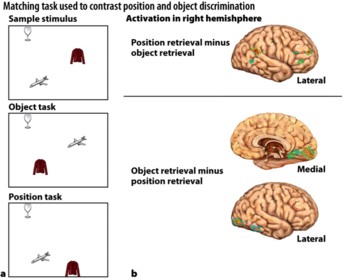
- 6—The Study and Test displays each contain three objects in three positions. On object retrieval trials, the participant judges if the three objects were the same or different. On position retrieval trials, the participant judges if the three objects are in the same or different locations. In the examples depicted, the correct response would be “same” for the object task trial and “different” for the position task trial. (b) Views of the right hemisphere showing cortical regions that showed differential pattern of activation in the position and object retrieval tasks.
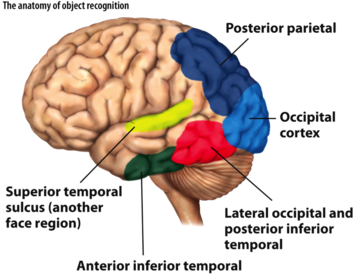
- 7The anatomy of object recognitionThe parahippocampal area and posterior parietal cortex process information about places and scenes. Multiple regions are involved in face recognition including fusiform gyrus and superior temporal sulcus while other body parts are recognized using area within the lateral occipital and posterior inferior temporal cortex.

- 8The role of motor system in object recognitionOur visual knowledge of many inanimate objects is supplemented by kinesthetic codes developed through our interactions with them

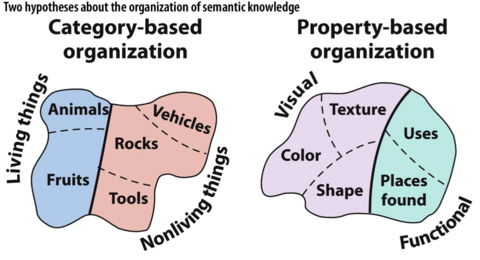
- 9Two hypotheses about the organization of semantic knowledge (Category-based and property-based)
- 10Representational differences between the visual pathwaysPhysiological responses of neurons in each lobe are distinct
Temporal lobe neurons are best suited for determining the identity of an object
Parietal lobe cells are best suited for detecting presence and location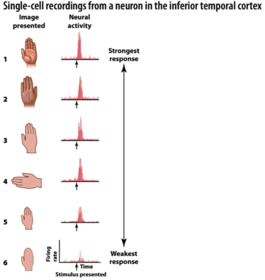
- 11How is agnosia different from memory loss?With memory loss a person cannot recall what an object is no matter what they do with it (tough it, taste it, etc.). A person with agnosia cannot recognize in object by vision alone but can identify it with other senses.
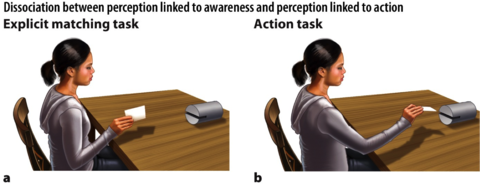
- 12Identification vs. action in agnosiaThe agnosia patient cannot match the orientation of the card to the slot but when asked to insert the card into the slot (motor activity) they can do it without problem
- 13Ventral-stream lesions in patient with agnosia
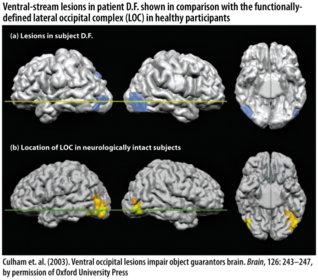
- 14The hierarchical coding hypothesisElementary features are combined to create objects that can be recognized by gnostic units. At the lowest level of the hierarchy are edge detectors.
- 15The ensemble coding hypothesisObjects are defined by the simultaneous activation of a set of defining properties. This is in contrast to the "grandmother cell" idea. This theory says that stimulus recognition is based on the collective activation of many neurons
- 16Grandmother cellsThe idea that there may be a single cell that fires when viewing a certain familiar face
- 17Perceiving objectsThe founders of Gestalt psychology postulated a series of laws to explain how our brains groups the perceived features of a visual scene into organized wholes. Figure and ground- an object is a figure that is distinct from the background
- 18Object consistencySensory input from the same object can vary when the object is viewed at different angles, in shadow, or another object is covering it. Despite this sensory variability, we rapidly recognize the objects and can judge if they depict the same object or different objects
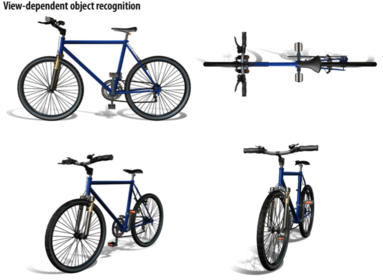
- 19View-dependent object recognitionView-dependent theories of object recognition posit that recognition processes depend on the vantage point. Recognizing that all four of these drawings depict a bicycle—one from a side view, one from an aerial view, and two viewed at an angle—requires matching the distinct sensory inputs to view-dependent representations.
- 20Asymmetry between left and right fusiform activation to repetition effectsa. Consistent with view-invariant representation
b. Consistent with view-dependent representation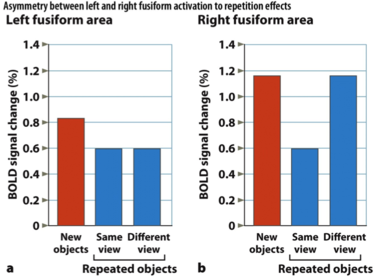
- 21The unusual-views test: Used to identify apperceptive agnosiaParticipants are asked whether two images seen from different viewpoints show the same object or not
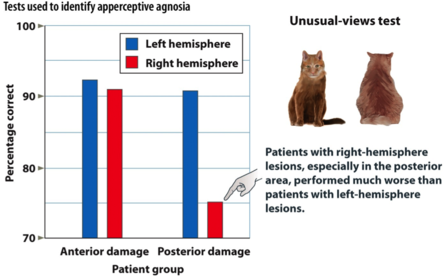
- 22The shadows test: Used to identify apperceptive agnosiaParticipants must identify the object when seen under normal or shadowed illumination

- 23Integrative agnosiaPatients are unable to integrate features into parts or parts into coherent wholes
- 24Associative agnosiaPatient can perceive object but cannot understand or assign meaning to them
- 25Apperceptive agnosiaPatient has problems identifying objects based on limited stimulus information (most common with right-hemisphere lesion)
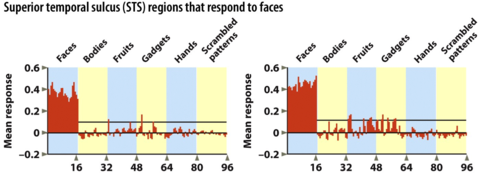
- 26Superior temporal sulcus regions that respond to faces
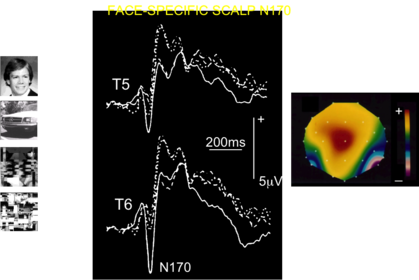
- 27Face specific N170
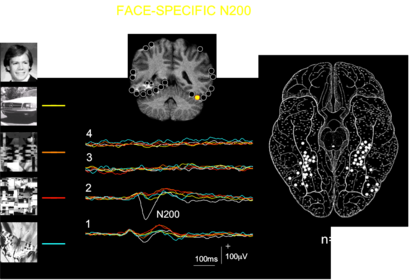
- 28Face specific N200
- 29Face perception vs. just eyesFG responds to full faces while the T6 responds to just eyes
- 30Category-specificity of face processingFusiform face area- Faces
Visual word form area- Letterstrings
Parahippocampal place area- Places
Extrastriate body area- Body parts - 31Locations of face and body recognition areasEBA=Extrastriate body area
OFA=Occipital face area
FFA=Fusiform face area
FBA=Fusiform body area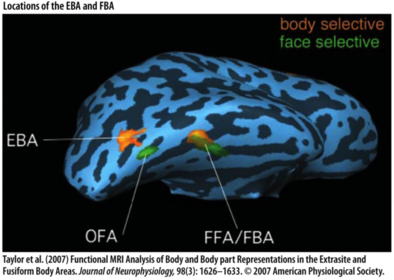
- 32Prosopagnosia-The ability to recognize faces is impaired, while the ability to recognize other objects may be relatively intact
-Individuals use "piecemeal" or "feature by feature recognition strategies - 33Prosopagnosia and focal lesions

- 34Autism and face perceptionAutistic individuals show a reduction in areas that are most activated by face stimuli
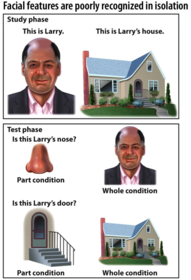
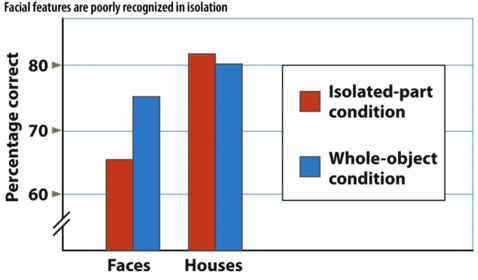
- 35Analytic versus holistic processingAnalytic: Emphasis on component parts, critical to reading, damage results in alexia
Holistic: Emphasis on the overall shape of an object, critical to face processing, damage results in prosopagnosia - 36Facial features are poorly recognized in isolation
- 37Bottom-up processingThe perception of objects is due to analysis of environmental stimulus input by sensory receptors; this analysis then influences the more complex, conceptual processing of that information in the brain
- 38Top-down processingThe perception of objects is due to the complex analysis of prior experiences and expectations within the brain; this analysis influences how sensory receptors process stimulus input from the environment
- 39Change blindness-Fail to detect a change in an object or a scene
-When detecting the difference between two scenes we identify important changes more quickly, more likely to notice improbable change, do not store detailed representation of the scene. - 40Inattentional blindness-Fail to notice when an unexpected but completely visible object suddenly appears
-Simons and Chabris' basketball study - 41Similarities between change blindness and inattentional blindness-Both involve top-down processing
-When an object appears that is not consistent with their concepts, expectations, and memory, people often fail to recognize this changed (change blindness) or new (inattentional blindness) object - 42How does perception act?Perception is not like a video camera in our head recording experiences.
Perception is an active and constructive process
Informações
- Descrição
- Cognitive Neuroscience (Midterm) FlashCards sobre Ch.6 Object Recognition, criado por Allison Sonia em 08-03-2017.
- Criado por
- Allison Sonia
- Visualizações
- 103
- Avaliação