
Quiz
translation
This quiz has question types that open in the usual player.
Questions in this quiz (105)
1How is the order of nucleotides in mRNA used to generate the linear sequences of amino acids in protein?
- Aprocess known as translation
- Bprocess know as transcription
- Cprocess know as post translational modifications
2What process is the most highly conserved across all organism and the most energetically costly?
- Atranslation
- Btranscription
- Ccellular respiration
3Transcription is a more formidable challenge than translation.
- ATrue
- BFalse
4The hydrophobic side chains of phenylalanine, tyrosine, and tryptophan forms interactions with the mRNA template.
- ATrue
- BFalse
5Crick proposed a [blank_start]special adaptor[blank_end] molecule that directly interacts with the coding units of mRNA. He proposed to also be a [blank_start]RNA[blank_end] molecule.
- ARNA
- Bspecial adaptor
6amino acids that are attached to a class of RNA molecules that represent 15% of all celluar RNA and transfer amino acids to a growing polypeptide chain.
- AtRNA
- BrRNA
- CmRNA
7The translation machinery is comprised of ?
- AmRNAs
- BtRNAs
- Caminoacyl-tRNA synthetases (aaRS)
- Dribosome
- ErRNA
- FDNA
8The competent of the translation machinery are always discarded after use.
- ATrue
- BFalse
9Provides the information to be interpreted by translation machinery
- ADNA
- BmRNA
- Camino acids
10This region of the mRNA specifies the order of amino acids by the ordered series of 3-nucleotide-long units called codons?
- Aintrons
- Bpoly A tail
- Cprotein coding region
11couple amino acids to specific tRNAs that recognize the appropriate codon?
- Aribozymes
- Baminoacyl tRNA synthetase
- Cpoly-a-polymerase
12coordinates correct recognition of mRNA by each tRNA and catalyzes peptide bond formation between growing peptide chain and amino acids attached to tRNA
- Aribosomes
- Bribozymes
- Ctransferase
13in mRNA containing 2 or more open reading frames that can encode for multiple polypeptide chains
- Aeukaryotic
- Bprokaryotic
14protein coding regions of each mRNA is composed of contiguous, non-overlapping string of codons called?
- Aprotein coding region
- Borigin of replication
- CORF
15Eukaryotes, contain a single ORF that encode for multiple protein which is called polycistronic.
- ATrue
- BFalse
16translation starts at the [blank_start]5'[blank_end] end of ORF and proceeds into the 3' end
- A5'
- B3'
17Start codons in bacteria
- AAUG
- BGUG
- CUUG
- DUAA
- EUGA
18eukaryotic cells always use AUG as a stop codon
- ATrue
- BFalse
19fundamental unit of an ORF is a [blank_start]codon[blank_end]
- Acodon
20What are the important functions of a start codon?
- Aspecify first amino acid incorporation
- Bcontains special interactions with tRNA for protein synthesis
- Cdefines the reading frame for all subsequent codons
- Dallows for hydrogen bonding to other bases
21Since the codons are a 3-nucleotide long, any stretch of mRNA could be translated in three different reading frames by overlapping.
- ATrue
- BFalse
22Stop codons are UAG,UGA and UAA in both eukaryotes and prokaryotes
- ATrue
- BFalse
23Eukaryotic mRNA recruit ribosomes by the shine-dalgarno sequence which is ribosome binding site(RBS) that recruit the translation machinery.
- ATrue
- BFalse
24the ribosome binding site
- Abinds with the 16s rRNA of the ribosome
- Bhas a sequnce of CCUCCU
- Calways has poor spacing
- Din all prokaryote has strong binding
25limited complementarity and poor spacing promotes active translation
- ATrue
- BFalse
26some prokaryotes lack a strong RBS but can still be actively translated by having a start and a stop codon right next to each other.
- ATrue
- BFalse
27who uses their 5' and 3' modified ends to facilitate translation?
- Abacteria
- Bprokaryotes
- Ceukaryotes
28Kozak sequence
- Aa purine, three bases upstream of the start codon and a guanine downstream
- Bextreme 5' end
- Cpresence
- Dscanning
- Einteracts with initiator tRNA
295' cap allows the ribosome to be recruited in order to go through a process called scanning.
- ATrue
- BFalse
30[blank_start]poly-A-tail[blank_end] at the end of mRNA enhances the level of translation of mRNA by promoting efficient recycling of [blank_start]ribosomes[blank_end].
- Apoly-A-tail
- Bribosomes
31[blank_start]tRNA[blank_end] molecules are 75 to 95 ribonucleotides in length which there are many types of.
- AtRNA
32The site at which amino acid is attached by the enzyme aminoacyl tRNA syntheses?
- AD loop
- B5'CCA3'
- Canticodon loop
- DTYC loop
33Unusual bases found in tRNAs primary structure created by post-transcriptional modifications?
- Apseudouridine
- Bdihydrouridine
- Chypoxanthine
- Duridine
34principle features of the tRNA clover leaf are
- Aacceptor stem
- BYU loop
- CD loop
- Danticodon loop
- Econstant loop
- Fvariable loop
35L-shape reveals the secondary structure of tRNA, which is stabilized by hydrogen bonds only.
- ATrue
- BFalse
36charged tRNAs have an amino acid attached to them by amino alkyl linkage
- ATrue
- BFalse
37acyl linkage is a high energy bond that is hydrolysis results in a large change in free energy, which helps drive the formation of peptide bonds
- ATrue
- BFalse
38step one of aminoacyl-tRNA charging is [blank_start]adenylyation[blank_end] which amino acid reacts with ATP, amino acid is attached to adenylic acid via group transfer ester bond.
- Aadenylyation
39Whats the driving force that make adenylaltion energetically favorable reaction?
- Athe release of pyrophosphate (PPI)
- Bhydrolysis of pyrophosphate (PPi)
40In step two of aminoacyl tRNA-charging- the adenylylated amino acid which is highly bound to the synthetase reacts with?
- AtRNA
- BPPI
- Canother amino acid
41Class 2 tRNA syntheses enzyme attach the amino acid to the 2'OH of the tRNA and are generally monomeric.
- ATrue
- BFalse
42each aminoacyl tRNA synthetase attaches a single amino acid to only one tRNA which is know as isoaccepting tRNAs.
- ATrue
- BFalse
43most organism have 20 different tRNA synthetase
- ATrue
- BFalse
44tRNA structure that determine recognition by specific aminacyl tRNA synthetases?
- Aacceptor stem and discriminator base
- BD loop
- Canticodon loop
- Dvariable loop
45Why does aminoacyl-tRNA synthetase face a challenge in selecting the correct amino acid?
- Asmall size
- Bside chains
- Csimilarity
46There is more proofreading after the aminoacyl-tRNA synthetase has used its editing pocket to charge tRNAs with low accuracy.
- ATrue
- BFalse
47when cysteinyl-tRNA ^cys converted to alanine-tRNA^ cys ( by reduction) and added to a cell free protein synthesizing system, alanine-tRNA^cys introduces alanines at the codons that are suppose to be cysteine. why?
- Aribosomes recognize tRNA not amino acid that its carrying
- Bwrong tRNA has been incorporated
- Cthe tRNA is isoaccepting therefore can carry more than one amino acid
48Eukaryotes can commence translation of the mRNA as it emerges from the RNA polymerase because the transcription machinery and the translation machinery are in the same compartment.
- ATrue
- BFalse
49The ribosome is made up of large subunit which contains the [blank_start]peptidase transferase center[blank_end] and the small subunit that contains the [blank_start]decoding center[blank_end].
- Adecoding center
- Bpeptidase transferase center
- C30S
- D50S
50polysomes are
- AmRNA with multiple ribosomes
- Bspaced 80 nt apart
- Cpolyribosomes
- Dhappen in eukaryotes
- Ehappen in prokaryotes
51When small and large subunits undergo of the ribosome associate with each other and the mRNA, translate the target mRNA, then dissociate after each round of sythesis.
- Aribosome cycle
- Bsedimentation by centrifugation
- Cpolysome
52translation occurs
- Afrom 5' to 3'
- Bfrom N terminal to C-terminal
- Cby attaching new amino acid to the C-terminus of a growing polypeptide chain
53substrate(s) for a round of amino acid addition are
- A2 charged species of tRNA
- B1 charged species of tRNA
54The bond between the aminoacyl-tRNA and the amino acid is not broken during the formation of the next peptide bond.
- ATrue
- BFalse
55What drives the peptide bond formation?
- Asimultaneous hydrolysis of nucleoside triphosphate
- Bbreaking the high energy acyl bond that joins the growing polypeptide chain to the tRNA
56ribosomal RNAs are represent the main component of the ribosome because
- Aare located in the interior of the ribosome
- Bessential for the peptidyl transferase reaction and binding the anticodon loop of tRNAs
- Care larger then proteins
- Dprotein stable rRNA by shielding negative charges of their sugar phosphate backbones
57what are the three binding sites for tRNA on a ribosome
- AA site
- BD site
- CEnter site
- DP site
- EE site
58peptidyl transferase center
- Aformed by 20 nucleotides of 23s RNA
- Bthe 3'OH group of the tRNA in the P site is critical for activity and assist a concerted proton transfer
- Corients tRNAs in optimal proximity for peptidyltransferase rxn to occur
59what allows only unpaired RNA to pass through the small and large subunit of the ribosome?
- Aentry and amino channel
- Bexit and adjacent channel
- Centry and exit channel
60[blank_start]Entry[blank_end] channel is through the small subunit which is only wide enough to let unpaired mRNA through and too narrow for a [blank_start]secondary[blank_end] structure. Ensures that codons in mRNA will be exposed and available for pairing with the anticodon loops of tRNA.
- AEntry
- Bsecondary
61the kink in the mRNA between two codons are included after ribosome translocation to not allow any entry of the mRNA
- ATrue
- BFalse
62[blank_start]Exit[blank_end] channel lets nascent polypeptide through. Some secondary structures can form inside but some can't. But [blank_start]tertiary[blank_end] and quaternary structure will not be formed until after its exit the ribosome.
- AExit
- Btertiary
63Successful initiation in translation occurs when?
- Aribosome is recruited to the mRNA
- Bribosome placed over the start codon
- Ccharged tRNA placed into P site
- DtRNA goes through hydrolysis
64translation initiation in prokaryotes is mostly done in the absence of the full ribosome
- ATrue
- BFalse
65Specialized charged tRNA that binds directly to the P site and not the A site during initiation.
- Amet-tRNA
- Binitiator tRNA
- Ccharged tRNA
66One of the three initiation factors, that binds to the small subunit and block its from reassociating with the large subunit or from binding charged tRNAs.
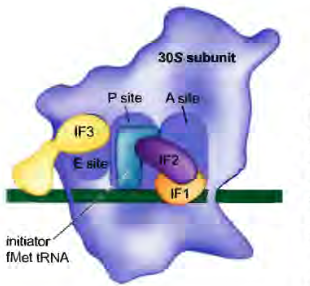
- AIF3
67purple-one of the three initiation factors in prokaryotes, it is a GTAPase which interacts with IF 1, charged initiator tRNA, and the small subunit.
yellow-prevents tRNAs from binding to the portion of the small subunit that will become part of the A site.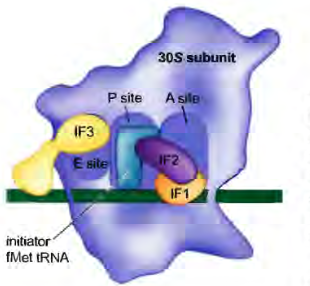
- AIF 1
- BIF 4
- CIF 3
- DIF2
68the last step in initiation is the 70s initiation complex, where fmet-tRNA, start codon, base pair which allows the small subunit to undergo a conformational change.
- ATrue
- BFalse
69In eukaryotic initiation, the 43s pre-initiation complex
- A1A attaches at the exit site
- BMet-tRNA^met is bound to e1F3
- CEIF1,3,5 are bound to the exit site
- Dthe initiation factors attach to the 40s ribosome
70recognition of eukaryotic mRNAs after 43S pre initiation complex,
- Arecognition of 5' cap mediated by 3 subunits
- Brecognition is mediated by a 3 subunit protein that specifically binds to RNA
- Cunstructured mRNA recruits the 43S pre initiation complex to mRNA by eIF4F and eIF5
71once the complex is assembled at the 5' end of the mRNA, they move along the 5'-3' direction by a process that ATP-dependent
- AeIF4F-associated RNA helices
- Bfinding the start codon
- Cbase pairing of the anticodon
72The reason why the initiator tRNA must bind to the small subunit before it binds to the mRNA is because it is used in scanning by recognizing the start codon through base pairing between anticodon of tRNA and start codon.
- ATrue
- BFalse
73The binding of the large subunit to the small subunit in eukaryotes
- Areleases initiation factors by GTP hydrolysis
- BFMet-tRNA is placed in the P site of the 80s initiation complex
- Cstart codon and initiator tRNA in the P site is now ready to accept charged tRNAs
74Poly-A-binding protein and eIF4G interact by the 5' and 3' end of the mRNA to
- Amake mRNA linear
- Bstabilize mRNA (exonucleases)
- Cdecrease efficiency of translation
- Dhelps recycling ribosomes
75Exceptions to eukaryotic polypeptide being encoded by an open reading frame that starts with AUG?
- Ainternal ribosome entry sites
- BeIF3
- CuORF
76eIF4G adaptor role when an mRNA is capped?
- AeIF4G directly binds to IRES
- BeIF4G binds to poly A tail
- CeIF4G serves as an adaptor between the pre initiation complex and the EIF4E bound to it
77Elongation is very different in prokaryotes and eukaryotes.
- ATrue
- BFalse
78Whats this step in this mechanism?
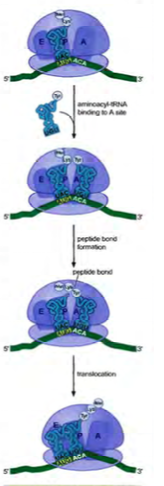
- Atranslocation
79When EF-Tu is bound to GDP and lacking any bound nucleotide it shows high affinity for aminoacyl-tRNAs.
- ATrue
- BFalse
80What are one of the three mechanisms that contributes to the fidelity of codon recognition?
- Atwo adjacent adenine residues in 16S
- BATP hydrolysis
81Third mechanism in correct codon-anticodon incorporation is [blank_start]accommodation[blank_end], which is rotation of tRNA into the peptidyl transferase center.
- Aaccommodation
- BGTP hydrolysis
82Reason why ribosome is a ribozyme?
- A23s RNA
- Bproteins
- Caminoacyl-tRNA
8323S rRNA catalyzes peptide bond formation by base pairing with the CCA variable loop of the tRNAs in the A and the P sites with help position alpha amino go of aminoacyl tRNA to attack carbonyl of growing peptide attached to peptidyl-tRNA.
- ATrue
- BFalse
84[blank_start]EF-G[blank_end] is an elongation factor that completes translocation by binding to the ribosome's factor binding center with GTP.
- AEF-G
- BEF-Tu
85[blank_start]molecular mimicry[blank_end] in which a protein takes on the appearance of a tRNA to facilitate association with the same binding site.
- Amolecular mimicry
- Ball elongation factor
86Exchange of GDP for GTP for both EF-TU-GDP and EF-G-GDP are? ( in order)
- AGDP release and binds to new GTP, exchanging GDP for GTP by complex
- Bexchanging GDP for GTP by complex, GDP release and binds to new GTP,
87Eukaryotic factors analogous to EF-Tu ([blank_start]eEF1[blank_end]) and EF-G([blank_start]eEF2[blank_end]) are name differently but have similar function.
- AeEF1
- BEIF1A
- CeEF2
- DEF-Tu
88how many molecules of ATP and GTP are used for peptide bond formation?
- A2 ATP and 1 GTP
- B2GTP and 1 ATP
- C3 ATP and 0 GTP
89Termination of translation is done by
- ARF1: recognizes UGA
- Brelease factors
- CRF2: recognizes UGA
- DeRF1
90the name of the codon on the release factor the recognizes a stop codon?
- Aanticodon
- Bpeptide anticodon
- CGGQ
91Class II release factor RF3,
- Ahas higher affinity for GDP than GTP
- Bconformational change in ribosome, the class 1 RF stimulates GDP to GTP exchange
- CNo class 1 RF, RF-3-GDP has high affinity for ribosome
92RRF
- Aribosome recycling factor
- Bmimics tRNA
- Cworks with EF-G and IF3
93Puromycin is an aminoglycoside antibiotic which binds to the 16rRNA causing misreading of the genetic code
- ATrue
- BFalse
94tetracycline is a polyketide, which block the p site.
- ATrue
- BFalse
95puromycin
- Amimics aa-tRNA
- Bused for cleaning purposes
96SsrA
- Ain prokaryotes
- Binitiation factor
- CtmRNA (tRNA/mRNA
97What is this mechanism?
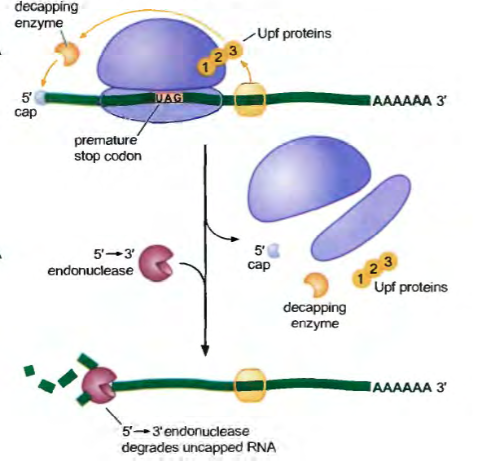
- Anon-stop mediated decay
- Bnonsense mediated mRNA decay
98what machanism is this?
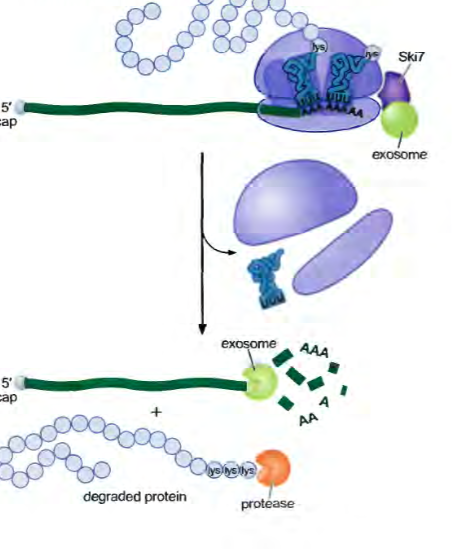
- Anonstop mediated decay
- Bnonsense mediated mRNA decay
99protein mediated regulation in bacteria
- Ainhibition of 30s initiation complex binding
- Bsecondary structure of mRNA can inhibit translation initiation
100riboswitches are
- ARNA sensors for regulation of translation
- Bbinding to its own mRNA
101regulation of translation by small RNA (sRNA) in bacteria
- AeIF2
- BHfq
102initiation in eukaryotic translation is globally regulated by
- Arapamycin
- BeIF4G
- CelF4E-binding proteins
103gene specific regulation of translation through cap sequestration in eukaryotes
- ATrue
- BFalse
104Iron regulation is mediated by amino acids acting as sensor via steric hinderance
- ATrue
- BFalse
105[blank_start]Translation[blank_end] of GCN4 is controlled by short upstream ORFs.
- ATranslation
- Bupregulation
Information
- Description
- translation
- Author
- Andrea B
- Language
- English
- Views
- 44
- Tags
- Rating
- No ratings yet Rate this quiz