
Chapter 8 evolution basics
Slides in this set (6)
-
- Evolution- the change in the genetic makeup of a population over time by passing useful or harmful traits to the offspring
- Common ancestry- closely related organisms all descended from a common ancestor
- Descent with modification- living organisms have descended with adaptation from ancestral species
-
Galapagos Finches(aka Darwin's Finches)
- Finches from the mainland were blown away to other islands
- They developed adaptations-heritable traits that increase an organism's ability to survive and reproduce
- Over many years, new species were formed(speciation).
- *Evolution is NOT organisms individually adapting to their environment.
-
- Natural Selection- organisms with traits that better allow them to survive or reproduce will leave more offspring than their peers
- 3 key principles:
- Parents pass on heritable traits to offspring(reproduction and inheritance)
- Not all offspring produced will survive(competition for resources)
- Offspring vary in traits(variation- can give an advantage in survival and reproduction)
-
Natural vs. Artificial Selection
- Nature "selects" organisms to survive and reproduce(ex: polar bears, giraffes, etc.)
- Humans can choose/select organisms that will survive and reproduce(ex: corn, dog breeding)
- -Those that are selected are not necessarily the best adapted to the environment
-
- Variation- differences in traits
- - This could mean differences in alleles:
- Mutations(random; must be heritable for it to affect evolution whether it is harmful or helpful)
- Sexual Reproduction(crossing over and independent assortment; also random)
- Fitness- how well an organism can survive and reproduce(NOT random)
- High fitness = more offspring
- Low fitness = less offspring
- *If a trait improves fitness, it will usually become more common.
-
Phylogenetic Trees & Speciation
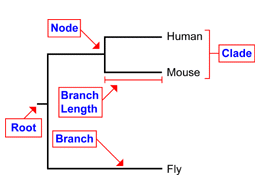
- Phylogenetic trees show how closely related species are.
- The more closely related = shared a recent common ancestor
- Clades are groups in trees made up of ancestor and all their descendants
- Phylogenetic trees are created based on information from physical anatomy, DNA, and fossils
Information
- Description
- 9th grade Biology Slide Set on Chapter 8 evolution basics, created by Ogonna Nnodimele on 10/12/2020.
- Created by
- Ogonna Nnodimele
- Views
- 0
- Rating