
Succession
Slides in this set (5)
-
- Ecosystems are made of all the interacting biotic and biotic factors in a particular area within which there are number of communities of organisms. Such ecosystems such as moorlands or a forest, we may get an impression that it has been there forever. That is not the case. Ecosystems are constantly changing, sometimes slowly and sometimes very rapidly.
- Succession is the term used to describe these changes, over time, in the species that occupy a particular area.
- Examples of successions happen when bare rock or barren lands is first colonised and may occur as a result of:
- volcanoes erupting and depositing lava
- sand being piled into dunes by wind or sea
- lakes or ponds being created by land subsiding
- silts and muds being deposited at rivers estuaries.
- Succession-Unit 4 AQA Biology
- AQA A2 Biology Unit 4: Populations
-
- Succession gets going once the autotrophs have arrived
- First autotrophs are mosses and lichens which can cling directly to the rock surface.
- Over time soils builds up due to weathering of the parent rock. This may be due to Freeze-thaw cycle.
- More complex plants with nitrogen fixing bacteria are often the first to colonise once a basic soil has built up because they can survive in low nitrates level
- Soil changes eventually that leads to vegetation changes, as deeper soil supports vascular plants such as ferns or flowering plants (e.g. grasses)
- Diversity increases, there is competition and taller plants grow, cutting off the light to smaller ones which may then die out. This adds to the soil content.
- Once the soil is deep enough it can then support bush (e.g. hawthorn and privet) and fast growing trees species (e.g. birch).
- Once bushes and trees are established this provides a site for nesting birds.
- So speeding the rate of further colonisation of new plants due to seeds brought by birds
- Once woodland is established it may be colonised by shade tolerant trees (e.g. lime,ash) and slower growing trees (e.g. oak)
- Typical endpoint= Climax community
- This process is very slow and may take centuries before it reaches a climax community which is stable.
-
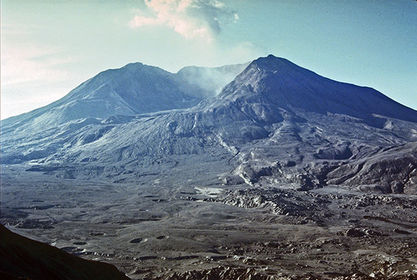
- Caption: After the eruption in the 1980s
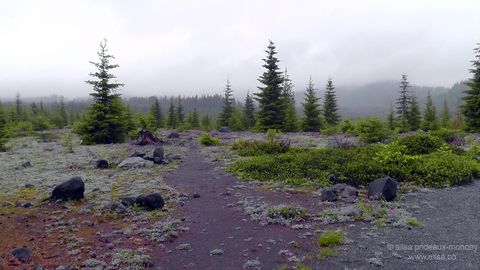
- Caption: Mount St Helens after the process of succession starting to occur
-
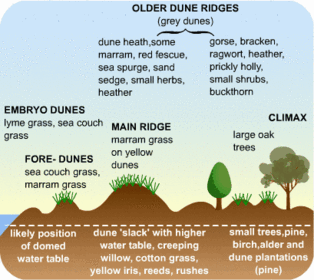
- Caption: Series of stages of sand dune succession
- Sand dunes gives us a good opportunity to see the stages. Next to the sea, the sand is an inhospitable place for plants to live. it is sharp draining, so it does no hold water for any length of time. it is constantly shifting, giving no opportunity to establish their roots. It holds very few nutrients, so plants cannot get inorganic ions, nitrates, for example- there are essential for growth.
- Not much further away from the sea, however, we can often see sand dunes that have been there for a short while. And further behind these, we can find older dunes. If we set out a transect from the sea behind the inland dunes, we can study what species live in the environment at different stages of succession - the earliest stages nearest the sea, and the latest stages furthest furthest away from the sea.
-
Common Features of Any Succession
- The non-living environment becomes less hostile, for example, soil forms, nutrients and more plentiful and plants provide shelter from the wind. this leads to:
- a greater number and variety of habitats that in turns produce:
- Increased biodiversity as different as different species occupy these habitats. This is especially evident in the early stages, reaching a peak in mid succession, but decreasing as the climax community is reached. The decrease is due to dominant species out-competing pioneer and other species, leading to their elimination from the community. With increased biodiversity comes:
- More complex food webs, leading to :
- increased biomass, especially during mid-succession.
- Climax communities are in a stable equilibrium with the prevailing climate. It is abiotic factors such as climate that determine the dominant species of the community. In the lowlands of the UK, the climax community is deciduous woodland. In other climates of the world it may be tundra, steppe or rain forest .
- Another type of succession occurs when land that has already sustained life is suddenly altered. This may be the result of the land clearance for agriculture or a forest fire. the process by which the ecosystems returns to its climax community is the same as described as above, except it occurs more rapidly. This is because the seeds and the spores still remain alive in the soil, and there is an influx of animals and plants through the dispersal and migration from the surrounding area. This type of succession does begin with a pioneer species, but with the organisms from subsequent successional stages. Because the land has been altered in some way for example, by fire, some of the species in the climax community will be different.
Information
- Description
- A-Level Biology Slide Set on Succession, created by Said Arab on 21/12/2015.
- Created by
- Said Arab
- Views
- 2
- Tags
- Rating