
Socrates
Slides in this set (3)
-
- Often called the forefather of Western philosophy
- Socrates was the son of a stone mason and sculptor in Athens
- he received a basic Greek education
- he married a woman called Xanthippe, who complained that he wasn't supporting her and their three sons with philosophy
- Socrates was more interested in the intellectual development of Athens' young boys
- Socrates became known for his fearlessness in hoplite battles
- little is known about Socrates' life, apart from what his students Plato and Xenophan, and playwright Aristophanes, recorded
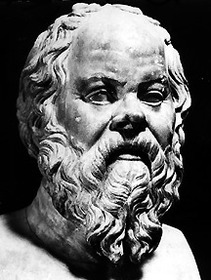
- Plato's Symposium describes Socrates' appearance; not ideal Athenian masculinity, short and stocky, with a snub nose and bulging eyes
- Caption: "A life which is unexamined is not worth living." - Socrates (469-399BC)
-
- engaged people in discussion, challenged ideas and pointed out contradictions
- adopted the standpoint that he knew nothing to demonstrate the power of reason to the exposed weakness of assumed knowledge
- Socrates became so well known because of his brilliant ideas and debates.
- The "Socratic method" laid the foundation for Western systems of logic.
- The Death of Socrates
- The political climate of Greece turned, and he was sentenced to death by hemlock poisoning, for 'corrupting the youth.'
- Socrates nobly accepted his death and didn't attempt to escape.
- https://www.youtube.com/watch?v=RVc8jwYexjE (Embed)
-
- Socrates emphasised that the mind was more important than the body.
- He believed that philosophy should achieve practical results for society and attempted to establish an ethical system based on logical rather than theological doctrine.
- Without constant reflection, life can be lived in the same manner as others, and we should strive to be individuals. Furthermore, human nature dictates that we start to repeat the mistakes of the past and not even realise it.
- The ultimate goal in life is to acquire ultimate wisdom, which comes from knowing oneself. The more a person knows, the greater their ability to reason and make choices that bring about happiness.
- https://www.youtube.com/watch?v=MmCvqz9gXUs (Embed)
Information
- Description
- AS - Level (Year 1) Philosophy (1) Ancient Greek Influences on the Philosophy of Religion) Slide Set on Socrates, created by Summer Pearce on 18/04/2016.
- Created by
- Summer Pearce
- Views
- 14
- Rating