
Enzymes
Slides in this set (3)
-
- Catalyst: a substance that increases the rate of a chemical reaction and is not changed in the process.
- Enzymes: proteins that function as biological catalysts.
- Enzymes are important in all living organisms as chemical reactions that take place in organisms normally happen too slowly to keep the organism alive - unless speeded up by enzyme action.
-
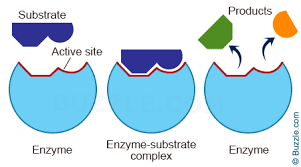
- Enzymes work on substances called substrates. The reaction takes place on a part of the surface of the enzyme called the active site.
- The substrate enters the active site to form an enzyme-substrate complex. The enzyme then produces the product(s).
- Only substrate molecules with a shape that fits in to the active site will take part in the reaction catalyzed by the enzyme.
-
Factors affecting enzyme action
- Temperature
- Increasing the temperature of an enzyme-controlled reaction increases the rate of reaction up to a maximum, which occurs at the optimum temperature.
- This is because greater kinetic energy is causing a greater number of effective collisions between the active site of the enzyme and substrate molecules.
- At higher temperatures the rate of reaction decreases quickly until it stops acting as a catalyst.
- This is due to a change in the shape of the active site meaning that the substrate can no longer fit - the enzyme is denatured.
- pH
- Most enzymes work best at one value of pH.
- At some values of pH the shape of the active site changes to that the substrate molecules no longer fit - denaturation of the enzyme.
Information
- Description
- GCSE Biology (05: Enzymes) Slide Set on Enzymes, created by Zoe CB on 24/04/2016.
- Created by
- Zoe CB
- Views
- 1
- Rating