
3.1.3 Transport in Plants
Slides in this set (15)
-
The Need for a Transport System
- Plants have a small SA:V and are quite large. Every cell must have a regular supply of water, oxygen and nutrients, so a transport system is needed.
- Plants have a low metabolic rate and so a low respiration rate. Their demand for oxygen is low - can be met by diffusion. However, demand for water and sugars is still high. Water and minerals are absorbed from the soil by the roots, and is transported up to the leaves. Sugar are made in the leaves and transported to the rest of the plant.
-
Vascular system in plants - key words
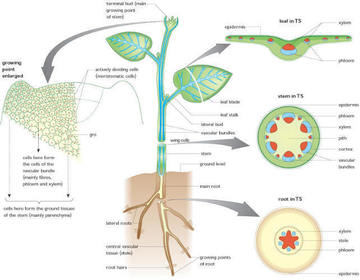
- Dicotyledonous plants - plants with two seed leaves and a branching pattern of veins (vascular bundles of xylem and phloem) in the leaf.
- Xylem - transports water and minerals from the roots to the leaves
- Phloem - transport dissolved assimilates, such as sugars, throughout the plant
-
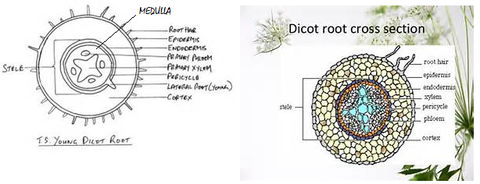
- Caption: Central core of xylem, with phloem in between the arms of the X of xylem - provides strength to withstand pulling forces. Endodermis helps get water into the xylem. Pericycle is a layer of meristem cells - cells which remain able to divide and differentiate.
-
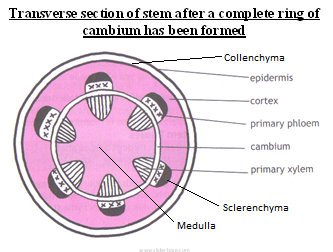
- Caption: Cambium is a layer of meristem cells that divide to produce new xylem and phloem.
-
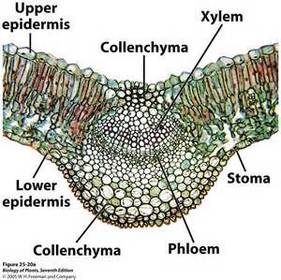
- Caption: A dicotyledonous leaf has a branching network of veins, getting smaller as they spread away from the central midrb. The xylem is located on top of the phloem.
-
Xylem - transports water & mineral ions
- Xylem tissue consists of:
- vessels to carry the water and mineral ions
- fibres to help support the plant
- living parenchyma cells to separate and support vessels
- Development of vessels:
- Lignin deposits on the walls of the cell, making them waterproof, killing the cell.
- End walls and cell contents decay, leaving a empty tube
- Lignin strengthens the walls. Forms patterns such as spirals or rings which allows the plant some flexibility. in some places lignification is incomplete, leaving gaps known as bordered pits - allows water to flow to adjacent vessels or into living parts of the plant
- Xylem adaptions:
- made from dead cells aligned end-to-end to form a continuous column.
- Narrow tubes - water column doesn't break easily
- Lignin - strengthens walls
- Bordered pits - water moves between vessels
- Lignin deposits in patterns - flexibility
- No cell contents - helps flow of water
-
Phloem - transports assimilates
- Phloem transports assimilates (mainly sucrose.) Sucrose is dissolved in water to form sap.
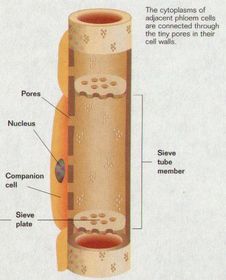
- Phloem tissue consists of sieve tubes and companion cells.
- Sieve tube elements - cells which are lined up end to end to make the sieve tubes in phloem that carry sap up and down the plant. Contain no nucleus and little cytoplasm, for easier mass flow of sap. Separated by sieve plates, which has lots of pores which sap can get through.
- Companion cells - small cells (between the sieve tube elements) with large nucleus, dense cytoplasm and lots of mitochondria which produce the ATP needed to load assimilates actively into the sieve tubes.
-
- Transpiration - the loss of water vapour from the aerial parts of a plant, mostly through the stomata in the leaves.
- Water enters through via xylem. Moves by osmosis into spongy mesophyll.
- Water evaporates.
- Water vapour moves by diffusion out of the leaf, down the water vapour potential gradient, through open stomata.
- Very important for plants. because water vapour lost from the leaf must be replaced from below - sets up a transpiration stream. This helps transport mineral ions, maintain cell turgidity, supplies water to cells and helps to keep the plant cool.
- Factors that affect transpiration:
- Light intensity - changes rate of photosynthesis. Stomata open to allow gas exchange for photosynthesis.
- Temperature - higher temperatures increase rate of evaporation and rate of diffusion, decreases relative water vapour potential of the air, increasing gradient.
- Humidity - changes water vapour potential gradient.
- Wind - maintains a high water vapour potential gradient
- Water avaliabilty - water needs to replace to water lost. If insufficient water, stomata close and leaves wilt.
-
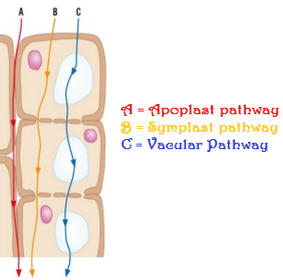
- Plasmodesmata - gaps in cell wall containing cytoplasm that connect two cells
- There are 3 pathways in which water can move through a plant:
- Apoplast pathway - water moves by mass flow, carrying dissolved mineral ions and salts, in the spaces between the cell walls. It doesn't pass through any plasma membranes.
- Symplast pathway - water moves by osmosis through the plasma membrane, into the cell cytoplasm and through the plasmodesmata to the next cell.
- Vacuolar pathway - water moves by osmosis through the plasma membrane, into the cell cytoplasm, through the vacuoles and through the plasmodesmata to the next cell.
-
Movement of water between cells
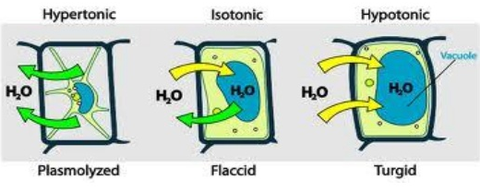
- Plant cell in pure water:
- Water moves into the cell by osmosis, down the water potential gradient. Once the cell is full of water, it is turgid. the strong cellulose wall prevents it from bursting. The water applies a pressure on the cell wall, called the potential pressure. This reduces the volume water entering the cell.
- Plant cell in a solution with a low water potential:
- Water moves out of the cell by osmosis, down the water potential gradient. Cytoplasm and vacuole shrink as the plant loses water. When the plasma membrane loses contact with the cell wall, the cell has plasmolysis. The tissue is flaccid.
-
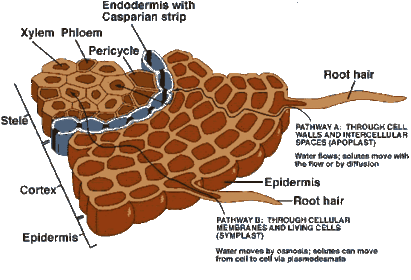
- Water moves into a root hair cell from the soil, due to osmosis.
- Water moves down a water potential gradient into the endodermis (layer of cells surrounding the medulla and xylem) of the vascular bundle. At the endodermis, water can't pass through via the apoplast pathway because it is blocked by a casparian strip (an impermeable, waterproof substance in the wall of the endodermal cells in plant roots, which creates a water tight seal between the cells, preventing water entering the xylem via the apoplast pathway. This ensures water and dissolved minerals have to pass through a plasma membrane.
- Transporter proteins in the plasma membrane actively pump mineral ions from the cortex into the medulla and xylem.
- Water potential of medulla and xylem decrease, so water moves into medulla and xylem by osmosis. It cannot pass back into the cortex because the apoplast pathway is blocked by the Casparian strip.
-
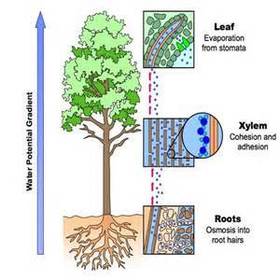
- Water moves up the xylem by mass flow. 3 processes help the movement of water:
- Root pressure - active transport of minerals into the medulla and xylem, draws water in by osmosis. Pressure in the medulla builds up and forces water into and up the xylem.
- Transpiration pull - water lost by transpiration must be replaced by water coming up the xylem. Water molecules are attracted to each other by cohesion forces, holding water molecules together in a long chain. The pull from above draws the chain up and creates tension in the column.
- Capillary action - force of adhesion attract the water molecules to the walls of the xylem vessel, which pull the water up the sides of the vessel.
-
Plant adaptations to water availability
- General adaptations of plants: waxy cuticle, stomata on underside of leaves, stomata close at night when there is no light for photosynthesis, deciduous plants lose their leaves in winter when temperatures may be too low for photosynthesis
- Xerophyte - a plant adapted to living in dry conditions
- For example:
- Marram grass - a plant that lives on sand dunes. Leaf rolled longitudinally so air is trapped inside - reduces water loss due to evaporation, thick waxy cuticle on outer side of rolled leaf - reduces evaporation, stomata on inner side of rolled leaf and in pits in the lower epidermis, dense spongy mesophyll with few air spaces - less SA for evaporation
- Cacti - succulents - store water in their stem, spines instead of leaves - reduces SA, green stem -photosynthesis, widespread roots.
- Hydrophyte - a plant adapted to living in water
- For example:
- Water lily - large air spaces in leaf to keep leaves afloat so they are in air and can absorb sunlight. Stomata on upper epidermis so they are exposed to air. Leaf stem has large air spaces to help with buoyancy and to allow oxygen to diffuse quickly to roots for respiration.
-
- Sink - a part of the plant where assimilates are removed from the transport system, for example the roots receive sugars and store them as starch
- Source - a part of the plant that loads materials into the transport system, for example, the leaves
- Translocation - transport of assimilates throughout a plant which occurs in the phloem
- Assimilates - substances made by the plant, using substances absorbed from the environment, inc sugars (mainly transported as sucrose) and amino acids.
- Active loading - the process in which sucrose is actively moved into the phloem sieve tube, involving energy from ATP from the companion cell
-
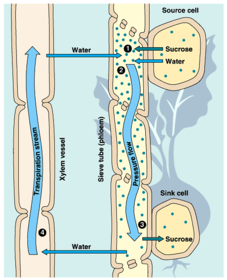
- Movement of sucrose along the phloem is by mass flow.
- 1. Energy from companion cells used to actively transport H+ out of companion cells. A concentration gradient is set up.
- 2. H+ diffuse back into companion cells through cotransporter proteins which only let H+ through if accompanied by a sucrose molecule.
- 3. Concentration of sucrose increase and they diffuse through the plasmodesmata into the sieve tube.
- 4. Water potential lowers. Water molecules move into the phloem by osmosis, increasing the hydrostatic pressure.
- 5. Sap moves down sieve tube from a high hydrostatic pressure at the source to lower hydrostatic pressure at the sink.
- 6. Sucrose moves out of the sieve tube by diffusion or active transport, increasing the water potential in the sieve tube.
- 7. Water moves out of the sieve tube, reducing the hydrostatic pressure.
Information
- Description
- A level Biology (Module 3: Exchange and Transport) Slide Set on 3.1.3 Transport in Plants, created by Zoe Mitchell on 03/01/2017.
- Created by
- Zoe Mitchell
- Views
- 3
- Rating