
Karteikarten
A-level psychology Attachment
Karten in diesem Stapel (16)
- 1ReciprocityA description of how 2 people interact. Mother-infant interaction is reciprocal in that both infant and mother respond to each other's signals, and each elicits a response from the other.
- 2Interactional SynchronyMother and infant reflect both the actions and emotions of the other and do this in a co-ordinated (synchronised/mirrored) way.
- 3Schaffer and Emerson (1964) Method- 60 babies (31 male, 29 female) all from Glasgow. Majority from skilled working-class families
- Babies & mothers were visited at home every month for the first year and again at 18 months.
- The researchers asked the mothers questions about the kind of protest their babies showed in seven everyday separations (e.g. an adult leaving the room) and stranger anxiety.
- This was designed to measure the infants attachment. - 4Schaffer and Emerson (1964) Findings- Between 25 and 32 weeks of age about 50% of babies showed signs of separation anxiety towards a particular adult (usually the mother.)
- Attachment tended to be to the caregiver who was most interactive and sensitive to infant signals and facial expressions.
- By the age of 40 weeks 80% of the babies had a specific attachment and almost 30% displayed multiple attachments. - 5Schaffer and Emerson (1964) Stage 1: Asocial Stage- First few weeks
- Baby is recognising and forming bonds with carers
- Actions towards humans and non-human objects are quite similar
- Show some preference to familiar adults (easier to calm them down).
- Happier in the presence of humans - 6Schaffer and Emerson (1964) Stage 2: Indiscriminate Attachment- From 2-7 months
- Display more observable social behaviour, show a preference for people rather than inanimate objects, recognise and prefer familiar adults.
- Usually accept cuddles and comfort from any adult - don't usually display separation or stranger anxiety. - 7Schaffer and Emerson (1964) Stage 3: Specific attachment- Around 7 months of age
- Majority start to display signs of separation anxiety (when separated from one particular adult), and stranger anxiety.
- This adult is termed the Primary attachment figure - person who offers most interaction and reciprocity. - 8Schaffer and Emerson (1964) Stage 4: Multiple Attachments- Soon after Stage 3, babies' attachment behaviour extends to multiple attachments with other adults with whom they regularly spend time.
- In the study, 29% of he children formed these 'secondary attachments' within a month of forming a specific attachment.
- After about 1 year, the majority of infants had developed multiple attachments. - 9Schaffer and Emerson (1964) Evaluation+ Good external validity - observations in families own homes.
+ Longitudinal design
-- Low population validity
-- Problems studying asocial stage - limited observable behaviour! - 10Classical conditioning (Learning theories of attachments)- Food serves as the UCS
- Pleasure = UCR
- Caregiver = NS
- Caregiver becomes CS after conditioning
- Produces CR of pleasure - 11Operant conditioning (Learning theories of attachments)e.g. babies cry for comfort, crying leads to response from caregiver e.g. feeding.
As long as the caregiver provides the correct response, crying is reinforced.
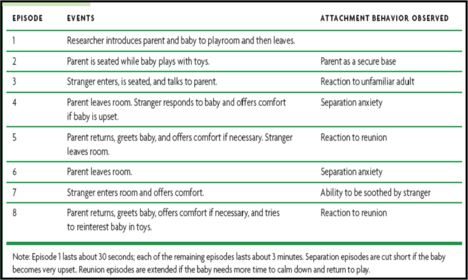
- At the same time the caregiver receives negative as their comfort makes the crying stop. - 12Ainsworth's Strange situation Procedure
- 13Ainsworth's Strange situation FindingsType B: Secure attachment - 60-75%
Type A: Insecure-avoidant attachment - 20-25%
Type C: Insecure resistant attachment - 3% - 14Secure Attachment (Type B)- These children explore happily, but regularly seek proximity with caregiver (secure base). Usually show moderate separation distress and stranger anxiety.
- Securely attached children required and accepted comfort from the caregiver in the reunion stage. - 15Insecure-Avoidant Attachment (Type A)- Children explore freely but do not seek proximity or display secure base behaviour, show little or no reaction when the caregiver leaves and make little effort to make contact when the caregiver returns.
- Little stranger anxiety, & do not require comfort when the caregiver returns. - 16Insecure-Resistant Attachment (Type C)- These children seek greater proximity than others and so explore less.
- Show huge separation and stranger anxiety, but they resist comfort when reunited with their caregiver.
Informationen
- Beschreibung
- A-Level Psychology Karteikarten am A-level psychology Attachment, erstellt von Emily Hargreaves am 14/02/2017.
- Erstellt von
- Emily Hargreaves
- Aufrufe
- 39
- Tags
- Bewertung