Karteikarten
Biology Unit 2 AQA
Karten in diesem Stapel (26)
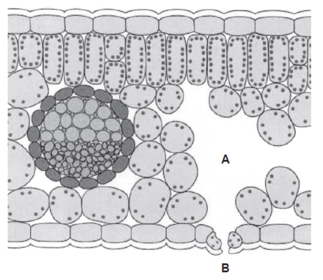
- 1Name two tissues in the leaf that transport substances around the plant [1 Mark]Xylem and phloem
- 2Gases diffuse between the leaf and the surrounding air. What is diffusion? [2 Marks]movement / spreading out of particles / molecules / ions / atoms
from high to low concentration. - 3Name one gas that will diffuse from point A to point B on the diagram on a sunny day. [1 Marks]oxygen / water vapour
- 4Some students were asked to investigate the distribution of clover in a field of grass. They noticed that the clover grew in patches among the grass. The students decided to use quad rats. Describe how the students should decide where to place the quad rats to investigate the distribution of the clover. [2 Marks]chose places randomly
method of obtaining randomness, e.g. (grid and) random numbers - 5The diagram shows one of the quad rats the students used. Estimate the number of squares of the quad rat covered with clover. [1 Mark]7 or 8
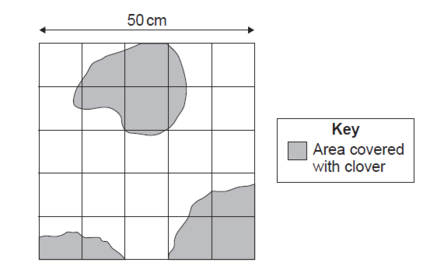
- 6Describe how your worked out your answer to the last question [1 Mark]count number of whole squares and add estimate of area covered by part squares
- 7Use your answer from the diagram to calculate the percentage of the quad rat covered by the clover. (2 marks)28 – 32 (in range)%
- 8Suggest one factor that could account for the distribution of the clover plants. [1 Mark]nutrients / minerals / ions / fertiliser / water
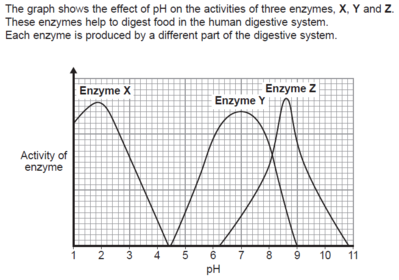
- 9What is the optimum (best) pH for the action of enzyme Z? [1 Mark]8.6
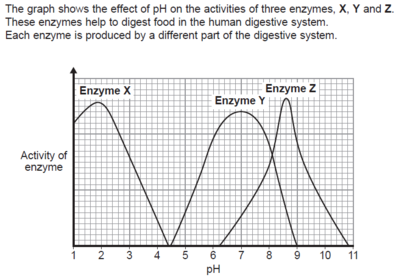
- 10The stomach makes a substance that gives the correct pH for enzyme action in the human stomach. Name this substance. [ 1 Mark]Hydrachloric Acid
- 11Which enzyme, X, Y or Z, will work best in the human stomach? [1 Mark]X
- 12QWOC-Different parts of the human digestive system help to break down molecules of fat so that they can be absorbed into the body. Describe how. To gain full marks you should refer to: the enzyme and where the enzyme is produced the products of digestion any other chemicals involved. [6 Marks]examples of biological points made in the response:
mechanical breakdown in mouth / stomach
fats fatty acids and / or glycerol
by lipase
(produced by) pancreas
and small intestine
fat digestion occurs in small intestine
bile
produced by liver
neutralises acid from stomach
produces alkaline conditions in intestine
refs. to increased surface area related to emulsification or chewing
products are small molecules / water-soluble
products absorbed by small intestine - 13—A = cytoplasm
B = (cell) membrane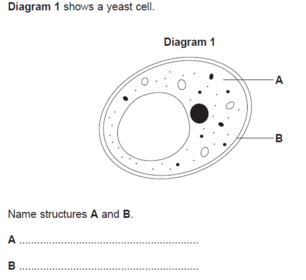
- 14Yeast cells can respire anaerobically. The equation for anaerobic respiration in yeast is: glucose alcohol + carbon dioxide (+ energy) Give one way in which anaerobic respiration in yeast cells is different from anaerobic respiration in human muscle cells. [1 Mark]in yeast:
makes alcohol / makes CO2 / does not make lactic acid - 15Complete the equation for photosynthesis. .............................. + water light energy .............................. + .............................. [3 marks]LHS – carbon dioxide / CO2
RHS
glucose / carbohydrate / sugar
oxygen - 16The rate of photosynthesis in a plant depends on several factors in the environment. These factors include light intensity and the availability of water. Describe and explain the effects of two other factors that affect the rate of photosynthesis. [5 Marks]any five from:
factor 1: CO2 (concentration)
effect - as CO2 increases so does rate and then it levels off or shown in a graph
explanation:
(graph increases) because CO2 is the raw material or used in photosynthesis / converted to organic substance / named eg
or
(graph levels off) when another factor limits the rate.
factor 2: temperature
effect – as temperature increases, so does the rate and then it decreases or shown in a graph
explanation:
(rise in temp) increases rate of chemical reactions / more kinetic energy
or
(decreases) because the enzyme is denatured. - 17A certain gene codes for the production of an enzyme called ‘HEXA’. One human genetic disorder causes damage to nerve cells in the brain. This disorder is caused by a small change in the DNA of the HEXA gene. People with this disorder make a changed HEXA enzyme that does not work. Explain how a change in the DNA of the HEXA gene can result in the production of a changed HEXA enzyme that does not work.changes code /sequences of bases
or
sequence of amino acids is different the enzyme has different / wrong shape / structure
so substrate will not fit into enzyme / will not join to enzyme - 18The gene coding for the HEXA enzyme is found on chromosome number 15. How many chromosomes are there in the nucleus of a human nerve cell? [1 Mark]46
- 19The boy grew up and got married. A blood test showed that his wife had also inherited the same changed HEXA gene. There is a 1 in 4 chance that this couple’s first child will have the genetic disorder. Use a genetic diagram to explain why. Use the following symbols in your explanation: H = allele for making the normal HEXA enzyme h = allele for making a HEXA enzyme that does not work. [3 mark]genetic diagram including: Parental gametes:
H and h from both parents derivation of offspring genotypes:
HH Hh Hh hh
identification of hh (having the disorder) if 1 in 4 - 20— product not contaminated with enzyme or is pure
enzyme can be reused
continuous flow process possible
enzyme more stable / can be used at higher temperature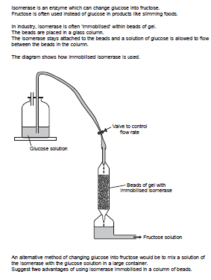
- 21—maximum fructose production / maximum enzyme activity
or
increase in flow rate does not increase production
higher rate leaves some glucose unchanged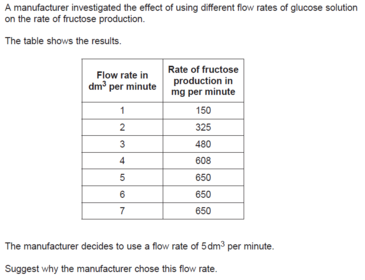
- 22Fructose is a much sweeter sugar than glucose. Explain why manufacturers of slimming foods may wish to use fructose as a sweetener instead of glucose. [2 Marks]less (fructose) needed (for same sweetness)
(less fructose ) less fattening / fewer ‘calories’ - 23How does a chromosome become two strands? [1 Mark]DNA replication / copies of genetic material were made
- 24For sexual reproduction, the plants produce gametes. Name the type of cell division that produces gametes. [1 Mark]meiosis
- 25Explain why each chromosome must become two strands before the cell divides. [2 Marks]one copy of each (chromosome / chromatid / strand) to each offspring cell
each offspring cell receives a complete set of / the same genetic material - 26—any two from:
offspring contain 3 copies of each gene / of each chromosome / odd number of each of the chromosomes
some chromosomes unable to pair (in meiosis)
(viable) gametes not formed / some gametes with extra / too many genes / chromosomes
or
some gametes with missing genes / chromosomes [2 Marks]