
Mindmap
Gram Negative Rods/Cocci
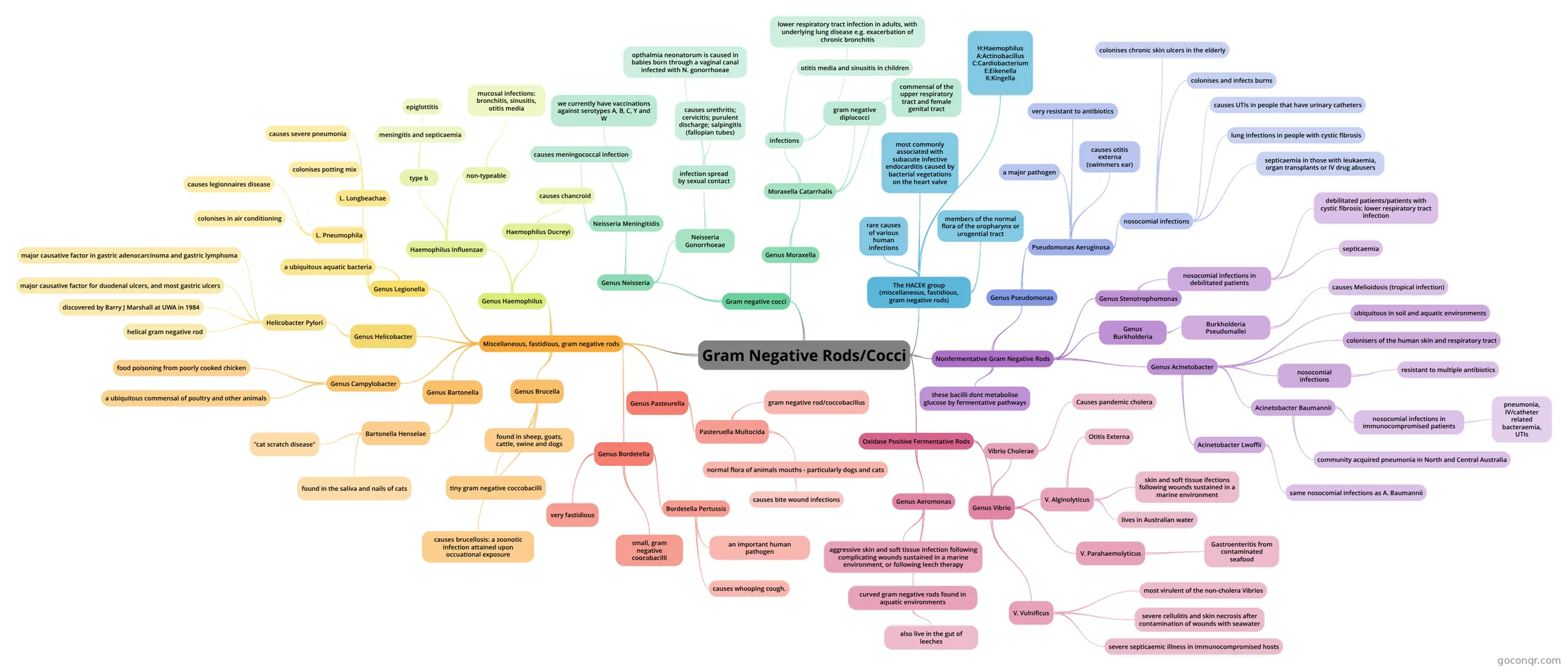
Mind map: Gram negative rods and cocci
Inhalt der Mindmap
Gram Negative Rods/Cocci
The HACEK group (miscellaneous, fastidious, gram negative rods)
- members of the normal flora of the oropharynx or urogential tract
- rare causes of various human infections
- most commonly associated with subacute infective endocarditis caused by bacterial vegetations on the heart valve
- H:Haemophilus A:Actinobacillus C:Cardiobacterium E:Eikenella K:Kingella
Nonfermentative Gram Negative Rods
- these bacilli dont metabolise glucose by fermentative pathways
- Genus Pseudomonas
- Pseudomonas Aeruginosa
- a major pathogen
- very resistant to antibiotics
- causes otitis externa (swimmers ear)
- nosocomial infections
- colonises chronic skin ulcers in the elderly
- colonises and infects burns
- causes UTIs in people that have urinary catheters
- lung infections in people with cystic fibrosis
- septicaemia in those with leukaemia, organ transplants or IV drug abusers
- Pseudomonas Aeruginosa
- Genus Stenotrophomonas
- nosocomial infections in debilitated patients
- debilitated patients/patients with cystic fibrosis: lower respiratory tract infection
- septicaemia
- nosocomial infections in debilitated patients
- Genus Burkholderia
- Burkholderia Pseudomallei
- causes Melioidosis (tropical infection)
- Burkholderia Pseudomallei
- Genus Acinetobacter
- ubiquitous in soil and aquatic environments
- colonisers of the human skin and respiratory tract
- nosocomial infections
- resistant to multiple antibiotics
- Acinetobacter Baumannii
- nosocomial infections in immunocompromised patients
- pneumonia, IV/catheter related bacteraemia, UTIs
- community acquired pneumonia in North and Central Australia
- nosocomial infections in immunocompromised patients
- Acinetobacter Lwoffii
- same nosocomial infections as A. Baumannii
Oxidase Positive Fermentative Rods
- Genus Vibrio
- Vibrio Cholerae
- Causes pandemic cholera
- V. Alginolyticus
- lives in Australian water
- skin and soft tissue ifections following wounds sustained in a marine environment
- Otitis Externa
- V. Parahaemolyticus
- Gastroenteritis from contaminated seafood
- V. Vulnificus
- most virulent of the non-cholera Vibrios
- severe septicaemic illness in immunocompromised hosts
- severe cellulitis and skin necrosis after contamination of wounds with seawater
- Vibrio Cholerae
- Genus Aeromonas
- curved gram negative rods found in aquatic environments
- also live in the gut of leeches
- aggressive skin and soft tissue infection following complicating wounds sustained in a marine environment, or following leech therapy
- curved gram negative rods found in aquatic environments
- Genus Vibrio
Miscellaneous, fastidious, gram negative rods
- Genus Pasteurella
- Pasteruella Multocida
- gram negative rod/coccobacillus
- normal flora of animals mouths - particularly dogs and cats
- causes bite wound infections
- Pasteruella Multocida
- Genus Bordetella
- Bordetella Pertussis
- an important human pathogen
- causes whooping cough.
- small, gram negative coocobacilli
- very fastidious
- Bordetella Pertussis
- Genus Brucella
- found in sheep, goats, cattle, swine and dogs
- tiny gram negative coccobacilli
- causes brucellosis: a zoonotic infection attained upon occuational exposure
- Genus Bartonella
- Bartonella Henselae
- found in the saliva and nails of cats
- "cat scratch disease"
- Bartonella Henselae
- Genus Campylobacter
- food poisoning from poorly cooked chicken
- a ubiquitous commensal of poultry and other animals
- Genus Helicobacter
- Helicobacter Pylori
- helical gram negative rod
- discovered by Barry J Marshall at UWA in 1984
- major causative factor for duodenal ulcers, and most gastric ulcers
- major causative factor in gastric adenocarcinoma and gastric lymphoma
- Helicobacter Pylori
- Genus Legionella
- a ubiquitous aquatic bacteria
- L. Pneumophila
- colonises in air conditioning
- causes legionnaires disease
- L. Longbeachae
- colonises potting mix
- causes severe pneumonia
- Genus Haemophilus
- Haemophilus Influenzae
- type b
- meningitis and septicaemia
- epiglottitis
- non-typeable
- mucosal infections: bronchitis, sinusitis, otitis media
- type b
- Haemophilus Ducreyi
- causes chancroid
- Haemophilus Influenzae
- Genus Pasteurella
Gram negative cocci
- Genus Neisseria
- Neisseria Meningitidis
- causes meningococcal infection
- we currently have vaccinations against serotypes A, B, C, Y and W
- Neisseria Gonorrhoeae
- infection spread by sexual contact
- causes urethritis; cervicitis; purulent discharge; salpingitis (fallopian tubes)
- opthalmia neonatorum is caused in babies born through a vaginal canal infected with N. gonorrhoeae
- infection spread by sexual contact
- Neisseria Meningitidis
- Genus Moraxella
- Moraxella Catarrhalis
- gram negative diplococci
- commensal of the upper respiratory tract and female genital tract
- infections
- lower respiratory tract infection in adults, with underlying lung disease e.g. exacerbation of chronic bronchitis
- otitis media and sinusitis in children
- Moraxella Catarrhalis
- Genus Neisseria
Informationen
- Beschreibung
- IMED2001 (Bacteria) Mindmap am Gram Negative Rods/Cocci, erstellt von Allira Payne am 02/06/2018.
- Erstellt von
- Allira Payne
- Aufrufe
- 2
- Bewertung