
Mindmap
Developmental psychology
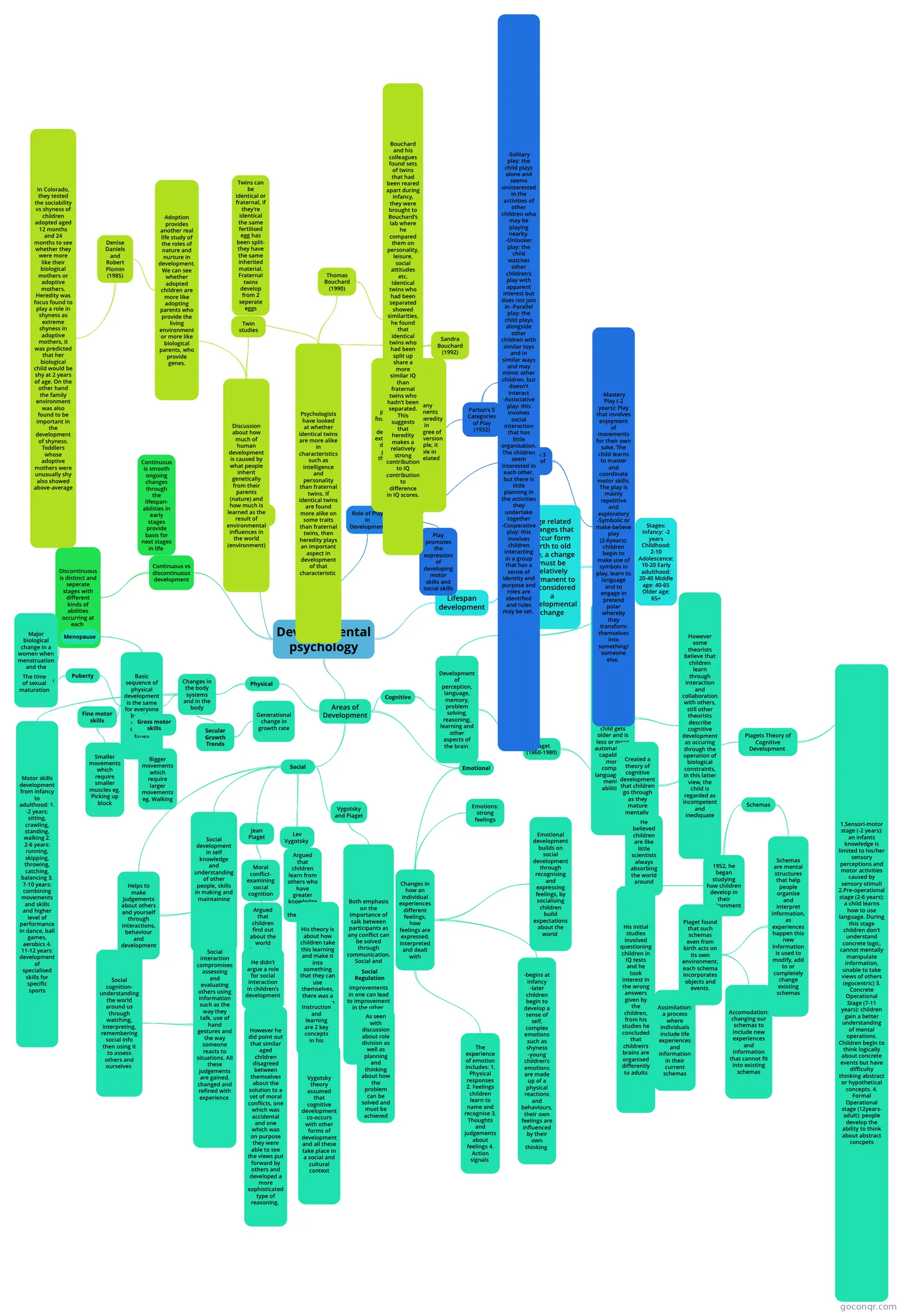
Mind map: Developmental psychology
Inhalt der Mindmap
Developmental psychology
Lifespan development
- Age related changes that occur form birth to old age, a change must be relatively permanent to be considered a developmental change
- Stages: Infancy: -2 years Childhood: 2-10 Adolescence: 10-20 Early adulthood: 20-40 Middle age: 40-65 Older age: 65+
- Age related changes that occur form birth to old age, a change must be relatively permanent to be considered a developmental change
Areas of Development
- Physical
- Changes in the body systems and in the body
- Basic sequence of physical development is the same for everyone but they occur at different times
- Gross motor skills
- Bigger movements which require larger movements eg. Walking
- Fine motor skills
- Smaller movements which require smaller muscles eg. Picking up block
- Menopause
- Major biological change in a women when menstruation and the ability to have children ceases
- Puberty
- The time of sexual maturation
- Gross motor skills
- Secular Growth Trends
- Generational change in growth rate
- Motor skills development from infancy to adulthood: 1. -2 years: sitting, crawling, standing, walking 2. 2-6 years: running, skipping, throwing, catching, balancing 3. 7-10 years: combining movements and skills and higher level of performance in dance, ball games, aerobics 4. 11-12 years: development of specialised skills for specific sports
- Basic sequence of physical development is the same for everyone but they occur at different times
- Changes in the body systems and in the body
- Cognitive
- Development of perception, language, memory, problem solving, reasoning, learning and other aspects of the brain
- Siegler (1998)
- Pointed out that there’s many ways to describe cognitive development, cognitive development can be regarded as occurring simply as the child gets older and is less or more automatically capable of more complex language and mental abilities
- However some theorists believe that children learn through interaction and collaboration with others, still other theorists describe cognitive development as occuring through the operation of biological constraints, in this latter view, the child is regarded as incompetent and inediquate
- Pointed out that there’s many ways to describe cognitive development, cognitive development can be regarded as occurring simply as the child gets older and is less or more automatically capable of more complex language and mental abilities
- Piaget (1860-1980)
- Created a theory of cognitive development that children go through as they mature mentally
- He believed children are like little scientists always absorbing the world around them
- His initial studies involved questioning children in IQ tests and he took interest in the wrong answers given by the children, from his studies he concluded that children’s brains are organised differently to adults
- 1952, he began studying how children develop in their environment
- Schemas
- Schemas are mental structures that help people organise and interpret information, as experiences happen this new information is used to modify, add to or completely change existing schemas
- Piaget found that such schemas even from birth acts on its own environment, each schema incorporates objects and events.
- Assimilation: a process where individuals include life experiences and information in their current schemas
- Accomodation: changing our schemas to include new experiences and information that cannot fit into existing schemas
- Piaget found that such schemas even from birth acts on its own environment, each schema incorporates objects and events.
- Schemas are mental structures that help people organise and interpret information, as experiences happen this new information is used to modify, add to or completely change existing schemas
- Schemas
- 1952, he began studying how children develop in their environment
- His initial studies involved questioning children in IQ tests and he took interest in the wrong answers given by the children, from his studies he concluded that children’s brains are organised differently to adults
- Piagets Theory of Cognitive Development
- 1.Sensori-motor stage (-2 years): an infants knowledge is limited to his/her sensory perceptions and motor activities caused by sensory stimuli 2.Pre-operational stage (2-6 years): a child learns how to use language. During this stage children don’t understand concrete logic, cannot mentally manipulate information, unable to take views of others (egocentric) 3. Concrete Operational Stage (7-11 years): children gain a better understanding of mental operations. Children begin to think logically about concrete events but have difficulty thinking abstract or hypothetical concepts. 4. Formal Operational stage (12years- adult): people develop the ability to think about abstract concpets
- He believed children are like little scientists always absorbing the world around them
- Created a theory of cognitive development that children go through as they mature mentally
- Siegler (1998)
- Development of perception, language, memory, problem solving, reasoning, learning and other aspects of the brain
- Emotional
- Changes in how an individual experiences different feelings, how feelings are expressed, interpreted and dealt with
- Emotions: strong feelings
- -begins at infancy -later children begin to develop a sense of self, complex emotions such as shyness -young children’s emotions are made up of a physical reactions and behaviours, their own feelings are influenced by their own thinking
- The experience of emotion includes: 1. Physical responses 2. Feelings children learn to name and recognise 3. Thoughts and judgements about feelings 4. Action signals
- Emotional development builds on social development through recognising and expressing feelings, by socialising children build expectations about the world
- Changes in how an individual experiences different feelings, how feelings are expressed, interpreted and dealt with
- Social
- Social development in self knowledge and understanding of other people, skills in making and maintaining friendships and reasoning about behaviour
- Helps to make judgements about others and yourself through interactions, behaviour and development
- Social interaction compromises assessing and evaluating others using information such as the way they talk, use of hand gestures and the way someone reacts to situations. All these judgements are gained, changed and refined with experience
- Social cognition- understanding the world around us through watching, interpreting, remembering social info then using it to assess others and ourselves
- Social interaction compromises assessing and evaluating others using information such as the way they talk, use of hand gestures and the way someone reacts to situations. All these judgements are gained, changed and refined with experience
- Jean Piaget
- Moral conflict- examining social cognition
- Argued that children find out about the world themselves
- He didn’t argue a role for social interaction in children’s development
- However he did point out that similar aged children disagreed between themselves about the solution to a set of moral conflicts, one which was accidental and one which was on purpose they were able to see the views put forward by others and developed a more sophisticated type of reasoning.
- He didn’t argue a role for social interaction in children’s development
- Argued that children find out about the world themselves
- Moral conflict- examining social cognition
- Lev Vygotsky
- Argued that children learn from others who have greater knowledge than themselves
- His theory is about how children take this learning and make it into something that they can use themselves, there was a emphasis on collaboration between adults and children
- Instruction and learning are 2 key concepts in his theory
- Vygotsky theory assumed that cognitive development co-occurs with other forms of development and all these take place in a social and cultural context
- Instruction and learning are 2 key concepts in his theory
- His theory is about how children take this learning and make it into something that they can use themselves, there was a emphasis on collaboration between adults and children
- Argued that children learn from others who have greater knowledge than themselves
- Vygotsky and Piaget
- Both emphasis on the importance of talk between participants as any conflict can be solved through communication. Social and cognitive are inter related and improvements in one can lead to improvement in the other
- Social Regulation
- As seen with discussion about role division as well as planning and thinking about how the problem can be solved and must be achieved
- Social Regulation
- Both emphasis on the importance of talk between participants as any conflict can be solved through communication. Social and cognitive are inter related and improvements in one can lead to improvement in the other
- Physical
Continuous vs discontinuous development
- Continuous is smooth ongoing changes through the lifespan- abilities in early stages provide basis for next stages in life
- Discontinuous is distinct and seperate stages with different kinds of abilities occurring at each
Nature vs Nurture
- Discussion about how much of human development is caused by what people inherit genetically from their parents (nature) and how much is learned as the result of environmental influences in the world (environment)
- Twin studies
- Twins can be identical or fraternal, if they’re identical the same fertilised egg has been split- they have the same inherited material. Fraternal twins develop from 2 seperate eggs
- Psychologists have looked at whether identical twins are more alike in characteristics such as intelligence and personality than fraternal twins. If identical twins are found more alike on some traits than fraternal twins, then heredity plays an important aspect in development of that characteristic
- Sandra Bouchard (1992)
- Drawing on many previous experiments found that while heredity played a role in determine the degree of extraverison/introversion displayed in people, it plays a bigger role in their IQ than unrelated siblings.
- Thomas Bouchard (1990)
- Bouchard and his colleagues found sets of twins that had been reared apart during infancy, they were brought to Bouchard’s lab where he compared them on personality, leisure, social attitudes etc. Identical twins who had been separated showed similarities, he found that identical twins who had been split up share a more similar IQ than fraternal twins who hadn’t been separated. This suggests that heredity makes a relatively strong contribution to IQ contribution to difference in IQ scores.
- Sandra Bouchard (1992)
- Psychologists have looked at whether identical twins are more alike in characteristics such as intelligence and personality than fraternal twins. If identical twins are found more alike on some traits than fraternal twins, then heredity plays an important aspect in development of that characteristic
- Twins can be identical or fraternal, if they’re identical the same fertilised egg has been split- they have the same inherited material. Fraternal twins develop from 2 seperate eggs
- Adoption Studies
- Adoption provides another real life study of the roles of nature and nurture in development. We can see whether adopted children are more like adopting parents who provide the living environment or more like biological parents, who provide genes.
- Denise Daniels and Robert Plomin (1985)
- In Colorado, they tested the sociability vs shyness of children adopted aged 12 months and 24 months to see whether they were more like their biological mothers or adoptive mothers. Heredity was focus found to play a role in shyness as extreme shyness in adoptive mothers, it was predicted that her biological child would be shy at 2 years of age. On the other hand the family environment was also found to be important in the development of shyness. Toddlers whose adoptive mothers were unusually shy also showed above-average
- Denise Daniels and Robert Plomin (1985)
- Adoption provides another real life study of the roles of nature and nurture in development. We can see whether adopted children are more like adopting parents who provide the living environment or more like biological parents, who provide genes.
- Twin studies
- Discussion about how much of human development is caused by what people inherit genetically from their parents (nature) and how much is learned as the result of environmental influences in the world (environment)
Role of Play in Development
- Piaget’s 3 Stages of Play
- -Mastery Play (-2 years): Play that involves enjoyment of movements for their own sake. The child learns to master and coordinate motor skills. The play is mainly repetitive and exploratory -Symbolic or make-believe play (2-6years): children begin to make use of symbols in play, learn to language and to engage in pretend polar whereby they transform themselves into something/ someone else.
- Parton’s 5 Categories of Play (1932)
- -Solitary play: the child plays alone and seems uninterested in the activities of other children who may be playing nearby. -Onlooker play: the child watches other children’s play with apparent interest but does not join in -Parallel play: the child plays alongside other children with similar toys and in similar ways and may mimic other children, but doesn’t interact -Associative play: this involves social interaction that has little organisation. The children seem interested in each other, but there is little planning in the activities they undertake together -Cooperative play: this involves children interacting in a group that has a sense of identity and purpose and roles are identified and rules may be set.
- Play promotes the expression of developing motor skills and social skills
- Piaget’s 3 Stages of Play
Informationen
- Beschreibung
- Year 11 2. Psychology YR 11 (UNIT 2) Mindmap am Developmental psychology, erstellt von ruby f am 22/10/2018.
- Erstellt von
- ruby f
- Aufrufe
- 2
- Bewertung
Mehr zu Stages of Human Development