
Mindmap
GCSE AQA Biology 2 Genetics
Inhalt der Mindmap
GCSE AQA Biology 2 Genetics
Stem cells
- Differentiation: Process by which a cell changes to become specialised for its job
- In most animal cells, ability to differentiate is lost v. early but lots of plant cells don't ever lose the ability
- Some cells are undifferentiated & can develop into different types of cell depending on instructions given - stem cells
- Found in early human embyos (can turn into any type of cell) & in adult bone marrow (can turn into certain ones - less versatile)
- Medicine already uses adult stem cell e.g. people with blood diseases (sickle cell anaemia) can be treated with bone marrow transplant (turn into blood cells to replace faulty ones)
- Scientists can extract embryonic stem cells & use them to replace faulty cells
- Could make beating heart muscle cells for people with heart disease, insulin-producing cells for people with diabetes, nerve cells for people with paralysis etc
- To get cultures of one specific type of cell, researchers try to control differentiation by changing environment - needs more research
- Stem cell research
- For
- Curing patients who already exist & are suffering is more important than embryo rights
- Embryos used in research are usually unwanted ones from fertility clinics - would be destroyed anyway
- Against
- Human embryos shouldn't be used as each one is potential life
- Should find other sources of stem cells
- Banned in some countries, but is allowed in UK if it follows strict guidelines
- For
- Differentiation: Process by which a cell changes to become specialised for its job
X and Y chromosomes
- 22 matched pairs of chromosomes in each human body cell - 23rd pair are labelled XX or XY (chromosomes which decide gender)
- All men have X and Y chromosome - Y chromosome causes male characteristics
- All women have 2 X chromosomes - XX combination allows female characteristics to develop
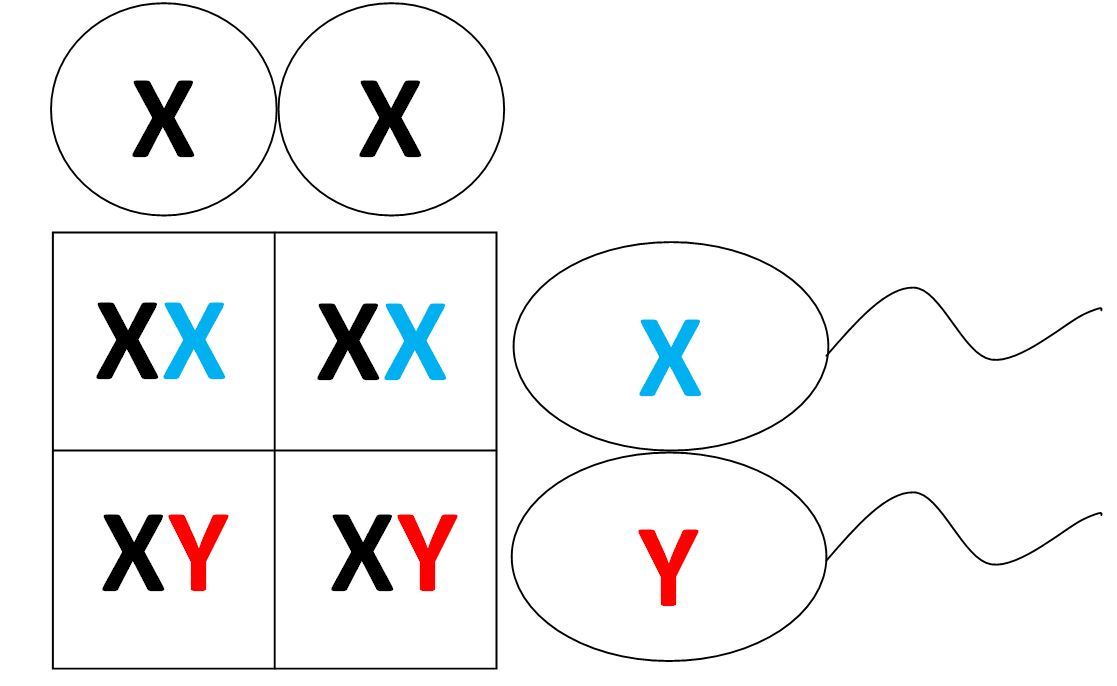
- When making sperm and eggs, chromosomes are split apart in first meiosis division - 50% chance sperm gets X/Y, 100% chance egg gets X
- Probability of getting boy/girl can be shown with a genetic diagram:
The work of Mendel
- Gregor Mendel - Austrian monk
- Noted how characteristics in plants were passed on from one generation to the next
- Results published in 1866 & eventually became foundation of modern genetics
- Reached 3 important conclusions:
- Characteristics in plants are determined by 'hereditary units'
- Hereditary units are passed on from both parents, one from each parent
- Hereditary units can be dominant or recessive - if individual has both dominant & recessive unit, dominant will be expressed
- We now know 'hereditary units' are genes - in Mendel's time nobody knew anything about genes or DNA so significance of his work was not realised until after his death
Inheriting characteristics
- Alleles: different versions of the same gene
- In genetic diagrams, letters usually represent alleles
- Homozygous: organism has 2 alleles for a particular gene that are the same
- Heterozygous: organism has 2 alleles for a particular gene that are differnt
- If 2 alleles are different, only one can determine characteristic - the dominant one
- For organisms to display recessive characteristic, both its alleles must be recessive
- Genotype: what alleles are present
- Phenotype: characteristic shown
- Alleles: different versions of the same gene
Genetic disorders
- Cystic fibrosis
- Genetic disorder of cell membranes - results in body producing lots of thick sticky mucus in air passages & pancreas
- Caused by a recessive allele - carried by about 1 person in 25
- For child to have disorder, both parents must be carriers or sufferers
- Polydactyly
- Genetic disorder where baby is born with extra fingers or toes - not life-threatening
- Caused by dominant allele - can be inherited if one parent carries gene (all carriers are sufferers)
- Cystic fibrosis
Embryo screening
- During IVF, embryos are fertilised in lab & implanted into mother's womb - more than one egg is fertilised so there's better chance of success
- Before implantation it is possible to remove a cell from each embryo to analyse its genes
- Many genetic disorders could be detected in this way
- Embryos with 'good' alleles would be implanted, one with 'bad' alleles would be destroyed
- Many genetic disorders could be detected in this way
- Before implantation it is possible to remove a cell from each embryo to analyse its genes
- For
- Will help to stop people suffering
- There are laws to stop it going too far
- During IVF, most embryos are destroyed anyway - screening just allows selected one to be healthy
- Treating disorders is very expensive
- Against
- Everyone might want to screen so they can pick most 'desirable' embryo
- Rejected embryos are destroyed - potential human life
- Implies people with genetic disorders are 'undesirable' - could increase prejudice
- Screening is expensive
- During IVF, embryos are fertilised in lab & implanted into mother's womb - more than one egg is fertilised so there's better chance of success
Bilder und Dateien der Mindmap
Informationen
- Beschreibung
- A mind map showing information about stem cells, x and y chromosomes, the work of Mendel, inheriting characteristics, genetic disorders and embryo screening.
- Erstellt von
- Lilac Potato
- Aufrufe
- 340
- Tags
- Bewertung