
Mindmap
Communication
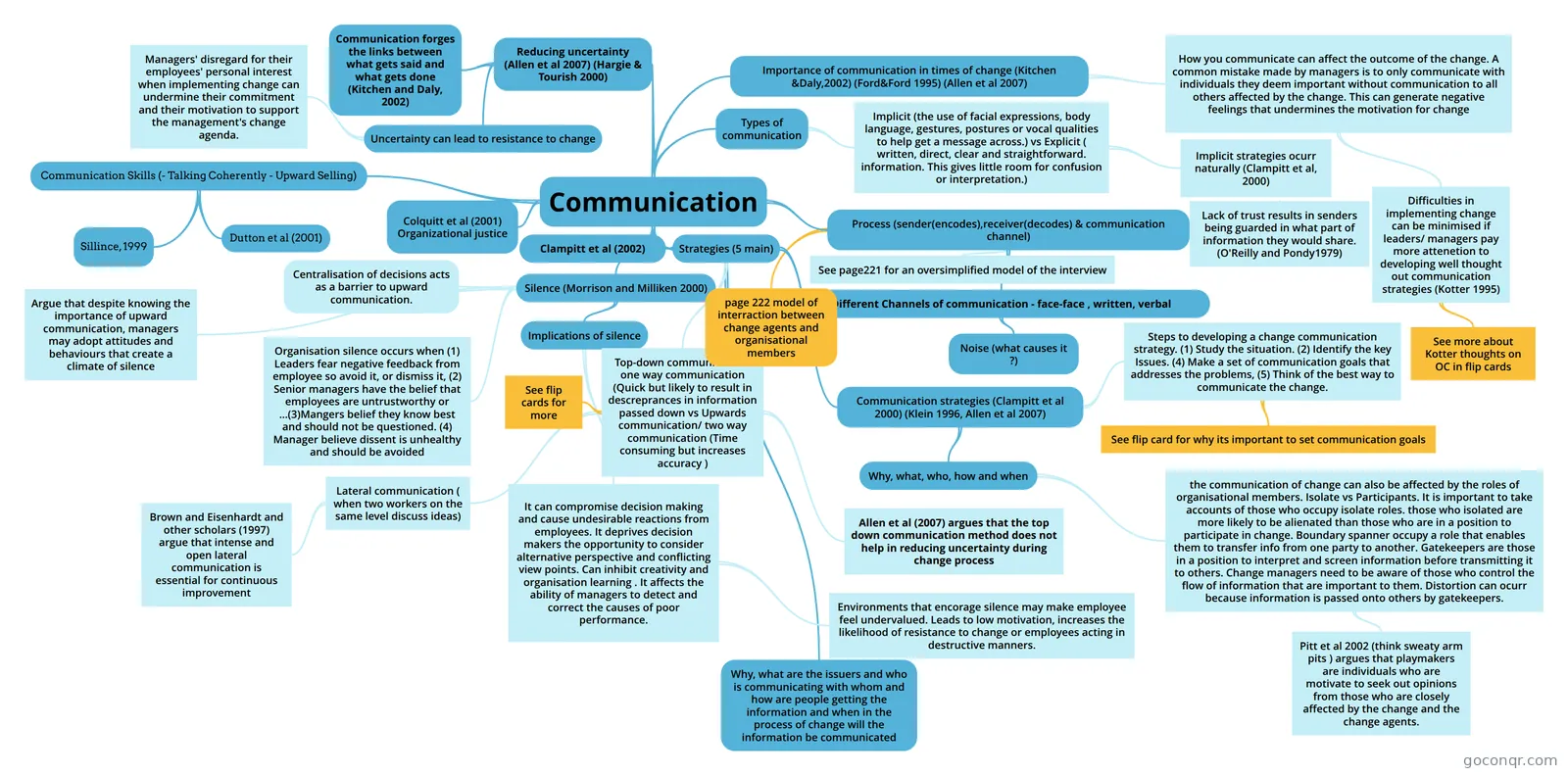
Mind map: communication in organizational change
Inhalt der Mindmap
Communication
Strategies (5 main)
- Clampitt et al (2002) Strategies of communication. (1)
- Communication strategies (Clampitt et al 2000) (Klein 1996, Allen et al 2007)
- Why, what, who, how and when
- the communication of change can also be affected by the roles of organisational members. Isolate vs Participants. It is important to take accounts of those who occupy isolate roles. those who isolated are more likely to be alienated than those who are in a position to participate in change. Boundary spanner occupy a role that enables them to transfer info from one party to another. Gatekeepers are those in a position to interpret and screen information before transmitting it to others. Change managers need to be aware of those who control the flow of information that are important to them. Distortion can ocurr because information is passed onto others by gatekeepers.
- Pitt et al 2002 (think sweaty arm pits ) argues that playmakers are individuals who are motivate to seek out opinions from those who are closely affected by the change and the change agents.
- the communication of change can also be affected by the roles of organisational members. Isolate vs Participants. It is important to take accounts of those who occupy isolate roles. those who isolated are more likely to be alienated than those who are in a position to participate in change. Boundary spanner occupy a role that enables them to transfer info from one party to another. Gatekeepers are those in a position to interpret and screen information before transmitting it to others. Change managers need to be aware of those who control the flow of information that are important to them. Distortion can ocurr because information is passed onto others by gatekeepers.
- Steps to developing a change communication strategy. (1) Study the situation. (2) Identify the key Issues. (4) Make a set of communication goals that addresses the problems, (5) Think of the best way to communicate the change.
- See flip card for why its important to set communication goals
- Why, what, who, how and when
- Top-down communication/ one way communication (Quick but likely to result in descreprances in information passed down vs Upwards communication/ two way communication (Time consuming but increases accuracy )
- Allen et al (2007) argues that the top down communication method does not help in reducing uncertainty during change process
- See flip cards for more
- Lateral communication ( when two workers on the same level discuss ideas)
- Brown and Eisenhardt and other scholars (1997) argue that intense and open lateral communication is essential for continuous improvement
- Clampitt et al (2002)
- Why, what are the issuers and who is communicating with whom and how are people getting the information and when in the process of change will the information be communicated
Importance of communication in times of change (Kitchen &Daly,2002) (Ford&Ford 1995) (Allen et al 2007)
- How you communicate can affect the outcome of the change. A common mistake made by managers is to only communicate with individuals they deem important without communication to all others affected by the change. This can generate negative feelings that undermines the motivation for change
- Difficulties in implementing change can be minimised if leaders/ managers pay more attenetion to developing well thought out communication strategies (Kotter 1995)
- See more about Kotter thoughts on OC in flip cards
- Difficulties in implementing change can be minimised if leaders/ managers pay more attenetion to developing well thought out communication strategies (Kotter 1995)
- How you communicate can affect the outcome of the change. A common mistake made by managers is to only communicate with individuals they deem important without communication to all others affected by the change. This can generate negative feelings that undermines the motivation for change
Reducing uncertainty (Allen et al 2007) (Hargie & Tourish 2000)
- Uncertainty can lead to resistance to change
- Managers' disregard for their employees' personal interest when implementing change can undermine their commitment and their motivation to support the management's change agenda.
- Communication forges the links between what gets said and what gets done (Kitchen and Daly, 2002)
- Uncertainty can lead to resistance to change
Process (sender(encodes),receiver(decodes) & communication channel)
- Different Channels of communication - face-face , written, verbal
- Noise (what causes it ?)
- Lack of trust results in senders being guarded in what part of information they would share. (O'Reilly and Pondy1979)
- See page221 for an oversimplified model of the interview
- page 222 model of interraction between change agents and organisational members
- Different Channels of communication - face-face , written, verbal
Communication Skills (- Talking Coherently - Upward Selling)
- Sillince, 1999
- Dutton et al (2001)
Silence (Morrison and Milliken 2000)
- Implications of silence
- It can compromise decision making and cause undesirable reactions from employees. It deprives decision makers the opportunity to consider alternative perspective and conflicting view points. Can inhibit creativity and organisation learning . It affects the ability of managers to detect and correct the causes of poor performance.
- Environments that encorage silence may make employee feel undervalued. Leads to low motivation, increases the likelihood of resistance to change or employees acting in destructive manners.
- It can compromise decision making and cause undesirable reactions from employees. It deprives decision makers the opportunity to consider alternative perspective and conflicting view points. Can inhibit creativity and organisation learning . It affects the ability of managers to detect and correct the causes of poor performance.
- Argue that despite knowing the importance of upward communication, managers may adopt attitudes and behaviours that create a climate of silence
- Organisation silence occurs when (1) Leaders fear negative feedback from employee so avoid it, or dismiss it, (2) Senior managers have the belief that employees are untrustworthy or ...(3)Mangers belief they know best and should not be questioned. (4) Manager believe dissent is unhealthy and should be avoided
- Centralisation of decisions acts as a barrier to upward communication.
- Implications of silence
Types of communication
- Implicit (the use of facial expressions, body language, gestures, postures or vocal qualities to help get a message across.) vs Explicit ( written, direct, clear and straightforward. information. This gives little room for confusion or interpretation.)
- Implicit strategies ocurr naturally (Clampitt et al, 2000)
- Implicit (the use of facial expressions, body language, gestures, postures or vocal qualities to help get a message across.) vs Explicit ( written, direct, clear and straightforward. information. This gives little room for confusion or interpretation.)
Colquitt et al (2001) Organizational justice
Informationen
- Beschreibung
- Degree Organisational Change Mindmap am Communication, erstellt von Tilly Akinwamide am 21/03/2016.
- Erstellt von
- Tilly Akinwamide
- Aufrufe
- 38
- Bewertung