
Mindmap
Gastrointestinal Infections
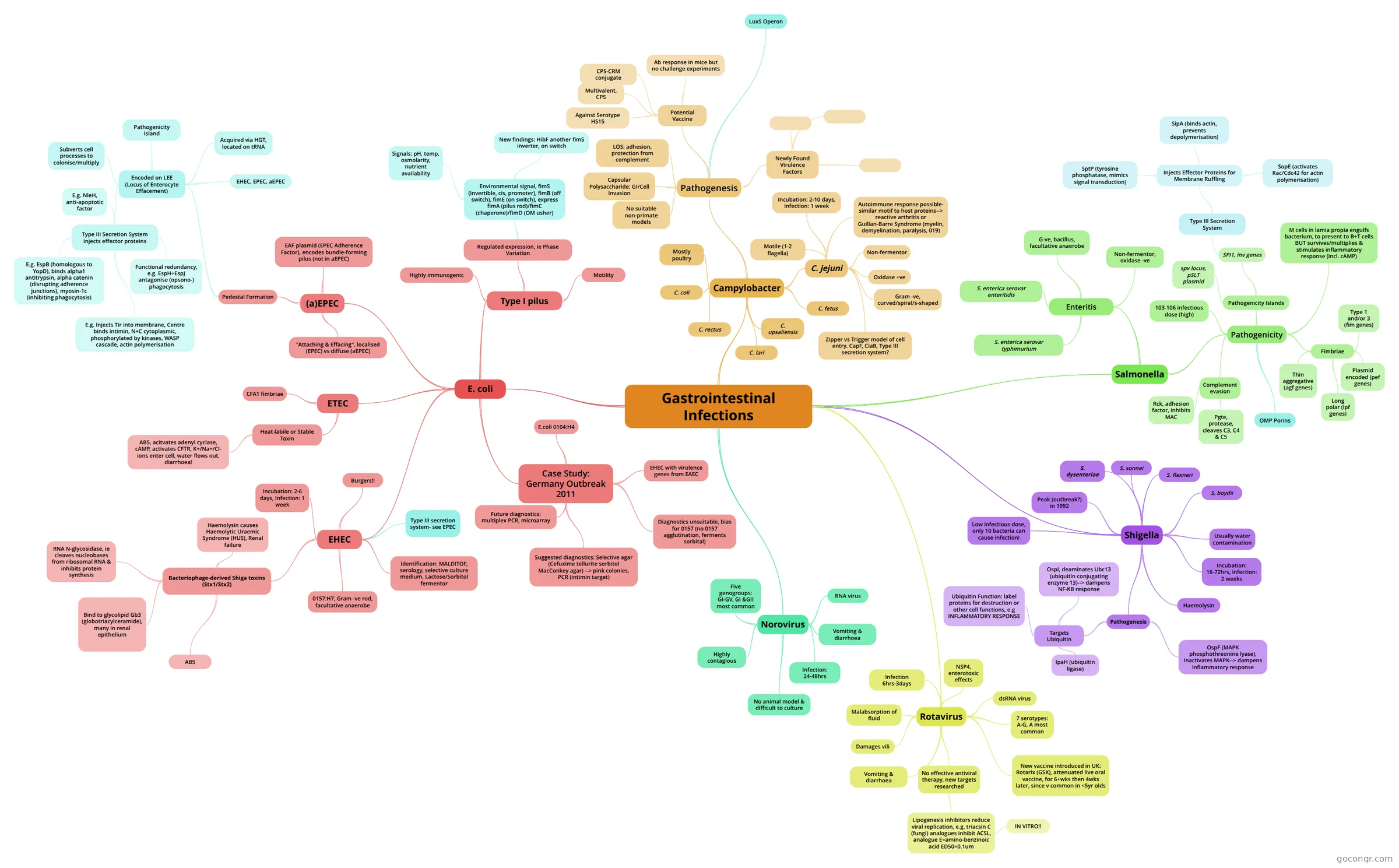
Mind map: Gastrointestinal infections
Inhalt der Mindmap
Gastrointestinal Infections
E. coli
- EHEC
- 0157:H7, Gram -ve rod, facultative anaerobe
- Bacteriophage-derived Shiga toxins (Stx1/Stx2)
- AB5
- Bind to glycolipid Gb3 (globotriacylceramide), many in renal epithelium
- RNA N-glycosidase, ie cleaves nucleobases from ribosomal RNA & inhibits protein synthesis
- Haemolysin causes Haemolytic Uraemic Syndrome (HUS), Renal failure
- Incubation: 2-6 days, Infection: 1 week
- Identification: MALDITOF, serology, selective culture medium, Lactose/Sorbitol fermentor
- Burgers!!
- Type III secretion system- see EPEC
- ETEC
- Heat-labile or Stable Toxin
- AB5, acitvates adenyl cyclase, cAMP, activates CFTR, K+/Na+/Cl- ions enter cell, water flows out, diarrhoea!
- CFA1 fimbriae
- Heat-labile or Stable Toxin
- Type I pilus
- Regulated expression, ie Phase Variation
- Environmental signal, fimS (invertible, cis, promoter), fimB (off switch), fimE (on switch), express fimA (pilus rod)/fimC (chaperone)/fimD (OM usher)
- New findings: HibF another fimS inverter, on switch
- Signals: pH, temp, osmolarity, nutrient availability
- Environmental signal, fimS (invertible, cis, promoter), fimB (off switch), fimE (on switch), express fimA (pilus rod)/fimC (chaperone)/fimD (OM usher)
- Highly immunogenic
- Motility
- Regulated expression, ie Phase Variation
- (a)EPEC
- "Attaching & Effacing", localised (EPEC) vs diffuse (aEPEC)
- Pedestal Formation
- Encoded on LEE (Locus of Enterocyte Effacement)
- Pathogenicity Island
- EHEC, EPEC, aEPEC
- Type III Secretion System injects effector proteins
- E.g. Injects Tir into membrane, Centre binds intimin, N+C cytoplasmic, phosphorylated by kinases, WASP cascade, actin polymerisation
- E.g. EspB (homologous to YopD), binds alpha1 antitrypsin, alpha catenin (disrupting adherence junctions), myosin-1c (inhibiting phagocytosis)
- Functional redundancy, e.g. EspH+EspJ antagonise (opsono-) phagocytosis
- E.g. NleH, anti-apoptotic factor
- Acquired via HGT, located on tRNA
- Subverts cell processes to colonise/multiply
- Encoded on LEE (Locus of Enterocyte Effacement)
- EAF plasmid (EPEC Adherence Factor), encodes bundle-forming pilus (not in aEPEC)
- Case Study: Germany Outbreak 2011
- E.coli 0104:H4
- EHEC with virulence genes from EAEC
- Diagnostics unsuitable, bias for 0157 (no 0157 agglutination, ferments sorbital)
- Suggested diagnostics: Selective agar (Cefuxime tellurite sorbitol MacConkey agar) --> pink colonies, PCR (intimin target)
- Future diagnostics: multiplex PCR, microarray
- EHEC
Campylobacter
- C. jejuni
- Gram -ve, curved/spiral/s-shaped
- Motile (1-2 flagella)
- Oxidase +ve
- Non-fermentor
- Incubation: 2-10 days, infection: 1 week
- Autoimmune response possible- similar motif to host proteins--> reactive arthritis or Guillan-Barre Syndrome (myelin, demyelination, paralysis, 019)
- Zipper vs Trigger model of cell entry. CapF, CiaB, Type III secretion system?
- C. upsaliensis
- C. coli
- C. lari
- C. fetus
- C. rectus
- Mostly poultry
- Pathogenesis
- No suitable non-primate models
- Capsular Polysaccharide: GI/Cell Invasion
- LOS: adhesion, protection from complement
- Potential Vaccine
- Against Serotype HS15
- Multivalent, CPS
- CPS-CRM conjugate
- Ab response in mice but no challenge experiments
- LuxS Operon
- Newly Found Virulence Factors
- C. jejuni
Salmonella
- Enteritis
- S. enterica serovar typhimurium
- S. enterica serovar enteritidis
- G-ve, bacillus, facultative anaerobe
- Non-fermentor, oxidase -ve
- Pathogenicity
- Pathogenicity Islands
- spv locus, pSLT plasmid
- SPI1, inv genes
- Type III Secretion System
- Injects Effector Proteins for Membrane Ruffling
- SptP (tyrosine phosphatase, mimics signal transduction)
- SipA (binds actin, prevents depolymerisation)
- SopE (activates Rac/Cdc42 for actin polymerisation)
- Injects Effector Proteins for Membrane Ruffling
- Type III Secretion System
- 103-106 infectious dose (high)
- M cells in lamia propia engulfs bacterium, to present to B+T cells BUT survives/multiplies & stimulates inflammatory response (incl. cAMP)
- Fimbriae
- Type 1 and/or 3 (fim genes)
- Plasmid encoded (pef genes)
- Long polar (lpf genes)
- Thin aggregative (agf genes)
- OMP Porins
- Complement evasion
- Rck, adhesion factor, inhibits MAC
- Pgte, protease, cleaves C3, C4 & C5
- Pathogenicity Islands
- Enteritis
Shigella
- S. flexneri
- S. sonnei
- S. dysenteriae
- S. boydii
- Usually water contamination
- Pathogenesis
- OspF (MAPK phosphothreonine lyase), inactivates MAPK--> dampens inflammatory response
- Targets Ubiquitin
- OspI, deaminates Ubc13 (ubiquitin conjugating enzyme 13)--> dampens NF-KB response
- IpaH (ubiquitin ligase)
- Ubiquitin Function: label proteins for destruction or other cell functions, e.g INFLAMMATORY RESPONSE
- Peak (outbreak?) in 1992
- Low infectious dose, only 10 bacteria can cause infection!
- Incubation: 16-72hrs, infection: 2 weeks
- Haemolysin
Rotavirus
- dsRNA virus
- 7 serotypes: A-G, A most common
- No effective antiviral therapy, new targets researched
- Lipogenesis inhibitors reduce viral replication, e.g. triacsin C (fungi) analogues inhibit ACSL, analogue E=amino-benzinoic acid ED50=0.1um
- IN VITRO!!
- Lipogenesis inhibitors reduce viral replication, e.g. triacsin C (fungi) analogues inhibit ACSL, analogue E=amino-benzinoic acid ED50=0.1um
- Damages vili
- Malabsorption of fluid
- Infection 6hrs-3days
- NSP4, enterotoxic effects
- New vaccine introduced in UK: Rotarix (GSK), attenuated live oral vaccine, for 6+wks then 4wks later, since v common in <5yr olds
- Vomiting & diarrhoea
Norovirus
- RNA virus
- Infection: 24-48hrs
- Vomiting & diarrhoea
- No animal model & difficult to culture
- Five genogroups: GI-GV, GI &GII most common
- Highly contagious
Informationen
- Beschreibung
- Medical Microbiology Mindmap am Gastrointestinal Infections, erstellt von hands97 am 29/04/2013.
- Erstellt von
- hands97
- Aufrufe
- 223
- Tags
- Bewertung