
Mindmap
Attachment
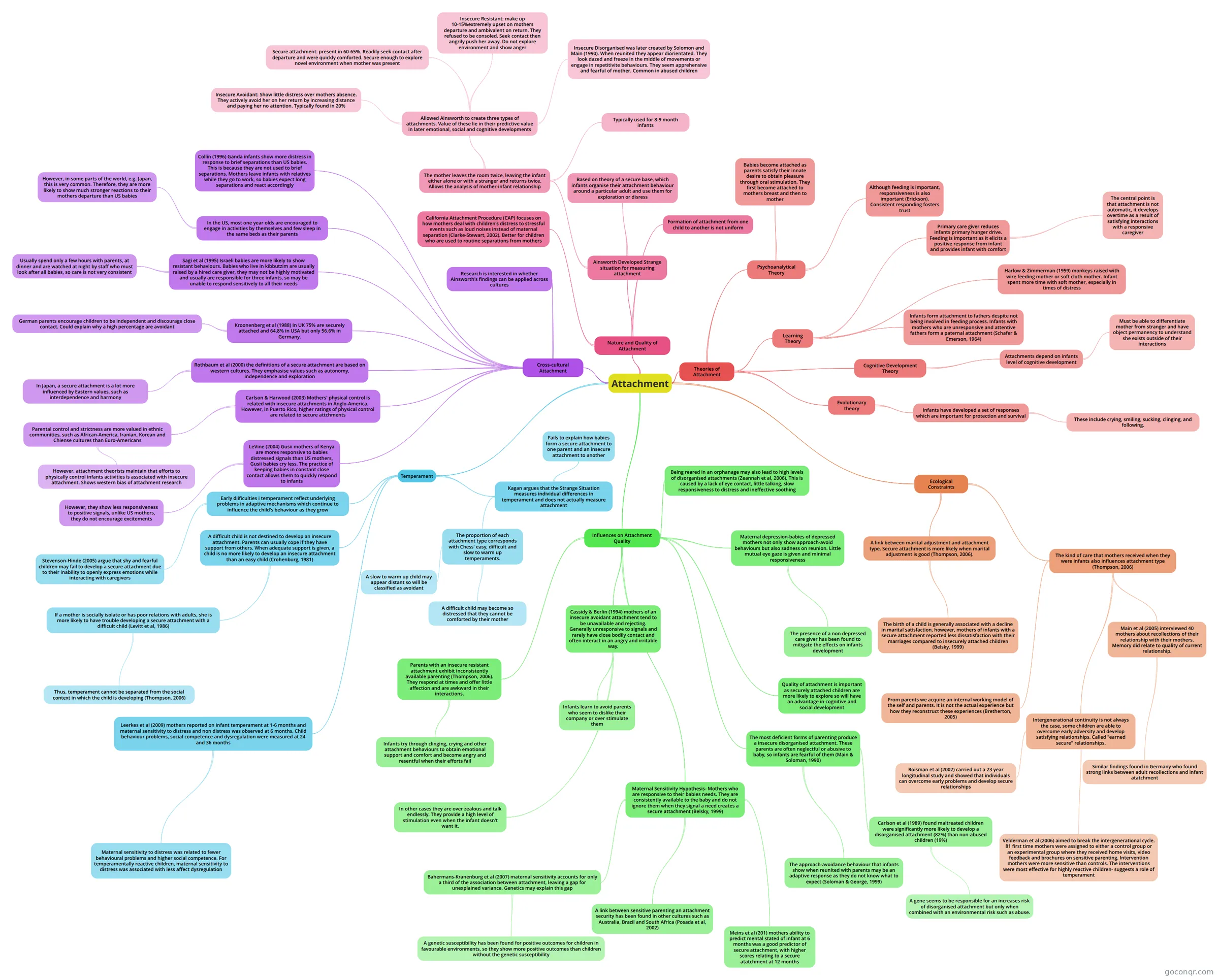
Mind map: attachment psychology
Inhalt der Mindmap
Attachment
Theories of Attachment
- Psychoanalytical Theory
- Babies become attached as parents satisfy their innate desire to obtain pleasure through oral stimulation. They first become attached to mothers breast and then to mother
- Although feeding is important, responsiveness is also important (Erickson). Consistent responding fosters trust
- Learning Theory
- Primary care giver reduces infants primary hunger drive. Feeding is important as it elicits a positive response from infant and provides infant with comfort
- The central point is that attachment is not automatic, it develops overtime as a result of satisfying interactions with a responsive caregiver
- Harlow & Zimmerman (1959) monkeys raised with wire feeding mother or soft cloth mother. Infant spent more time with soft mother, especially in times of distress
- Infants form attachment to fathers despite not being involved in feeding process. Infants with mothers who are unresponsive and attentive fathers form a paternal attachment (Schafer & Emerson, 1964)
- Primary care giver reduces infants primary hunger drive. Feeding is important as it elicits a positive response from infant and provides infant with comfort
- Cognitive Development Theory
- Attachments depend on infants level of cognitive development
- Must be able to differentiate mother from stranger and have object permanency to understand she exists outside of their interactions
- Attachments depend on infants level of cognitive development
- Evolutionary theory
- Infants have developed a set of responses which are important for protection and survival
- These include crying, smiling, sucking, clinging, and following.
- Infants have developed a set of responses which are important for protection and survival
- Psychoanalytical Theory
Nature and Quality of Attachment
- Formation of attachment from one child to another is not uniform
- Ainsworth Developed Strange situation for measuring attachment
- Based on theory of a secure base, which infants organise their attachment behaviour around a particular adult and use them for exploration or disress
- The mother leaves the room twice, leaving the infant either alone or with a stranger and returns twice. Allows the analysis of mother-infant relationship
- Typically used for 8-9 month infants
- Allowed Ainsworth to create three types of attachments. Value of these lie in their predictive value in later emotional, social and cognitive developments
- Secure attachment: present in 60-65%. Readily seek contact after departure and were quickly comforted. Secure enough to explore novel environment when mother was present
- Insecure Avoidant: Show little distress over mothers absence. They actively avoid her on her return by increasing distance and paying her no attention. Typically found in 20%
- Insecure Resistant: make up 10-15%extremely upset on mothers departure and ambivalent on return. They refused to be consoled. Seek contact then angrily push her away. Do not explore environment and show anger
- Insecure Disorganised was later created by Solomon and Main (1990). When reunited they appear diorientated. They look dazed and freeze in the middle of movements or engage in repetitivite behaviours. They seem apprehensive and fearful of mother. Common in abused children
- California Attachment Procedure (CAP) focuses on how mothers deal with children's distress to stressful events such as loud noises instead of maternal separation (Clarke-Stewart, 2002). Better for children who are used to routine separations from mothers
Cross-cultural Attachment
- Research is interested in whether Ainsworth's findings can be applied across cultures
- Collin (1996) Ganda infants show more distress in response to brief separations than US babies. This is because they are not used to brief separations. Mothers leave infants with relatives while they go to work, so babies expect long separations and react accordingly
- In the US, most one year olds are encouraged to engage in activities by themselves and few sleep in the same beds as their parents
- However, in some parts of the world, e.g. Japan, this is very common. Therefore, they are more likely to show much stronger reactions to their mothers departure than US babies
- Sagi et al (1995) Israeli babies are more likely to show resistant behaviours. Babies who live in kibbutzim are usually raised by a hired care giver, they may not be highly motivated and usually are responsible for three infants, so may be unable to respond sensitively to all their needs
- Usually spend only a few hours with parents, at dinner and are watched at night by staff who must look after all babies, so care is not very consistent
- Kroonenberg et al (1988) In UK 75% are securely attached and 64.8% in USA but only 56.6% in Germany.
- German parents encourage children to be independent and discourage close contact. Could explain why a high percentage are avoidant
- Rothbaum et al (2000) the definitions of a secure attachment are based on western cultures. They emphasise values such as autonomy, independence and exploration
- In Japan, a secure attachment is a lot more influenced by Eastern values, such as interdependence and harmony
- Carlson & Harwood (2003) Mothers' physical control is related with insecure attachments in Anglo-America. However, in Puerto Rico, higher ratings of physical control are related to secure attchments
- Parental control and strictness are more valued in ethnic communities, such as African-America, Iranian, Korean and Chiense cultures than Euro-Americans
- However, attachment theorists maintain that efforts to physically control infants activities is associated with insecure attachment. Shows western bias of attachment research
- Parental control and strictness are more valued in ethnic communities, such as African-America, Iranian, Korean and Chiense cultures than Euro-Americans
- LeVine (2004) Gusii mothers of Kenya are mores responsive to babies distressed signals than US mothers, Gusii babies cry less. The practice of keeping babies in constant close contact allows them to quickly respond to infants
- However, they show less responsiveness to positive signals, unlike US mothers, they do not encourage excitements
Influences on Attachment Quality
- Quality of attachment is important as securely attached children are more likely to explore so will have an advantage in cognitive and social development
- Maternal Sensitivity Hypothesis- Mothers who are responsive to their babies needs. They are consistently available to the baby and do not ignore them when they signal a need creates a secure attachment (Belsky, 1999)
- A link between sensitive parenting an attachment security has been found in other cultures such as Australia, Brazil and South Africa (Posada et al, 2002)
- Bahermans-Kranenburg et al (2007) maternal sensitivity accounts for only a third of the association between attachment, leaving a gap for unexplained variance. Genetics may explain this gap
- A genetic susceptibility has been found for positive outcomes for children in favourable environments, so they show more positive outcomes than children without the genetic susceptibility
- Meins et al (201) mothers ability to predict mental stated of infant at 6 months was a good predictor of secure attachment, with higher scores relating to a secure atatchment at 12 months
- Cassidy & Berlin (1994) mothers of an insecure avoidant attachment tend to be unavailable and rejecting. Generally unresponsive to signals and rarely have close bodily contact and often interact in an angry and irritable way.
- In other cases they are over zealous and talk endlessly. They provide a high level of stimulation even when the infant doesn't want it.
- Infants learn to avoid parents who seem to dislike their company or over stimulate them
- Parents with an insecure resistant attachment exhibit inconsistently available parenting (Thompson, 2006). They respond at times and offer little affection and are awkward in their interactions.
- Infants try through clinging, crying and other attachment behaviours to obtain emotional support and comfort and become angry and resentful when their efforts fail
- The most deficient forms of parenting produce a insecure disorganised attachment. These parents are often neglectful or abusive to baby, so infants are fearful of them (Main & Soloman, 1990)
- The approach-avoidance behaviour that infants show when reunited with parents may be an adaptive response as they do not know what to expect (Soloman & George, 1999)
- Carlson et al (1989) found maltreated children were significantly more likely to develop a disorganised attachment (82%) than non-abused children (19%)
- A gene seems to be responsible for an increases risk of disorganised attachment but only when combined with an environmental risk such as abuse.
- Maternal depression-babies of depressed mothers not only show approach-avoid behaviours but also sadness on reunion. Little mutual eye gaze is given and minimal responsiveness
- The presence of a non depressed care giver has been found to mitigate the effects on infants development
- Being reared in an orphanage may also lead to high levels of disorganised attachments (Zeannah et al, 2006). This is caused by a lack of eye contact, little talking, slow responsiveness to distress and ineffective soothing
Ecological Constraints
- A link between marital adjustment and attachment type. Secure attachment is more likely when marital adjustment is good (Thompson, 2006).
- The birth of a child is generally associated with a decline in marital satisfaction, however, mothers of infants with a secure attachment reported less dissatisfaction with their marriages compared to insecurely attached children (Belsky, 1999)
- The kind of care that mothers received when they were infants also influences attachment type (Thompson, 2006)
- From parents we acquire an internal working model of the self and parents. It is not the actual experience but how they reconstruct these experiences (Bretherton, 2005)
- Main et al (2005) interviewed 40 mothers about recollections of their relationship with their mothers. Memory did relate to quality of current relationship.
- Similar findings found in Germany who found strong links between adult recollections and infant atatchment
- Intergenerational continuity is not always the case, some children are able to overcome early adversity and develop satisfying relationships. Called "earned secure" relationships.
- Roisman et al (2002) carried out a 23 year longitudinal study and showed that individuals can overcome early problems and develop secure relationships
- Velderman et al (2006) aimed to break the intergenerational cycle. 81 first time mothers were assigned to either a control group or an experimental group where they received home visits, video feedback and brochures on sensitive parenting. Intervention mothers were more sensitive than controls. The interventions were most effective for highly reactive children- suggests a role of temperament
- A link between marital adjustment and attachment type. Secure attachment is more likely when marital adjustment is good (Thompson, 2006).
Temperament
- Kagan argues that the Strange Situation measures individual differences in temperament and does not actually measure attachment
- The proportion of each attachment type corresponds with Chess' easy, difficult and slow to warm up temperaments.
- A difficult child may become so distressed that they cannot be comforted by their mother
- A slow to warm up child may appear distant so will be classified as avoidant
- Fails to explain how babies form a secure attachment to one parent and an insecure attachment to another
- The proportion of each attachment type corresponds with Chess' easy, difficult and slow to warm up temperaments.
- Early diificulties i temperament reflect underlying problems in adaptive mechanisms which continue to influence the child's behaviour as they grow
- Stevenson-Hinde (2005) argue that shy and fearful children may fail to develop a secure attachment due to their inability to openly express emotions while interacting with caregivers
- A difficult child is not destined to develop an insecure attachment. Parents can usually cope if they have support from others. When adequate support is given, a child is no more likely to develop an insecure attachment than an easy child (Crohenburg, 1981)
- If a mother is socially isolate or has poor relations with adults, she is more likely to have trouble developing a secure attachment with a difficult child (Levitt et al, 1986)
- Thus, temperament cannot be separated from the social context in which the child is developing (Thompson, 2006)
- If a mother is socially isolate or has poor relations with adults, she is more likely to have trouble developing a secure attachment with a difficult child (Levitt et al, 1986)
- Leerkes et al (2009) mothers reported on infant temperament at 1-6 months and maternal sensitivity to distress and non distress was observed at 6 months. Child behaviour problems, social competence and dysregulation were measured at 24 and 36 months
- Maternal sensitivity to distress was related to fewer behavioural problems and higher social competence. For temperamentally reactive children, maternal sensitivity to distress was associated with less affect dysregulation
- Kagan argues that the Strange Situation measures individual differences in temperament and does not actually measure attachment
Informationen
- Beschreibung
- Developmental Mindmap am Attachment, erstellt von eloisefeeney27 am 13/05/2014.
- Erstellt von
- eloisefeeney27
- Aufrufe
- 20
- Bewertung