
Mindmap
DEVELOPMENTAL PSYCHOLOGY
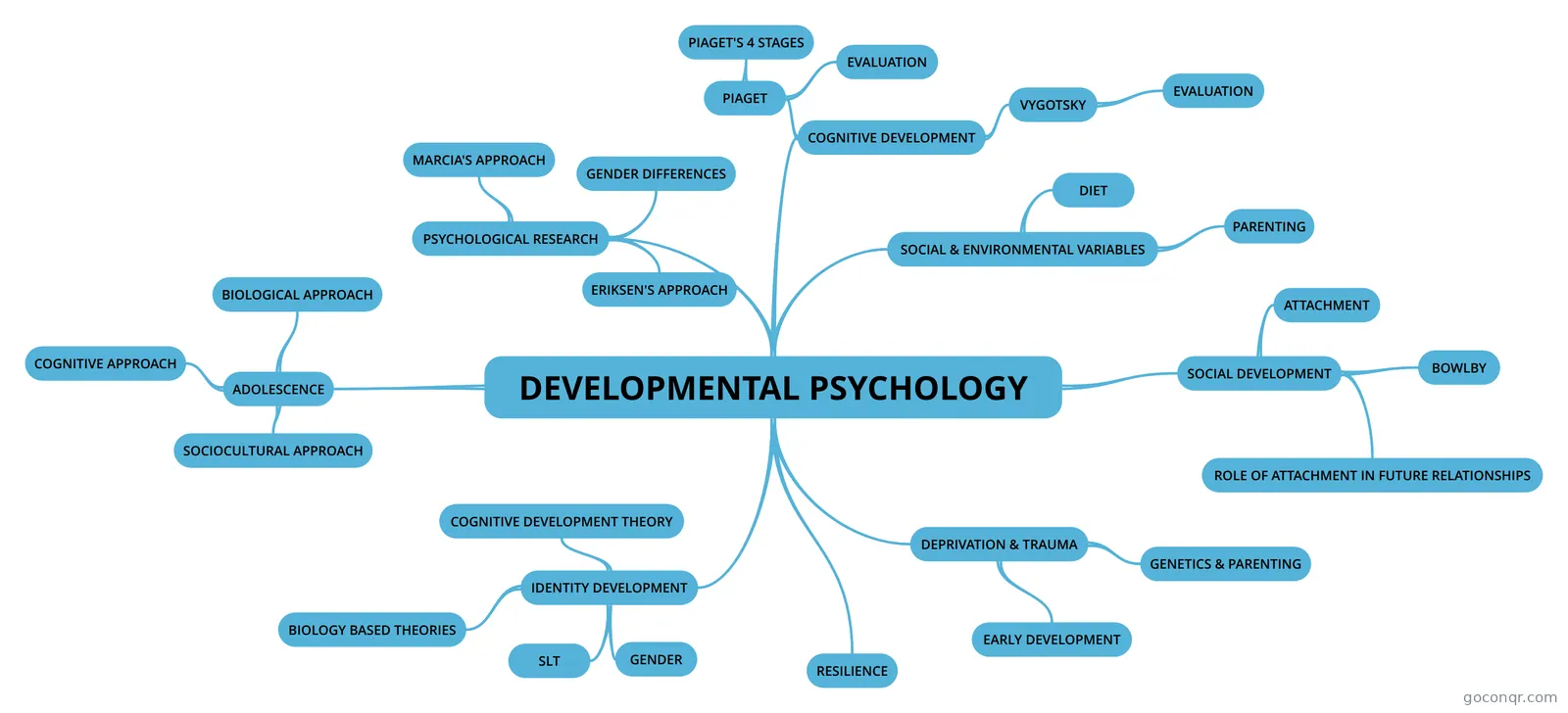
Mind map: Developmental psychology
Inhalt der Mindmap
DEVELOPMENTAL PSYCHOLOGY
COGNITIVE DEVELOPMENT
- PIAGET
- 1. Piaget argued that knowledge developed through schemas. 2. Schemas are mental representations of the world & how the individual interacts with it. 3. Schemas help order our thinking and act as mental shortcuts. 4. They influence perception & attention. 5. As a child develops, his schemas develop as a result of his interaction with the world. 6. All children are born with an innate range of schemas (sucking, reaching, gripping). 7. These, in turn, are modified as a result of experience - ADAPTATION. 8. Piaget also argued that children actively construct knowledge as a result of their interaction with new objects & experiences. 9. For this reason, Piaget is also known as a constructivist. 10. The child's interaction with new events & objects, as well as the mixing of these with existing knowledge, cause him to develop cognitively. 11. ASSIMILATION - This occurs when new events can be fitted into existing schemas of what the child already understands - dog example. 12. ACCOMMODATION - This occurs when new events do not fit existing schemas. 13. Either a schema has to be modified to allow the new world view, or a new schema has to be created - calling a dog a horse. 14. These 2 processes clearly demonstrate the Piagetian child. 15. He is an active learner who is constantly engaged with the world, testing & retesting ideas. 16. Piaget saw children as little scientists who are always engaged in creating, then testing hypotheses.
- PIAGET'S 4 STAGES
- 1. SENSORIMOTOR STAGE (0-2) - infant has no formal schema for itself or the world. 2. It only knows the world through it sense and motor actions it performs. 3. PROFOUND EGOCENTRISM - infant can't distinguish between itself & the environment as it has no real knowledge of the world around it. 4. LACK OF OBJECT PERMANENCE - when it cannot see an object, it ceases to exist for the infant (develops at about 8 months) 5. Piaget's claims have been contradicted by other researchers. 6. Bower (1982) constructed a simple experiment wherby a child was shown an object and then a screen placed between object and child. 6. Object was removed, and then screen taken away. 7. Bower claimed the children showed enough surprise at the disappearance of the object, to argue that object permanence was more flexible than Piaget envisaged. 1. PRE-OPERATIONAL STAGE (2-7) - The child still relies on external appearances rather than internal logic. 2. Object permanence is established and the stage ends with the emergence of concrete operations. 3. Egocentism still dominates. 4. CENTRATION - the tendency to focus on only 1 aspect of an object or situation at a time. 5. CONSERVATION - children show a lack of this - the realisation that objects can remain the same despite a change in appearance - example with water in different sized glasses. 6. CLASSIFICATION LIMITATION - the child's inability to classify similar objects into the same groups (shape & colour). 7. Criticisms of this stage - Piaget was interested in SYMBOL USE in play (using a broom as a sword). 8. This suggests a more sophisticated understanding of objects than the simple lack of conservation ability can portray. 9. Another criticism was the negative tone used to describe this stage. 10. He focuses on what the child CAN'T do rather than what it can achieve. 11. Children at this stage have been shown to have active imaginations. 12. Field et al. (1982) found that 4-5 year olds can spend as much as 20% of their playtime constructing sophisticated roles for different objects beyond their intended use (brooms as horses). 13. Children also construct complicated role plays (mommy & daddy games). 14. They give explicit instruction in sometimes, lengthy monologues before the play begins. 15. Children can also develop imaginary friends, with complex characters. 16. This used to be seen as a sign of disturbance, but now it is seen as a product of a rich imagination and part of normal development. 17. They are a significant phenomena in childhood. 18. They act as guardians and protectors. 19. Some children can't distinguish them from real people, but most understand the difference. 20. It has been theorised that children with imaginary friends are able to develop linguistic and mental skills younger than those who don't have. 1. CONCRETE OPERATIONAL STAGE (7-11) - OPERATIONS refer to definitive rules or schemas, but they can only be applied to real objects. 2. Piaget claimed that children did not have the mental ability for logic, in this stage. 3. CONSERVATION - has developed - example with coloured beads. 1. FORMAL OPERATIONAL STAGE - (11+) - the child's mental structures are so well developed that ideas and problems can be manipulated mentally without the need for physical objects. 2. Children can use their imaginations. 3. They can think about hypothetical problems and abstract concepts. 4. Piaget believed everyone reaches this stage by 20.
- EVALUATION
- STRENGTHS 1. Piaget produced the first comprehensive theory of child cognitive development. 2. He modified the theory to take account of criticism and believed it would constantly change as new evidence came to light. 3. The theory is biology based and sees the child as a determined, dynamic thinker, & Piaget was the first person to investigate whether biological maturation drove cognitive development. 4. He also discovered the concept of CONTRUCTIVISM. WEAKNESSES 1. Piaget's methods are too formal. 2. Piaget failed to differentiate between competence (what a child is capable of doing) and performance (what a child can do). 3. The idea of biological readiness has been questioned. 4. Piaget has been criticised for under-estimating the role of language in cognitive development. 5. Piaget has also been criticised for under-estimating the role of social development in cognitive development. 6. He has been criticised for under-estimating children's cognitive abilities in general as many children show more abilities at younger ages than Piaget suggested. 7. Piaget over-estimated people's formal operational ability (research shows that only 1/3 of the population reach this late stage of cognitive development). 8. The theory is very descriptive but doesn't provide a detailed explanation for the stages. 9. The model can be seen as too rigid and inflexible.
- VYGOTSKY
- 1, Vygotsky's main contribution is his focus on the importance of social interaction, culture & language in a child's cognitive development. 2. Vygotsky divided the intellect into basic innate capabilities which he called elementary functions. 3. He argued that these functions could only develop into higher functions through cultural influence. 4. Vygotsky thought of culture as a body of knowledge, held by people of greater knowledge or in books - hence the importance he placed on language development in cognitive development. 5. Vygotsky hypothesised that the child begins to interact with the world through its actions, but society places meaning on those actions through social interaction. 6. A child tries to reach for an object but fails to grasp it, An adult hands the object to the child. The original movement by the child takes on a new meaning - from reaching for an object to communicating with an adult. 7. The primary way we communicate with the world is by language, not physical gestures. 8. Language for children, is a way to produce change in others. 9. However, when language becomes internalised, it converges with thought, & eventually we are able to direct & control our thinking by using language. 10. We develop an inner voice for thinking, & a more complex, vocabulary-rich voice for communication with others. 11. Vygotsky stressed the importance of culture through the zone of proximal development (ZPD). 12. The ZPD is the distance between the child's current abilities, and their potential abilities under adult supervision. 13. Expert instruction wakens a series of functions that can be extended under suprtvision from an expert (usually an adult). 14. These abilities would lie dormant and unused if they were left untutored.¨ 15. This shows the difference between the Piagetian individual construction approach, and the importance of social construction put forward by Vygotsky. 16. Wood et al. (1976) introduced the idea of scaffolding as development of Vygotsky's ZPD theory in which the disorganised & spontaneous thoughts presented by the child are responded to with the more systematic, logical & rational conceps of a more knowledgeable (ususally adult) helper VYGOTSKY'S 3 STAGES 1. PRE-INTELLECTUAL SOCIAL SPEECH (0-3) - thought is not constructed using language, & speech is only used to enact social change (receiving objects from a parent). 2. EGOCENTRIC SPEECH (3-7) - language helps to control the child's own behaviour & is spoken out loud (verbalising actions when playing games). 3. INNER SPEECH (7+) - the child uses speech silently to develop their thinking, & publicly for social communication.
- EVALUATION
- STRENGTHS 1. The concept of scaffolding has bee useful from a teaching perspective as the quality of the scaffolding provided by parents could predict the child's success in the classroom. 2. This can be applied to reading & maths problems in early development. 3. Those children who are supported at home will be more confident in the classroom. 4. The value that Vygotsky placed on inner speech has also received support. 5. He argued that the inner voice was a key part of learning & cognitive development. 6. Behrend et al. (1992) quantified inner speech by observing the amount of whispering & lip movement children engaged in when given a task. 7. They found that children who used the greatest amount of inner speech tended to perform better on tasks. 8. Vygotsky makes an important contribution to developmental psychology as he emphasizes the importance of social interaction on cognitive development - an area lacking in Piaget's approach. WEAKNESSES 1. Vygotsky's approach has been criticised for placing too much emphasis on the social environment and for being too vague in his outline of social influence. 2. It should be noted however, that Vygotsky died at the age of 38, so his work as a cognitive developmental researcher was still in its infancy - had he lived longer he would have advanced his theories & been able to respond to peer-review. 1. Vygotsky and Piaget's ideas should not be seen as dramatically opposed to each other. 2. In many ways they compliment each other & an integration of both views might be a productive way forward. 3. However, there is a lack of empirical support for Vygotsky's ideas - this is largely explained by his emphasis on processes rather than outcomes (processes are harder to test for).
- PIAGET
SOCIAL & ENVIRONMENTAL VARIABLES
- DIET
- PARENTING
SOCIAL DEVELOPMENT
- ATTACHMENT
- BOWLBY
- ROLE OF ATTACHMENT IN FUTURE RELATIONSHIPS
DEPRIVATION & TRAUMA
- EARLY DEVELOPMENT
- GENETICS & PARENTING
RESILIENCE
IDENTITY DEVELOPMENT
- GENDER
- SLT
- COGNITIVE DEVELOPMENT THEORY
- BIOLOGY BASED THEORIES
- 1. This approach assumes behaviour is the result of physiological mechanisms. 2. There is strong evidence that much of our gender role identity is linked to innate natural processes, but this explanation to explain a complex cognitive & social construction, like gender role behaviour, is unrealistic. ROUGH & TUMBLE (R&T) PLAY 1. It is widely accepted that R&T play is the result of hormonal changes in young male mammals, in particular, an increase in testosterone in early infanthood & at puberty. 2. Most research into R&T play (humans & non-human primates), indicates that R&T play creates valuable practice for the complex social interactions that creatures need to undertake in order to become competent, socially mature adults. 3. Over the past 25 years, in Western society, there has been an increasing reduction of the time & space allocated for children to engage in such play, while over the same period, concerns about poor socialisation of young people have been increasingly raised. 4. Michael Thompson has written extensively about the unique world of boys & how schools & modern society frequently årevent boys from expressing themselves the way they are naturally inclined to. 5. He has argued that many teachers overreact to boys' behaviour in classrooms, since most R&T play is non-violent & will not lead to violence. 6. He says we need to change our views and looks to other cultures (Japan) where rules and appropriate behaviour guidelines for socialising & play are left in the hands of the children, not the adults. 7. O'Donnell & Sharp (2004) argue that R&T play situations in which boys explore a sense of nationalism & territory, show human similarity to other mammal species which also use physical & expressive play. 8. Jarvis (2006) observed children in a primary school in the UK & concluded that boys show a clear preference for R&T play, as well as showing gender differences & awareness in R&T play-based fantasy games. 9. She gives an evolutionary argument to explain the prevalence of this behaviour in young males: boys need to know how to compete with other boys for resources & access to female mates, and those who are more practiced, are likely to be more successful. 10. Females occupy a primarily nurturing role in primate societies & do not need to engage in R&T play, as it doesn't serve an evolutionary purpose. 11. Girls predominantly engage in complex social & emotional interactions, as well as grooming activity, which is aso prevalent in primate societies. 12. CAH is a condition resulting from åre-natal exposure to male androgens. 13. Berenhaum & Snyder (1995) found that girls with the condition showed a significantly greater preference for boys' toys & activities, while boys with the condition did not differ significantly from the non-CAH control group in any way. 14. This clearly shows the impact of hormones on behaviour. 15. Beach (1974) found female dogs exposed to male hormones were more likely to urinate like male dogs. 16. Young et al. (1964) found that female monkeys exposed to male hormones were more likely to engage in R&T play. 17. Viewing gender specific behaviour from just a biological viewpoint, while ignoring social & cognitive factors, will not give a balanced view.
ADOLESCENCE
- Adolescence is typically defined as the transitional periods between childhood & adulthood.
- COGNITIVE APPROACH
- 1. From a cognitive developmental perspective, adolescence can be defined as the period when the Piagetian notion of formal operational thought develops. 2. This allows for consideration of new beliefs & possibilities.
- SOCIOCULTURAL APPROACH
- 1. Adolescence can also be defined through a political or or socially constructed paradigm. 2. WHO defines it as the period between 10 & 20 years of age. 3. However, this does not take into account the varying social roles undertaken in many cultures as a consequence of adolescence. 4. In the West, 18 or 19 year olds may still be seen as adolescents, but in other cultures, 14 year olds may be expected to marry and perform adult functions in the community. 5. The culture of the TEENAGER developed in post-WW2 America & teenagers quickly became an interesting source of social research, & for corporations manufacturing specific products (films, jeans, cars, hair products) to sell to them. 6. A modern equivalent is the recent increase in interest in the pre-teens from market researchers. 7. They have discovered that many young children in the West have a degree of disposable income & can be persuaded to spend it on ring-tones, toys, games, if properly targeted.
- BIOLOGICAL APPROACH
PSYCHOLOGICAL RESEARCH
- ERIKSEN'S APPROACH
- MARCIA'S APPROACH
- GENDER DIFFERENCES
Informationen
- Beschreibung
- Mindmap am DEVELOPMENTAL PSYCHOLOGY, erstellt von Kate Reed am 14/04/2015.
- Erstellt von
- Kate Reed
- Aufrufe
- 57
- Bewertung