
Mindmap
INFLAMMATION
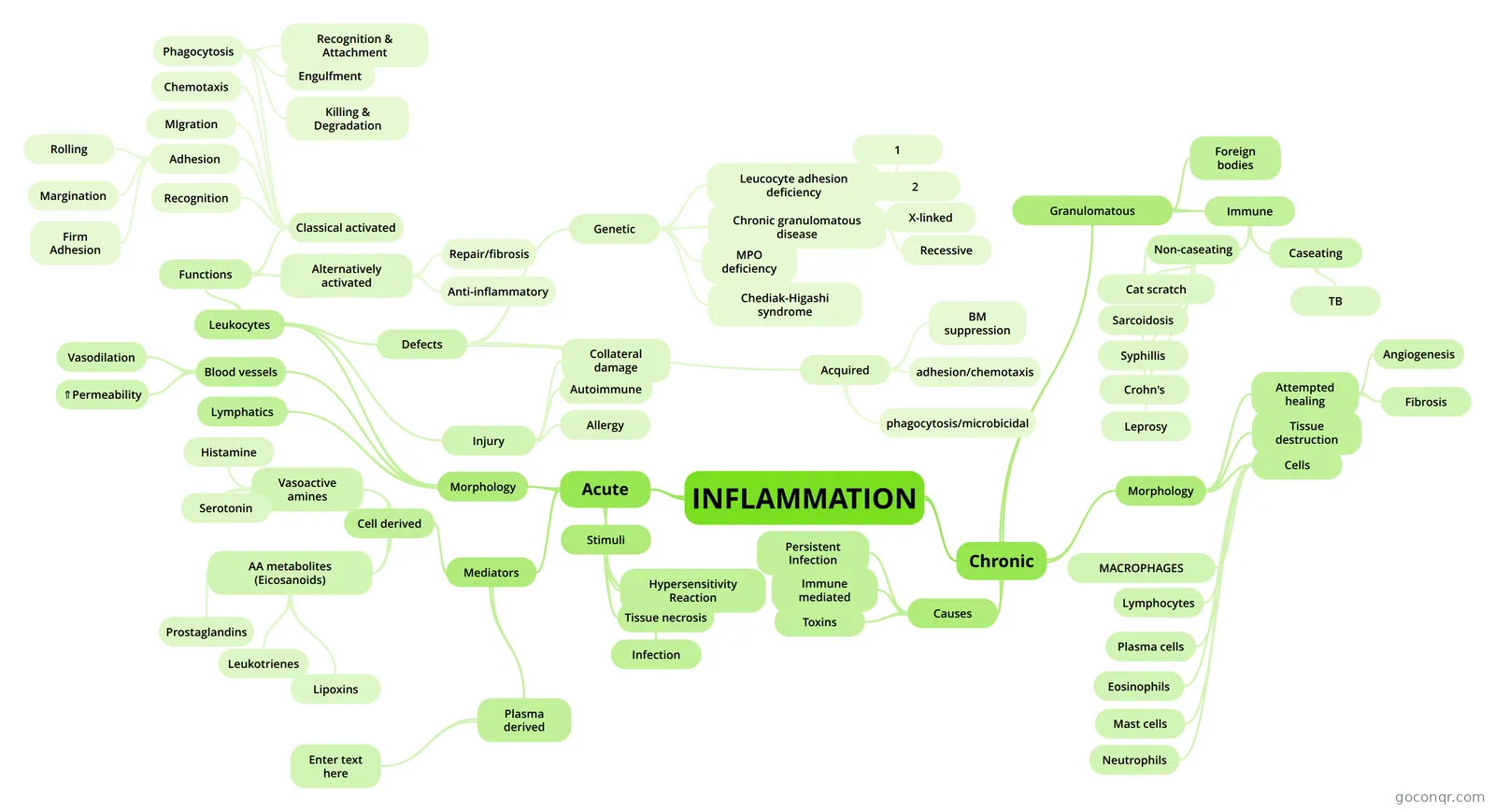
Mind map: inflammation
Inhalt der Mindmap
INFLAMMATION
Acute
- Stimuli
- Infection
- Toll-like receptors (TLRs)
- Tissue necrosis
- Uric acid, ATP, HMGB-1 -->inflammation Hypoxia --> HIF-1a --> VEGF
- Hypersensitivity Reaction
- Cytokines
- Infection
- Morphology
- Blood vessels
- Vasodilation
- histamine NO stasis of blood (moving slowly as increased calibre, decreased volume --> margination of leucocytes.
- ⇑Permeability
- IMMEDIATE TRANSIENT RESPONSE (15-30mins) VEGF/histamine/leukotrienes/substance P: endothelium retracts, increased transcytosis DELAYED PROLONGED RESPONSE Toxins/UV/XR - endothelial damage
- Vasodilation
- Leukocytes
- Neutrophil 6-24h Monocytes 24-48h Varies Pseudomonas - neutrophils for several days Viral - lymphocyte first
- Functions
- Classical activated
- Adhesion
- Margination
- Rolling
- Selectins: P (platelets) E (endothelium) -bond with Sialyl Lewis X-modified glycoprotein L (leukocytes) -Glycam1, CD34Enhanced by increased expression of adhesion molecules by cytokines.
- Firm Adhesion
- INTEGRINS _leukocyte surface proteins) ICAM-1, various integrins
- MIgration
- -transmigration/diapedesis -mainly in post-capillary venules -towards chemokines chemical [gradient] -PECAM-1 (CD31) -may adhere at site needed via INTEGRINS and CD44
- Chemotaxis
- 'locomotion along chemical gradient' ENDOgenous -IL-8, complement, EXOgenous -bacterial products (N-formylmethanyl peptides, lipids) These all react at GPCR -polymerisation of actin leading edge and myosin at back -filopodia that pull back of cell in direction of extension --> migration
- Recognition
- See written notes. Various receptors -GPCR (bacterial peptides, chemokines) -TLR (microbial products) -Phagocyte receptors -Cytokine receptors (IFN 7)
- Phagocytosis
- Recognition & Attachment
- macrophage mannose-R (glycoproteins/glycolipids) opsinons-R scavenger-R (LDL)
- Engulfment
- lysosomal enzymes
- Killing & Degradation
- ROS & NO phagocyte oxidase RESPIRATORY BURST protected within lysosome H2O2 + Cl- + MPO = hypochlorite (kills by halogenation)
- Recognition & Attachment
- Adhesion
- Alternatively activated
- Anti-inflammatory
- TGFB IL-10
- Repair/fibrosis
- IL-3, IL-4 Arginate proline polyamnoses
- Anti-inflammatory
- Classical activated
- Injury
- Collateral damage
- Autoimmune
- Allergy
- Defects
- Genetic
- Leucocyte adhesion deficiency
- 1
- mutation in B chain CDH/8
- 2
- mutation in fucosyl transferase
- 1
- Chronic granulomatous disease
- phagocyte oxidase mutation
- X-linked
- membrane
- Recessive
- cytoplasmic
- MPO deficiency
- Chediak-Higashi syndrome
- defect in lysosomal membrane traffic
- Leucocyte adhesion deficiency
- Acquired
- BM suppression
- tumours/chemo/radio
- adhesion/chemotaxis
- DM/cancer/sepsis/dialysis
- phagocytosis/microbicidal
- leukaemia/anaemia/sepsis/DM/malnutrition
- BM suppression
- Genetic
- Lymphatics
- Increase flow to cope with oedema (may proliferate) Can be infected - lymphangitis. Nodes - lynmphadenitis
- Blood vessels
- Mediators
- Cell derived
- Vasoactive amines
- Histamine
- • Physical injury - trauma, cold, heat • Binding of antibodies to mast cells - alergic reactions • Fragments of complement - anaphylatoxins • Histamine releasing prots from leuks • neuropeps - subs P • Cytokine - IL-1. Il-8 =vasodilation +^permeability
- Serotonin
- platelets (aggr) neuroendocrine cells =similar effects
- Histamine
- AA metabolites (Eicosanoids)
- synthesised by 2 major classes of enzyme COX → Prostglandins Lipo-oxygenases → leukotrienes and lipoxins
- Prostaglandins
- Leukotrienes
- Lipoxins
- Vasoactive amines
- Plasma derived
- Enter text here
- Cell derived
- Stimuli
Chronic
- Causes
- Persistent Infection
- delayed-type hypersensitivity
- Immune mediated
- RA, MS
- Toxins
- Persistent Infection
- Morphology
- Tissue destruction
- IFNa, cytokines, microbes: ROS, NOS Proteases Cytokines Coag. factors AA metabolites
- Attempted healing
- IL-4 GFs Fibrogenic cytokines Angiogenic factors Remodelling collegenases
- Fibrosis
- Angiogenesis
- Cells
- MACROPHAGES
- MonoCYTE - Circulating MonoBLAST - Bone marrow (Hours) MonoPHAGES - TIssue (months/years)
- Lymphocytes
- Activate and recruit macrophages via: TNF IL-17 chemokines T cells
- Plasma cells
- develop fromactivated B lymphocytes produce antibodies
- Eosinophils
- IgE mediated parasites
- Mast cells
- display receptor that binds Fc portion of IgE in immediate hypersensitivity IgE bound to Fc recognize antigen → degranulation → ediators released e.g. Histamine and PGs mediators limit/promote infamm reactions in different circumstances
- Neutrophils
- can also be present in chronic inflammation
- MACROPHAGES
- Tissue destruction
- Granulomatous
- focus of chronic inflammation microscopic aggregation of macrphages epithelial-like cells surrounded by mononuclear leukocytes 'giant-cells'
- Foreign bodies
- Immune
- T cells → Il 2 → other T cells → IFN-Ɣ → activation of Macros and transformation into epitheloid and multinucleate giant cells
- Caseating
- TB
- • focus of activated macros - epitheloid cells • rim of fibros, l’cytes, histiocytes, langerhans, giant cells • central necrosis with amorphous cellular debris, acid fast bacilli
- TB
- Non-caseating
- Leprosy
- acid fast bacilli in macros
- Cat scratch
- Rounded granuloma with central debris and neuts giant cells uncommon
- Sarcoidosis
- abundant macrophages
- Syphillis
- Treponema Pallidum Gumma: microscopic to grossly visible lesion • wall of histiocytes, plasma cell infiltrate • central cells necrotic without loss of cellular outline
- Crohn's
- occasional non-caseating granuloma in wall of intestine, with dense chronic inflamm infiltrate
- Leprosy
- Causes
Informationen
- Beschreibung
- Pathology Mindmap am INFLAMMATION, erstellt von Joey Ellston am 29/04/2013.
- Erstellt von
- Joey Ellston
- Aufrufe
- 616
- Tags
- Bewertung