
Karteikarten
6 Planning the research project: Research design
Karten in diesem Stapel (29)
- 1Five research designs1. Experimental & related designs
2. Cross-sectional design
3. Longitudinal design
4. Case study design
5. Comparative design - 2Difference between design and method1. DESIGN provides a framework for collection & analysis of data
2. METHOD is the technique used for collecting date
(surveys, focus groups, interviews & questionnaires) - 3Choice of design reflects on various dimensions of the research process1. Causal connections between variable
2. Whether & how the results can be generalised
3. Understand & explain behaviour
4. Explain social phenomena - 4Experimental design (laboratory & field experiment)1. Classic experimental design
2. Laboratory experiment
3. Quasi-experiments
4. Logic of comparison - 5Classic experimental designConsists of:
1. Experimental group (treatment group)
2. Control group
Dependent variable is measured:
1. Pre-test
2. Manipulated
3. Post-test - 6Classic experimental design & validity1. Internal validity
2. External validity
3. Replicability - 7Threats to internal validity1. Testing
2. History
3. Maturation
4. Selection
5. Ambiguity about the direction of causal influences - 8Threats to external validity (Generalisability)1. Interaction of selection & treatment
2. Interaction of setting & treatment
3. Interaction of history & treatment
4. Interaction effect of pre-testing
5. Reactive effects of experimental arragements - 9The laboratory experiment1. Positives:
- Internal validity
- Easy to replicate
2. Negatives:
- External validity
* setting & treatment
* selection & treatment
- Ecological validity - 10Quasi-experimentsHave certain characteristics of experimental design but do not fulfil all the internal validity requirements
- 11Logic of comparisonA central feature of any experiment is the comparison
- 12Cross-sectional designInvolves the collection of data on more than one case and at a single point in time
- 13Characteristics of the cross-sectional design1. More than one case
2. At a single point in time
3. Quantitative or quantifiable data
4. Patterns of association - 14Reliability, replicability & validity of cross-sectional design1. Reliability and measurement validity - low
2. Replicability - likely
3. Internal validity - low
4. External validity - good / bad
5. Ecological validity - low - 15Longitudinal designAre concerned with improving the understanding of causal influences over time.
1. Panel study
2. Cohort study - 16The panel studyData is collected on at least 2 (often more) occasions
- 17The cohort studySelect either and entire cohort of people or a randomly selected sample of them as the focus of data collection.
- 18Longitudinal design problems (both panel & cohort)1. Sample attrition
2. When to collect further data
3. Panel conditioning effect - 19Case study designInvolves the detailed and intensive analysis of one or more cases which the researcher aims to study in-depth.
A case can be:
1. A single organisation
2. A single location
3. A single event - 20Three types of case studies according to Stake (1995)1. Intrinsic cases - particularities of a single situation
2. Instrumental case studies - understanding a broader issue
3. Multiple/collective cases - explore a general phenomenon - 21Quantitative design criteria significant to Case study design (Yin 2009) Reliability, replicability & validity1. Measurement validity
2. Internal validity
3. External validity
4. Ecological validity
5. Reliability
6. Replicability - 22Types of cases1. Critical - clearly specified hypothesis
2. Unique - unique/extreme case is focus
3. Revelatory - new insights are revealed
4. Representative / typical - exemplifies an everyday situation
5. Longitudinal - situations change over time - 23Additional types of cases According to Lee, Collier & Collins (2007)1. Exploratory - conducts preliminary research
2. Descriptive - expands on trends / themes already discovered
3. Explanatory - more detailed understanding - 24More than one case: What is the difference between a Multiple-case study & cross-sectional design?MULTIPLE-CASE - the emphasis is on the individual case
CROSS-SECTIONAL - the focus is on the sample of cases - 25Longitudinal research & the case studyRetrospective interviewing
- 26Comparative design According to Usunier (1998)1. Cross-cultural approaches - that compare national management systems & local business customs in various countries
2. Intercultural approaches - that focus on the study of the interaction between people and organisation with different national or cultural backgrounds - 27Comparative design is something of a hybrid1. In quantitative research, it is frequently an extension of a cross-sectional design;
2. In qualitative research, it is frequently an extension of a case study design - 28Level of analysisSOGI method
1. Societies
2. Organisations
3. Groups
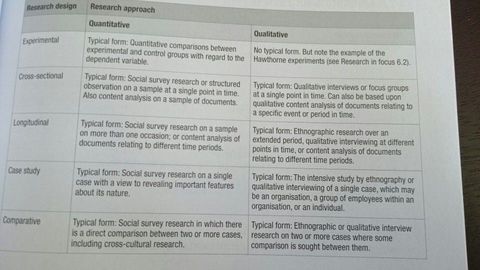
4. Individuals - 29Research approach & research design
Informationen
- Beschreibung
- Degree Research Methodology Karteikarten am 6 Planning the research project: Research design, erstellt von Luzelda Maré am 18/06/2015.
- Erstellt von
- Luzelda Maré · Jun 2015
- Aktualisiert
- 19 Feb 2016
- Aufrufe
- 7
- Bewertung