
Photosynthesis
Slides in this set (4)
-
- What is it?
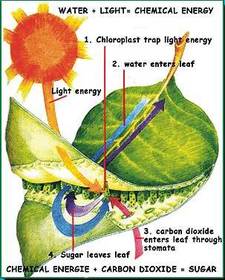
- Photosynthesis is a chemical process through which plants, some bacteria and algae, produce glucose and oxygen from carbon dioxide and water, using only light as a source of energy.
- During
- photosynthesis radiant energy from the sun (sunlight) is absorbed by
- green plants. The energy is used to convert carbon dioxide, water and
- minerals the plants take in from their surroundings into sugar and
- gaseous oxygen.
- Photosynthesis
- is critical to life on Earth. Without photosynthesis the food supply
- would finish and the Earth’s atmosphere would lose its oxygen.
- Caption: The Process of Photosynthesis in Plants
-
The 2 Stages of Photosynthesis
- The photochemical stage involves the radiant energy supplied by
- sunlight and involves reactions called light dependant reactions. Green
- plants contain a light absorbing pigment called chlorophyll. When a
- molecule of chlorophyll absorbs light it uses the energy to boost
- electrons to a higher energy level and the molecule is said to be
- excited. The electrons at the higher energy levels are transferred along
- chains of electron carrier molecules. The energy transfers of the
- electrons are responsible for the formation of key energy carrying
- molecules along with the splitting of the water molecule to oxygen and
- hydrogen.
- These molecules then undergo the second stage of
- photosynthesis, the biochemical reaction. Here they react with hydrogen
- formed from the splitting of water in the photochemical stage and carbon
- dioxide from the atmosphere with the presence of enzymes to form the
- organic glucose molecules. The reactions in this stage are referred to
- as light-independent reactions because they do not require light as they
- use the energy already provided by the light in the light-dependent
- reactions. Thus, photosynthesis has transferred the energy from light to
- chemical energy in the sugar.
-
Factors Limiting Photosynthesis
- Photosynthesis can be limited by three factors: light intensity, carbon dioxide concentration and temperature.
- Without enough light, a plant cannot photosynthesise very quickly, even
- if there is plenty of water and carbon dioxide. Increasing the light
- intensity will boost the speed of photosynthesis.
- Sometimes photosynthesis is limited by the concentration of carbon
- dioxide in the air. Even if there is plenty of light, a plant cannot
- photosynthesise if there is insufficient carbon dioxide.
- If it gets too cold, the rate of photosynthesis will decrease. Plants
- cannot photosynthesise if it gets too hot.If you plot the rate of
- photosynthesis against the levels of these three limiting factors, you
- get graphs like the ones above.
- The Rate of Photosynthesis
- Plants and photosynthesis
-
Photosynthesis and Transportation
- https://www.youtube.com/watch?v=cMte2VCtZ-I (Embed)
- Caption: Process of photosynthesis and transportation of material in plants
Information
- Description
- Photosynthesis
- Created by
- Landon Valencia · Jul 2015
- Updated
- Jan 11, 2017
- Views
- 1,895
- Tags
- Rating