
Flashcards
Section 1.2
Cards in this deck (28)
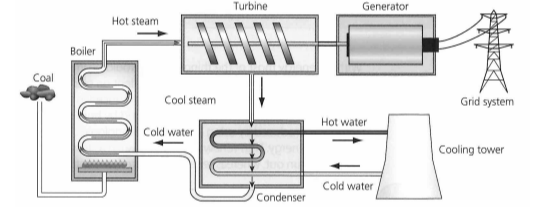
- 1How do fossil fuels turn into electrical power?Burning fossil fuels → Heat water to make steam → Steam turns turbines → Turbines turn generators → Electrical power
- 2What is wrong with burning fossil fuels?Burning fossil fuels increases the carbon dioxide which adds to the greenhouse effect and global warming. All fuels have to be burnt to produce heat.
- 3Summarise what fossil fuels are.Traditionally people rely on fossil fuels (coal, gas and oil) to provide their energy. Fossil fuels were formed millions of years ago from dead organisms.
- 4Where are fossil fuel power stations usually found?Fossil fuel power stations are usually found near seas or rivers because a water supply is needed for cooling.
- 5Describe the process of coal turning into electricity.
- 6Summarise coal.Most coal mining in the UK has stopped but we still get 23 percent of our electricity from coal fired power plants. It doesn't require any processing before burning but it is usually crushed. There is enough coal to last hundreds of years.
- 7Summarise oil.Oil is used for some heating systems and is the main fuel used in road and sea transportation. Stocks of oil will run out before coal. There is no immediate shortage of it, the amount of oil in the North Sea has reduced.
- 8Summarise natural gas.It is the main source of power for electricity production in the UK. It can be burnt easily and then transported through pipelines. It mainly consists of methane and is found underground with coal and oil deposits. It has to be processed to be removed.
- 9Describe nuclear power.Some electricity comes from nuclear reactors where uranium atoms are split to produce heat. This creates steam to drive turbines connected to generators that produce electricity.
- 10Name a disadvantage of a nuclear power station.The cost of safely disposing of unused nuclear power stations is high and there have been several incidents resulting in nuclear material leaking.
- 11Describe the process of fission.Some electricity comes from nuclear reactors where uranium atoms are split to produce heat. This process is known as fission.
- 12What is renewable energy and give some examples of it?It is energy from a source which is not depleted when used. Renewable sources of power are much better for the environment. Examples of renewable energy sources are wind and solar power.
- 13How does wind generate electrical power?The use of wind provides mechanical power through wind turbines to generate electrical power.
- 14List some of the best places to place a wind turbine.The best places to put wind turbines are on the coast, offshore, on the hilltops or between hills or mountains. This is so that the wind supply is reliable. Also the wind can vary in size and power so positioning is critical.
- 15Name the two different types of solar technologies.Solar technologies are either passive or active depending on how they catch solar energy and convert it into power.
- 16Define passive solar technologies.Passive solar technologies convert sunlight into usable heat and cause air movement for ventilating to heat and cool spaces. An example of passive solar technology would be positioning a building to gain heat from the sun by placing windows to the south side of the building.
- 17Define active solar technologies.Active solar heating systems use solar energy to heat a fluid (either liquid or air) and then transfer the solar heat directly to the interior space or to a storage system for later use. An example of active solar systems would be photovoltaic cells.
- 18Summarise on how tides generate electricity.The incoming tide passes through a turbine generating electricity. The water is held in the high tide state upstream of the barrier until it is needed. It is then released at low tide flows out through the turbines and then turns them again generating electricity.
- 19What causes tides?The gravitational pull of the moon causes change in water levels (tides).
- 20Summarise on how hydroelectricity works.Once enough water has been stored up in a dam the water is stored in a reservoir which can then be channeled through turbines that are used to turn generators for producing electricity. The main cost is the building of the dam and the waterflow below the dam can affect the growing of crops and river ecosystems.
- 21Summarise on how waves generate electricity.The movement of the waves is converted into mechanical energy to compress air which is forced through a turbine. The waves can vary a lot in size and power so positioning is critical.
- 22Define biomass.Involves growing plants so that they can be burnt or using decaying. The burning can cause some atmospheric pollution but is not as severe as burning fossil fuels.
- 23What are energy storage systems?When we don't want to use the energy that we generate immediately we have to store it. An example of a storage system would be a pumped storage system, flywheels, clockwork, capacitors and rechargeable batteries.
- 24Name three examples of energy storage systems.Kinetic pumped, mechanical energy, electrical energy storage are three examples of a storage system.
- 25Summarise on kinetic pumped energy systems.It instantly releases the electricity into the system by opening valves to allow water to flow from the high reservoir to the lower one through turbines. This can't be sustained for long but it is usually long enough for the other power stations to catch up with demand and avoid the need for power cuts.
- 26Summarise on mechanical energy storage systems.An example of one of these would be a flywheel. A flywheel is a rotating mechanical device that is used to store rotational energy that can be called up instantaneously. Electricity is used to accelerate and slow the flywheel so an energy conversion takes place.
- 27Summarise on electrical energy storage systems.Capacitors are the most popular non chemical way of storing energy. It is a device for storing electrical energy, consisting of two conductors in close proximity and insulated from each other. An example of such a storage device is the parallel-plate capacitor.
- 28Name the different types of batteries.Batteries consist of two different types. Single-use which we discard and rechargeable. Both of these are very useful.
Information
- Description
- GCSE Design and Technology Flashcards on Section 1.2, created by A Kanani on 25/09/2021.
- Created by
- A Kanani
- Views
- 0
- Rating